Contact center of the Ukrainian Judiciary 044 207-35-46
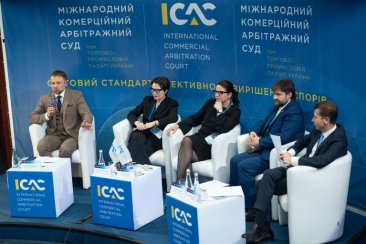
Judge-Speaker of the Grand Chamber of the Supreme Court Kostiantyn Pilkov, Supreme Court Judge at the Civil Cassation Court Dmytro Hudyma and Supreme Court Judge at the Commercial Cassation Court Olena Kibenko took part in the XII International Arbitration Readings in memory of Academician Ihor Pobirchenko "Ukraine as a Place of Arbitration. The Modern Dimension of Efficiency".
The event was aimed at discussing the role of national courts in supporting the arbitration infrastructure and shaping the pro-arbitration environment in Ukraine. The discussions were attended by judges, members of parliament, representatives of the academic community, the bar and international experts. The first session of the event was dedicated to the topic "Made in Ukraine: a new generation arbitration jurisdiction" and focused on the choice of jurisdiction, current trends and prospects of Ukraine as a seat of arbitration.
The second session, moderated by Kostiantyn Pilkov, was devoted to the topic “Pro-arbitration climate in action: the role of national courts in supporting the arbitration infrastructure in Ukraine”. Opening the session, the judge first of all noted that the discussion brought together judges of civil and commercial jurisdictions, arbitrators, academics and lawyers to analyse the current state of arbitration promotion by national courts.
.jpg)
Kostiantyn Pilkov emphasised that the Ukrainian case law is increasingly adopting the approach of non-interference in the activities of arbitration and respect for its decisions. According to him, it is the coherence of approaches between civil and commercial jurisdictions, which deal with arbitration in different ways: the former in the enforcement and setting aside of awards, the latter in the recognition of arbitration agreements, that is an important condition for the further development of a pro-arbitration climate in Ukraine.
The judge also noted that such interaction between courts and arbitration not only strengthens international confidence in Ukraine as a place of arbitration, but also creates a mature legal culture in which national courts become reliable partners of arbitration institutions in ensuring effective dispute resolution.
During this session, Dmytro Hudyma spoke about the relevant conclusions of the Supreme Court. He said that the Supreme Court has already developed a practice in cases in which the sanctioned creditors receive an ICAC award in their favour and try to enforce it.
The judge drew attention to the decision of the Civil Cassation Court of the Supreme Court of 18 December 2024 in case No. 824/107/23. The court concluded that participants in civil turnover often try to use legitimate civil law instruments (applications for recognition and enforcement of arbitral awards) for an unlawful purpose, i.e. not to ensure certainty in private relations, protect rights and interests. Obviously, they should not use such tools to create preconditions for withdrawing assets from sanctions and for ‘circumventing’ them.
.jpg)
This resolution also contains conclusions that:
- the prosecutor has the right to appeal against the decision to recognise and enforce the arbitral award if this procedure is used to remove assets from sanctions;
- if sanctions were imposed on the creditor after the award was made but before recognition and enforcement, the award cannot be recognised and the relevant permission granted;
- the change of the sanctioned creditor to its non-sanctioned successor does not affect the inability to recognise and enforce the award.
Considering the issue of whether a duplicate writ of execution can be issued to enforce the ICAC award if the original writ is seized in criminal proceedings, the speaker drew attention to the resolution of the Civil Cassation Court of the Supreme Court of 15 February 2024 in case No. 824/9/22.
The Supreme Court found that an attempt by a recoverer under the rules of civil proceedings to obtain duplicate writ of execution that are not deemed lost (lost, stolen, destroyed or significantly damaged, making it impossible to enforce them) but have the status of temporarily seized (arrested) property or material evidence in criminal proceedings, is not aimed at fulfilling the task of civil proceedings, but is an attempt to avoid the application of the provisions of the Criminal Procedure Code of Ukraine, which clearly regulate the treatment of such property and evidence. In this case, the recoverer may use the procedures established by the CPC of Ukraine for the return of temporarily seized property, cancellation of its seizure and return of material evidence.
In addition, Dmytro Hudyma addressed, in particular, the following issues whether it is possible to postpone the enforcement of the ICAC award (resolution of the CivCC of the Supreme Court of 16 January 2025 in case No. 824/109/22); whether it is possible to cancel the ICAC award if the seller (debtor), when selling the goods, was guided by unreliable information provided by the buyer from a third party about the quality of the seller's goods (resolution of the CivCC of the Supreme Court of 7 October 2024 in case No. 824/17/24); whether a court’s assessment of the seizure of a writ of execution as its loss has prejudicial effect (resolution of the CivCC of the Supreme Court of 15 February 2024 in case No. 824/9/22), etc.
Olena Kibenko covered the topic "Delimitation of jurisdiction of courts and arbitration: practice of commercial courts and ways of development". She focused on the dilemma faced by commercial courts in cases where the parties refer to arbitration agreements: to restrict access to the state court and refer the dispute to arbitration or, conversely, to consider the dispute, risking that the higher court or the ECHR will recognise that in this case it was not a court established by law (i.e. the dispute should have been considered by arbitration).
.jpg)
Using the positions taken in two cases of the Joint Chamber of the Commercial Cassation Court of the Supreme Court, considered in 2021 and 2024, the judge compared how the approach was formed under which an arbitration agreement cannot be an independent subject of a claim. This approach, she said, lays the foundation for the development of a sustainable case law that recognises arbitration as a full-fledged court, shows respect for this dispute resolution mechanism, and contributes to the establishment of Ukraine as an arbitration-friendly jurisdiction.
Olena Kibenko noted that the emergence of a pro-arbitration approach reflects the evolution of legal education and the culture of judges' thinking - the new generation of judges who have studied private international law and commercial arbitration as basic legal disciplines no longer need additional explanations of the principle of "competence-competence" or the autonomy of an arbitration clause.
The judge drew attention to the fact that the arbitrability of disputes is defined in Article 22 of the Commercial Procedural Code of Ukraine, while a common mistake is to apply Article 77 of the Law of Ukraine “On International Commercial Arbitration”, which delimits the jurisdiction of state courts of different countries (Supreme Court resolution of 14 June 2023 in case No. 914/2039/18).
She cited a number of examples from the Supreme Court's case law that demonstrate the consistent formation of a pro-arbitration approach in cases where the court could potentially take the opposite position.
Thus, in its resolutions dated 3 May 2023 in case No. 924/497/22 and 20 August 2025 in case No. 910/10001/24, the Supreme Court recognised disputes over shares in the authorised capital of companies as arbitrable, emphasising that arbitration clauses in such legal relations are valid and enforceable (distinguishing such disputes from corporate disputes, which are not arbitrable by virtue of the provisions of Article 22 of the Commercial Procedural Code of Ukraine).
The judge also addressed the issues of correlation between arbitration agreements and bankruptcy procedures, noting that this aspect is not regulated by Ukrainian legislation at all. She shared her experience of participating in the SIFoCC international working group, where judges from different countries discussed the conflict between the arbitrability of disputes and the principle of concentration of creditors' claims. According to the judge, Ukrainian practice is moving in the direction where disputes on the merits relating to the debtor, but subject to an arbitration agreement, are recognised as being subject to arbitration. This approach, she said, strengthens the credibility of Ukraine as a pro-arbitration jurisdiction. In particular, the judge drew attention to cases No. 911/2977/21 (911/3687/21) and No. 914/597/23, in which the Supreme Court drew a line between pro-arbitration and pro-creditor approaches.
.jpg)
The judges' presentations are available by the following links:
Dmytro Hudyma's presentation - https://court.gov.ua/storage/portal/supreme/prezentacii_2025/Prezent_Vusnov_VS_proarbutr.pdf;
presentation by Olena Kibenko - https://court.gov.ua/storage/portal/supreme/prezentacii_2025/Prezent_Gosp_syd_mighnar_arbitr.pdf.
The event was organised by the International Commercial Arbitration Court at the Ukrainian Chamber of Commerce and Industry (the ICAC) jointly with its partners.
Photo courtesy of the organisers.
The video of the event is available at https://www.youtube.com/live/tmMDkMx5hKI.
_03_03.png)