Contact center of the Ukrainian Judiciary 044 207-35-46
On 27 October 2025, the working group of the Supreme Court held a meeting to prepare the opinion of the Supreme Court Plenum on the draft law "On Amendments to Article 31 of the Code of Administrative Procedure of Ukraine on Specifics of Determining the Court Composition for Consideration of Cases by the Grand Chamber of the Supreme Court in Appeal Proceedings" (reg. No. 13397 of 24 June 2025). In accordance with Article 46 of the Law of Ukraine "On the Judiciary and the Status of Judges", this draft law is under consideration by the SC Plenum.
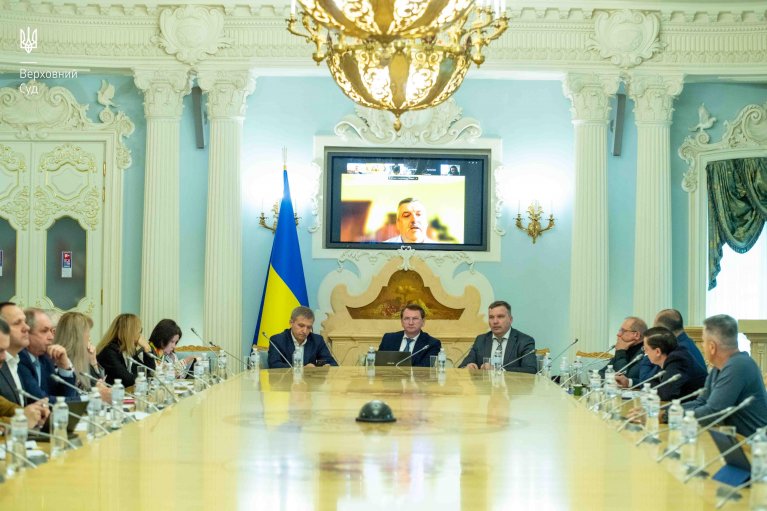
Representatives of the Scientific Advisory Council of the Supreme Court, which, pursuant to Article 47 of the Law of Ukraine "On the Judiciary and the Status of Judges", acts as an advisory body to the Supreme Court to ensure proper scientific support for the administration of justice, also took part in the meeting. The powers of the SC SAC include, among other things, preliminary consideration of draft opinions of the Supreme Court Plenum on draft legislative acts related to the judiciary, court proceedings, status of judges, enforcement of court decisions and other issues related to the functioning of the judicial system of Ukraine.
.jpg)
Opening the meeting of the working group, Oleh Tkachuk, Judge of the Grand Chamber of the Supreme Court, Scientific Secretary of the Scientific Advisory Council of the Supreme Court, noted that the purpose of the draft law, according to the explanatory note to it, is to improve the legal regulation of the procedure for determining the composition of the court, including the rapporteur judge, for the consideration of administrative cases by the Grand Chamber of the Supreme Court as a court of appeal, which, according to the authors of the draft law, will help ensure the implementation of the principles of procedural equality of judges, impartiality, automated determination of the composition of the court, as well as an even workload, which is mandatory in the activities of the courts.
To achieve this objective, it is proposed to supplement Part 6 of Article 31 of the Code of Administrative Procedure of Ukraine with a second paragraph providing that, if a case before the Supreme Court is to be considered on appeal collegially by the Grand Chamber of the Supreme Court, the presiding judge at the sessions of the Grand Chamber shall be the rapporteur judge determined by the Unified Judicial Information and Communication System during the initial allocation of the case, without regard to the judge’s specialization (the jurisdiction of the cassation court from which the judge was elected to the Grand Chamber of the Supreme Court by the assembly of judges).
.jpg)
As reported by the Secretary of the Grand Chamber of the Supreme Court, Vitalii Urkevych, on 12 September 2025 the Plenum of the Supreme Court decided to establish a working group to prepare the opinion of the Plenum on the draft law under discussion, since several draft opinions – both in support of and opposing this legislative initiative – had been presented for consideration by the Plenum. Therefore, according to him, it is extremely important to hear the views of scholars on the advisability of introducing the amendments to the Code of Administrative Procedure of Ukraine proposed in draft law No. 13397.
.jpg)
Member of Parliament of Ukraine and initiator of the draft law, Serhii Demchenko, explained that the initiative to propose legislative regulation of certain provisions of the Code of Administrative Procedure of Ukraine is based, inter alia, on the fact that, pursuant to Part 2 of Article 45 of the Law of Ukraine “On the Judiciary and the Status of Judges”, the Grand Chamber acts, among other things, as a court of appellate instance when reviewing court decisions rendered by the Administrative Cassation Court within the Supreme Court in the course of considering cases under administrative judicial procedure. Within appellate proceedings, the Grand Chamber of the Supreme Court operates within administrative jurisdiction as a court of fact, establishing the specific legal relations of the parties, events, and circumstances, applying the relevant rules of law to them, as well as performing the function of verifying the validity and lawfulness of the decision of the court of first instance. In such cases, a judge’s specialization is not decisive, and his or her procedural competence is universal within the Grand Chamber of the Supreme Court.
.jpg)
Judge of the Grand Chamber of the Supreme Court Oleh Kryvenda noted that the problem associated with the analyzed draft law arose because the application of the current procedural legislation does not occur in the manner envisaged by the law. The Law of Ukraine “On the Judiciary and the Status of Judges” provides that the Grand Chamber of the Supreme Court acts as a court of appellate instance; that is, it does not act only in certain specifically defined cases, but rather all cases considered by the Supreme Court as a court of first instance must be reviewed by the Grand Chamber of the Supreme Court as a court of appellate instance (in particular, cases concerning the lawfulness of actions or inaction of the Verkhovna Rada of Ukraine, the President of Ukraine, the High Council of Justice, and the High Qualification Commission of Judges of Ukraine).
As the judge emphasized, the Grand Chamber of the Supreme Court considers cases of all categories; therefore, in his view, when cases are examined by the Grand Chamber in cassation proceedings, it is possible to speak of the principle of specialization by jurisdictions. However, when administrative cases are reviewed by the Grand Chamber of the Supreme Court acting as a court of appellate instance, such a rule cannot apply.
.jpg)
In Oleh Kryvenda’s view, the issue of determining the composition of the court for the consideration of cases by the Grand Chamber of the Supreme Court in appellate proceedings can be resolved without amending the legislation, by adjusting the Rules for the Use of the Automated Court Document Management System at the Supreme Court to specify that cases considered on appeal are allocated for reporting to all judges of the Grand Chamber of the Supreme Court, regardless of specialization.
.jpg)
Members of the Scientific Advisory Council at the Supreme Court – Doctor of Juridical Sciences, Professor, Corresponding Member of the National Academy of Legal Sciences of Ukraine, Corresponding Member of the National Academy of Sciences of Ukraine, member of the Presidium of the NAS of Ukraine, and Director of the State Institution “V. K. Mamutov Institute of Economic and Legal Research of the National Academy of Sciences of Ukraine” Volodymyr Ustymenko; Doctor of Juridical Sciences, Professor, Professor of the Department of Criminal Law and Criminal Procedure at the National University of Kyiv-Mohyla Academy Andrii Boiko; and Doctor of Juridical Sciences, Professor, Professor of the Department of Criminal Procedure at Yaroslav Mudryi National Law University Oleksandr Drozdov – drew attention to the fact that although the proposed legislative initiative is aimed at balancing the workload among judges of the Grand Chamber of the Supreme Court representing different judicial jurisdictions, such an approach does not take into account the fundamental principles of judicial organization governing the procedural activity of the Supreme Court. One of the principles of judicial proceedings in Ukraine is the specialization of judges, which ensures an objective and professional approach to the allocation of cases among judges of different jurisdictions and to the resolution of such cases with due regard to judges’ competencies in the relevant fields of substantive and procedural law.
.jpg)
Doctor of Juridical Sciences, Professor, and Advisor to the Rector of the Kyiv University of Law of the National Academy of Sciences of Ukraine, Iryna Sopilko, noted that the approach proposed by draft law No. 13397 may be approved, as it has the potential to ensure a more even distribution of workload among judges of the Grand Chamber of the Supreme Court.
.jpg)
In addition, in the opinion of Doctor of Juridical Sciences, Associate Professor, Professor of the Department of Constitutional and Administrative Law at the National Transport University, and Honored Lawyer of Ukraine Oleksandr Konstantyi, it is necessary to amend the Law of Ukraine “On the Judiciary and the Status of Judges” with regard to redistributing the number of judges delegated to the Grand Chamber of the Supreme Court from the cassation courts, in order to ensure a proportional workload among judges, by increasing the number of judges delegated to the Grand Chamber of the Supreme Court by the Administrative Cassation Court within the Supreme Court. The scholar also supported the idea of allocating, to all judges of the Grand Chamber of the Supreme Court regardless of specialization, cases concerning appeals against decisions of the High Council of Justice adopted following the consideration of complaints against decisions of its Disciplinary Chambers. This could help overcome the imbalance in the distribution of cases among judges of the Grand Chamber of the Supreme Court.
.jpg)
Judges of the Supreme Court also joined the discussion. In particular, Judge of the Grand Chamber of the Supreme Court Serhii Martiev supported the idea of judges’ specialization. According to him, the rapporteur judge serves as a guide in the case, orienting, inter alia, judges of the Grand Chamber of the Supreme Court from other jurisdictions regarding existing trends and the established practice of a particular cassation court. Moreover, it should be taken into account that cases in appellate proceedings are considered by the full composition of the Grand Chamber of the Supreme Court; therefore, the total number of cases that can be reviewed will not change.
%20%D0%BF%D0%BE%D0%B3%D0%BE%D0%B4%D0%B6%D0%B5%D0%BD%D0%B0%20%D0%91%D1%96%D0%BB%D0%BE%D0%BA%D0%BE%D0%BD%D1%8C_%D0%9D%D0%9A%D0%A0.jpg)
Supreme Court Judge of the Civil Cassation Court Olena Bilokon noted that the goal set out in the explanatory note to draft law No. 13397 would not be achieved with the changes proposed in it. Instead, Supreme Court judge of the Administrative Cassation Court Andrii Zhuk supported the idea of the draft law, which, in his opinion, is no longer aimed at levelling the workload between the judges of the Supreme Court, but at implementing the provisions of Article 45 of the Law of Ukraine "On the Judiciary and Status of Judges".
.jpg)
Supreme Court Judge of the Criminal Cassation Court Oleksandra Yanovska advised to look at the problem from the point of view of court service users and emphasised the important role of the judge-rapporteur in administrative cases considered by the SC GC on appeal, which should be determined taking into account the specialisation.
.jpg)
Judge of the Grand Chamber of the Supreme Court Tetiana Strelets expressed support for the draft law, while agreeing that it may not resolve the issue of workload distribution among judges of the Grand Chamber of the Supreme Court. She explained that, in the context of discussing the specialization of the rapporteur judge, it is worth considering more broadly the issue of whether priorities should exist for judges of a particular jurisdiction in the consideration of cases. Supreme Court Judge of the Commercial Cassation Court Yurii Vlasov, in turn, stated that solutions to the problem of the workload of judges of the Grand Chamber of the Supreme Court should be sought in a different plane. In his opinion, it would make sense to transfer cases of the aforementioned category to the newly established Specialized District Administrative Court as a court of first instance. In that case, the Specialized Administrative Court of Appeal would carry out appellate review of the relevant cases, and the Supreme Court would conduct cassation review of court decisions, which would restore citizens’ right to cassation appeal in these categories of cases.
.jpg)
Larysa Rohach, President of the Commercial Cassation Court of the Supreme Court, drew attention to the need to direct the discussion in a practical direction – to the analysis of the provisions of draft law No. 13397, rather than the internal organisation of the Grand Chamber of the Supreme Court. She emphasised that the issues of the internal work of the Grand Chamber of the Supreme Court, in particular its organisational structure and the workload of judges, are undoubtedly important, but, in her opinion, do not fall within the scope of legislative regulation and do not require intervention at the level of law.
%D0%BF%D0%BE%D0%B3%D0%BE%D0%B4%D0%B6%D0%B5%D0%BD%D0%B5%20%D0%A0%D0%BE%D0%B3%D0%B0%D1%87.jpg)
Larysa Rohach emphasized the issue of the effectiveness of the legislative amendments proposed in the draft law and the need to assess legislative initiatives not only from a formal but also from a practical perspective – namely, whether they will actually contribute to achieving the objectives stated in the explanatory note to the draft law. In particular, analyzing the proposal to amend the wording of Part 6 of Article 31 of the Code of Administrative Procedure of Ukraine, the judge noted that the current version of this provision is well established, clear, and does not create problems in law enforcement.
Commenting on the issue of optimizing the consideration of cases by the Grand Chamber of the Supreme Court, the President of the Commercial Cassation Court emphasized that increasing the number of judges from among whom a rapporteur judge may be determined will not affect the overall capacity of the Grand Chamber of the Supreme Court to consider a greater number of cases.
.jpg)
Hryhorii Machulskyi, Supreme Court Judge of the Commercial Cassation Court, noted that any legislative changes to the consideration of appeals, given the different approach in the proposed draft law and in the relevant provisions of the procedural law applicable to the courts of appeal, should ensure a sense of equality for the parties, rather than undermine it.
.jpg)
According to Oleksandr Banasko, Judge of the Grand Chamber of the Supreme Court, the discussion of the amendments proposed in draft law No. 13397 does not address the cause of the uneven workload of the judges of the Grand Chamber of the Supreme Court, but only offers a hypothetical solution to the consequences of this. He supported the idea of transferring administrative cases that are currently considered by the Grand Chamber of the Supreme Court acting as a court of appellate instance to the newly established Specialized District Administrative Court as a court of first instance and to the Specialized Administrative Court of Appeal. As a result, the need to regulate the problem of uneven workload at the legislative level would disappear, since the competence of the Grand Chamber of the Supreme Court would then include, inter alia, the review of court decisions in cases of administrative jurisdiction, which would radically change the situation regarding the uneven workload of judges of administrative jurisdiction within the Grand Chamber of the Supreme Court (for example, according to statistical data, in 2023 and 2024 the Grand Chamber of the Supreme Court had 15 cassation appeals in administrative cases under consideration each year). In addition, as the judge noted, the issue of uneven workload of judges of the Grand Chamber of the Supreme Court does not require legislative regulation; instead, the Supreme Court should be given the opportunity to resolve it independently at meetings of judges or sessions of the Plenum of the Supreme Court.
.jpg)
As noted by First Deputy Chief of the Staff and Head of the Department for Analytical and Legal Work of the Supreme Court Rasim Babanly, the legal nature of the functioning of the Grand Chamber of the Supreme Court is aimed at the interjurisdictional character of disputes. Therefore, if the activity of the Grand Chamber of the Supreme Court is based on the idea that cases of all jurisdictions are considered by the full composition of the Grand Chamber, and that the rapporteur judge is a representative of the judicial jurisdiction in which the case is heard, then this logic should also extend to appellate proceedings.
_03_03.png)