Contact center of the Ukrainian Judiciary 044 207-35-46
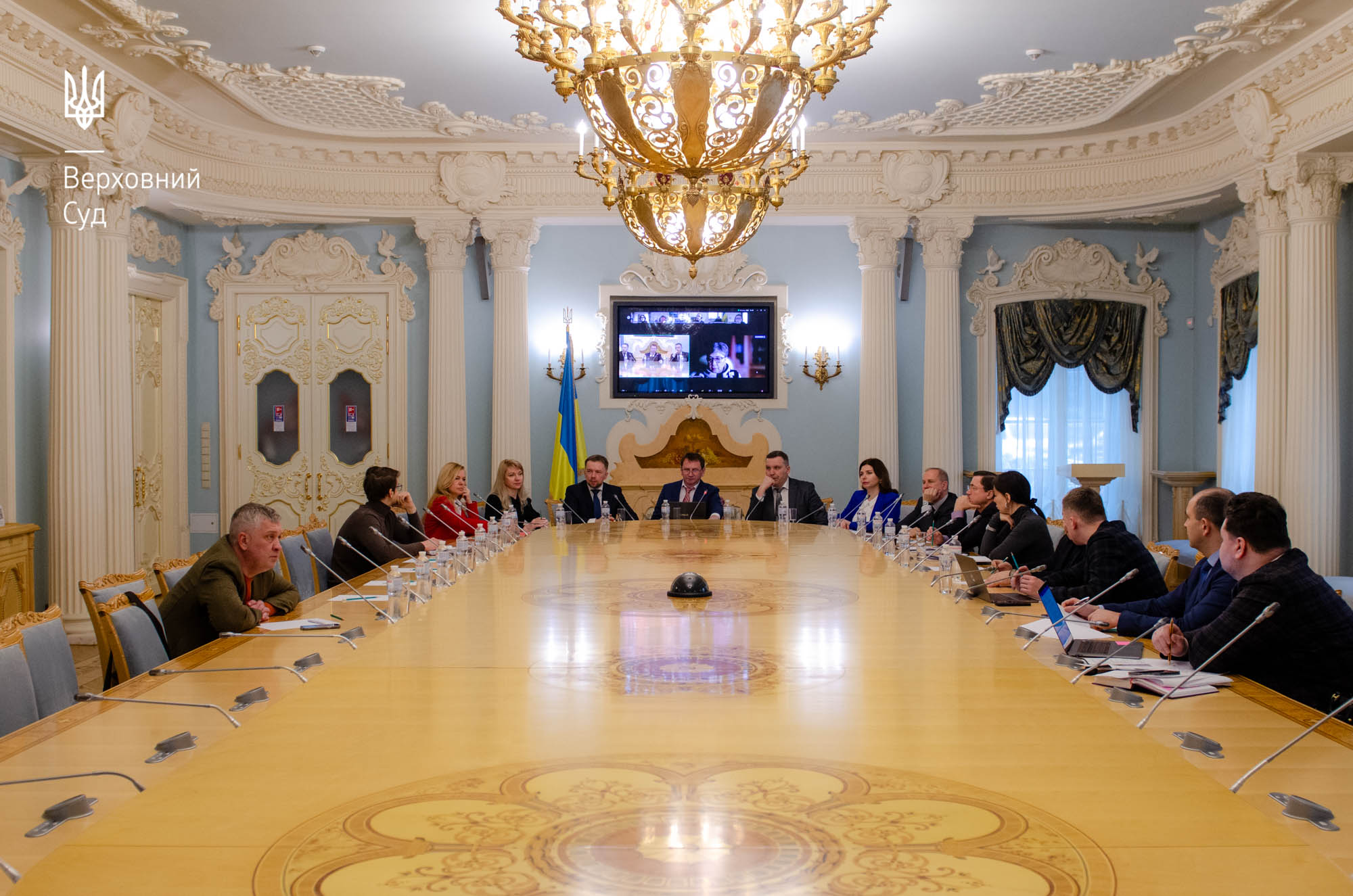
At the opening of the meeting of the working group of the Scientific Advisory Council at the Supreme Court, the Scientific Secretary of the SAC at the Supreme Court, Judge of the Grand Chamber of the Supreme Court Oleh Tkachuk, noted that this meeting concerns problematic issues arising in connection with registration procedures and challenges to decisions of the Ministry of Justice of Ukraine in the field of state registration of rights, transfer of ownership, and so on. In practice, the Ministry of Justice effectively has the power to resolve issues related to registration procedures out of court. Registration in favour of one or another owner of property may be cancelled, and a period of certain uncertainty then begins, he added.
Oleh Tkachuk informed that in the practice of the Grand Chamber of the Supreme Court, issues are being resolved, in particular, concerning the application of Article 37 of the Law of Ukraine “On State Registration of Real Rights to Immovable Property and Their Encumbrances” in disputes regarding the recognition as unlawful and cancellation of an order of the Ministry of Justice adopted following consideration of a complaint against a decision, action or inaction in the field of state registration of rights, as well as for the formation of a uniform approach to determining the composition of participants and methods of protection in this category of disputes.
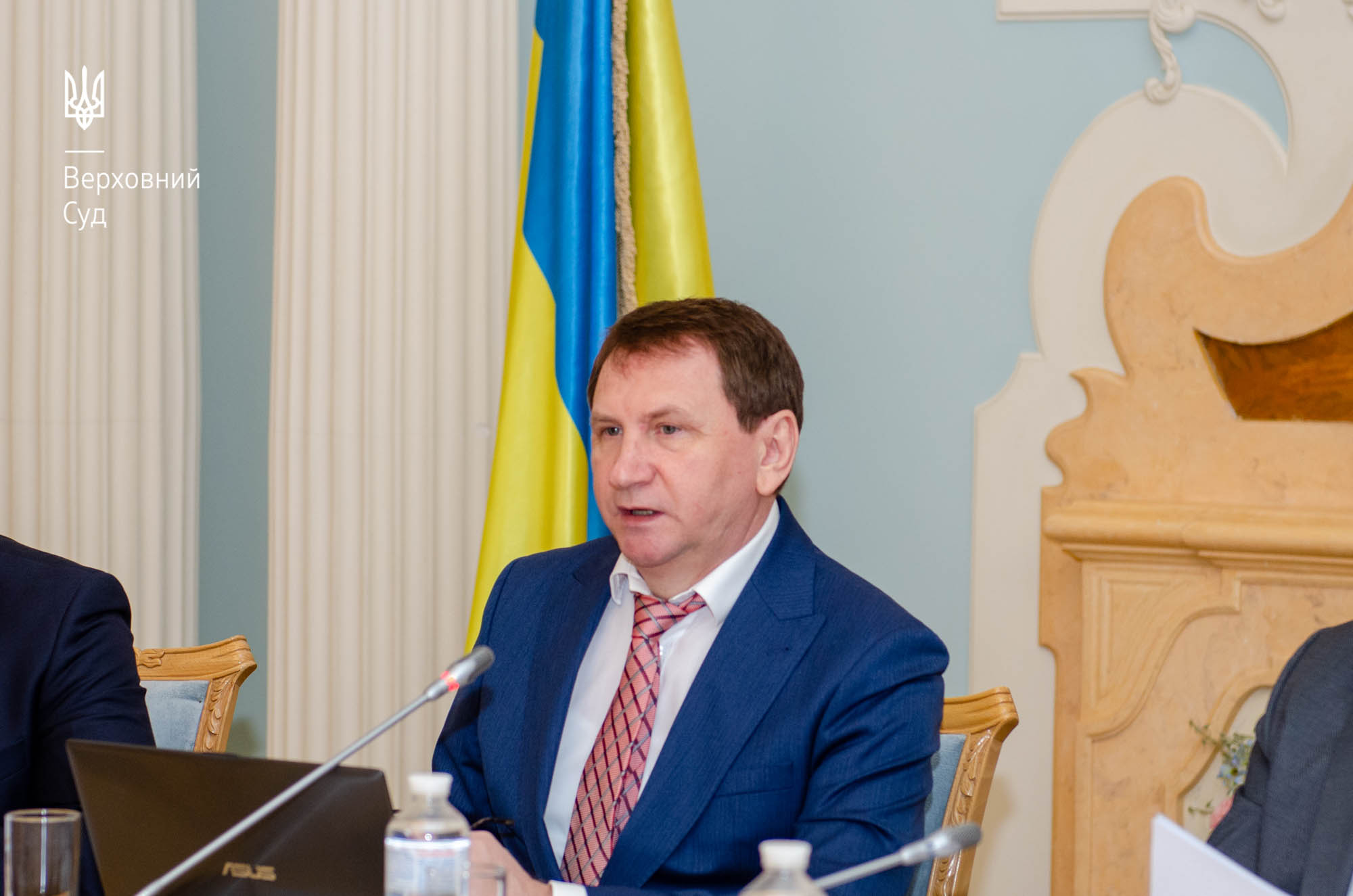
The speaker also added that there are two decisions of the Constitutional Court of Ukraine regarding the constitutionality of certain provisions of Article 37 of the Law of Ukraine “On State Registration of Real Rights to Immovable Property and Their Encumbrances”. He drew attention to the fact that, given the different wording in various versions of the Law, the out-of-court procedure for cancelling registration or transfer of ownership continues to cause legal uncertainty. The Constitutional Court of Ukraine concluded that, despite the different versions of the Law, including Article 37, such a procedure cannot be recognised as constitutional.
Outlining the issue raised, Judge of the Grand Chamber of the Supreme Court Kostiantyn Pilkov proposed discussing whether a separate category of disputes can exist at all, the subject of which would be an order of the Ministry of Justice of Ukraine adopted following consideration of a complaint against registration actions. He questioned whether the dispute can be with the state regarding registration, or whether it is actually a dispute over a civil right. Only a dispute over a civil right should be considered by courts and ultimately resolved with the establishment of legal certainty. In other words, not a dispute with the state regarding registration, but a dispute with another person in whose favour the corresponding right is registered for the person who claims that right or contests it, the rapporteur explained.
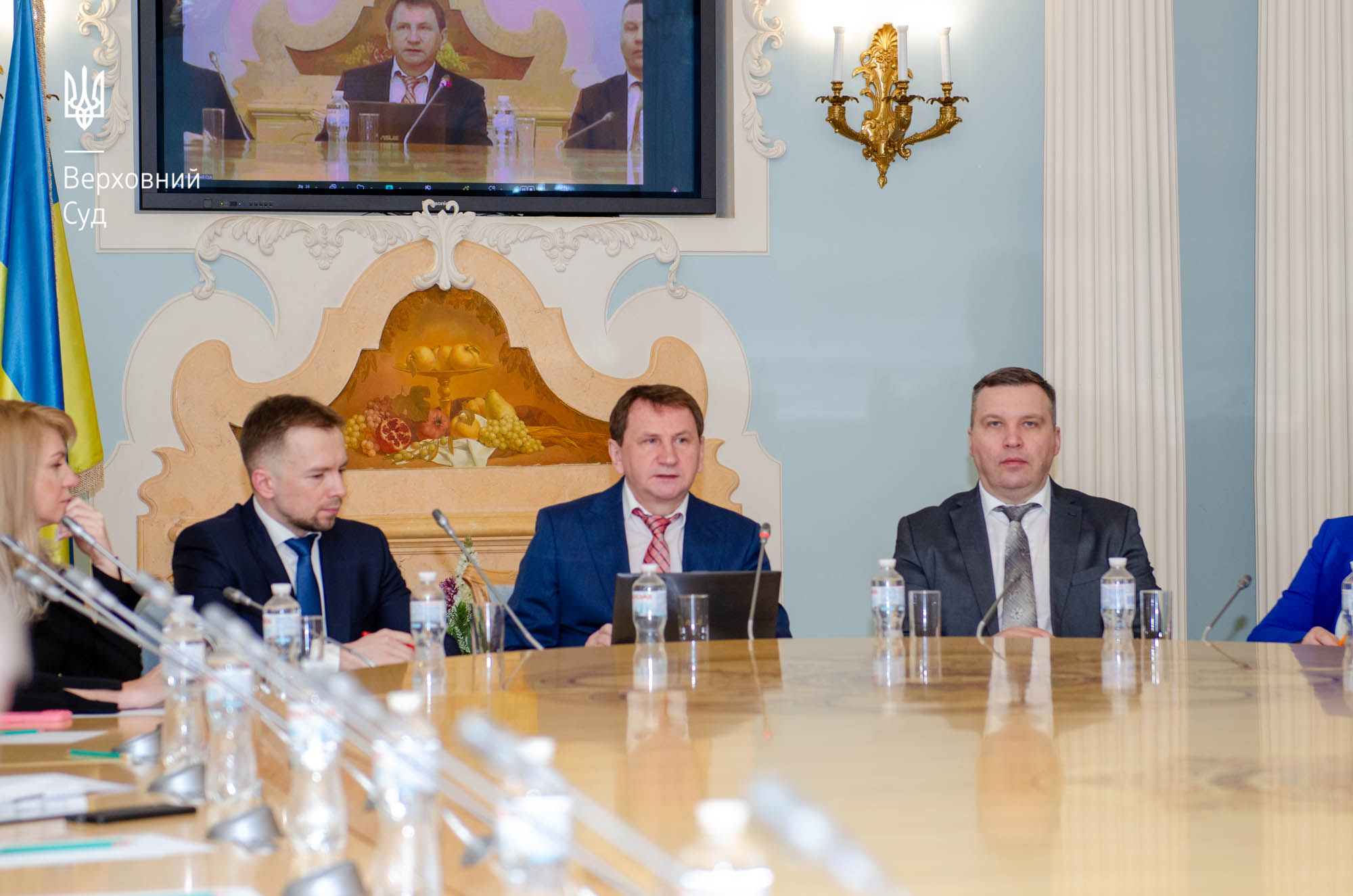
Secretary of the Grand Chamber of the Supreme Court Vitalii Urkevych emphasised that, when discussing the issues raised at the meeting, it is essential to bear in mind the applicability of the Law of Ukraine “On Administrative Procedure”. The outcome of a judicial challenge to a decision by a public authority in the field of state registration of real rights simultaneously affects civil rights as well.
Doctor of Laws Inna Spasybo-Fatieieva outlined the concept of possession. She noted that when we speak of possession from the standpoint of fact or right, we refer to possession as fact, possession as right, and possession as a legal power/authority. Taking these aspects into account, the owner is indeed the possessor. If they are not the possessor, they transfer the property under a different right, which may be registered. However, if someone contests an entry in the register concerning a right, that person is neither possessor nor owner. Consequently, they cannot bring a vindication claim but may only bring a claim for recognition of the right, proving that they hold the right while the registered person does not. Thus, possession has always been understood as a person's domination over a thing. When speaking of “book possession” (i.e., possession recorded in registers), in practice we see that property has completely displaced the ordinary understanding of possession. Yet this gives rise to another problem – the significance of the entry in the register. Here, it becomes necessary to resolve whether the reliability of that entry constitutes the most important value for real property law and civil turnover, she added.
Judge of the Supreme Court in the Administrative Cassation Court Volodymyr Bevzenko noted that the subject of this meeting is precisely the order of the Ministry of Justice of Ukraine in the field of state registration of real rights. Point 3.2 of the Decision in the case on the constitutional submission by the High Administrative Court of Ukraine concerning the official interpretation of the provisions of part one of Article 143 of the Constitution of Ukraine, points “a”, “b”, “c”, “d” of Article 12 of the Land Code of Ukraine, and point 1 of part one of Article 17 of the Code of Administrative Procedure of Ukraine, dated 1 April 2010 No. 10-рп/2010, provides that local self-government bodies, when resolving matters of local importance assigned to their competence by the Constitution of Ukraine and laws of Ukraine, are subjects of public authority exercising public administrative functions, including registration. As subjects of public authority, local self-government bodies resolve matters in the field of land relations within the limits of the law. According to the Law of Ukraine “On State Registration of Real Rights to Immovable Property and Their Encumbrances”, state registrars include not only local self-government bodies but also state authorities. This list undoubtedly includes the Ministry of Justice of Ukraine.
The speaker also emphasised that, in addition to the Law of Ukraine “On State Registration of Real Rights to Immovable Property and Their Encumbrances”, a number of other registration laws are subject to the Law of Ukraine “On Administrative Procedure”, including the Law of Ukraine “On State Registration of Civil Status Acts”, the Law of Ukraine “On State Registration of Legal Entities, Individual Entrepreneurs and Public Formations”, the Law of Ukraine “On the State Land Cadastre”, to which the provisions of the Law of Ukraine “On Administrative Procedure” apply. Pursuant to Article 39 of the Law of Ukraine “On the State Land Cadastre”, decisions, actions or inaction of the State Cadastral Registrar may be challenged in court in the manner prescribed by the Code of Administrative Procedure of Ukraine.
Judge Volodymyr Bevzenko also drew attention to the fact that provisions of certain “registration laws” are embedded (incorporated) in other statutes, such as the Law of Ukraine “On Regulation of Urban Development Activities”, which provides for various types of administrative procedures for state registration. Decisions, actions or inaction taken, performed or permitted in the public construction sector, in accordance with the provisions of the Law of Ukraine “On Regulation of Urban Development Activities”, are challenged exclusively before administrative courts.
At the same time, part 2 of Article 1 of the Civil Code of Ukraine provides that civil legislation does not apply to property relations based on administrative or other authoritative subordination of one party to another, as well as to tax and budgetary relations. Therefore, when determining the nature of these relations, it must be recognised that they are governed by the Law of Ukraine “On Administrative Procedure”. It is therefore necessary to acknowledge that we are dealing with an administrative procedure carried out by an administrative body on the basis of and in the manner provided by administrative law, and that, as a result of such administrative proceedings, an administrative act is adopted.
In the opinion of Doctor of Laws Volodymyr Kossak, state registration still cannot be equated with factual possession. It is necessary to delineate the competence of both the court and the Ministry of Justice. The jurisdiction of the court should primarily cover all disputes concerning property rights. At the same time, it must be taken into account that certain administrative procedures do indeed exist.
As noted by Doctor of Laws Larysa Krasytska, in addressing the issues raised, one should start with how we generally view state registration of ownership rights; only then will questions of jurisdiction in such disputes not arise. State registration, the scholar pointed out, should be regarded as part of the factual composition (de facto elements), and accordingly, the rights of the owner must be protected in any event.
Doctor of Laws Volodymyr Prymak noted that, in resolving the problems raised, the focus should be on the legitimate interests that we seek to protect. He urged participants not to concentrate on the concept of the “book possessor” and the distinction between possessory protection, but rather to ensure the interests of persons who have grounds to bring a claim against the Ministry of Justice for cancellation of an act or another claim directly against the unlawful possessor for restoration of the violated position.
Speaking about the concept of “book possession”, Doctor of Laws Vitalii Yarotskyi pointed out that it is impossible to resolve the complications arising in the legal regulation of relations in the real estate sphere by simplifying approaches, including those applied by law enforcers and courts. In his view, there is a need for a fundamental change in the position whereby “book possession” combines both legal and factual aspects.
Doctor of Laws Olena Belianevych stated that, from the perspective of civil relations and the emergence of certain rights, state registration constitutes a legal fact embedded within a chain of other legal facts. Therefore, when examining the problem of owner protection, it too must be considered in light of the ownership rights provided for in the Civil Code of Ukraine. Thus, in Olena Belianevych’s conviction, the person whose ownership right is contested or not recognised by another party is the one who requires protection.
The following judges of the Supreme Court also participated in the meeting of the working group of the Scientific Advisory Council at the Supreme Court: Oleksandr Banasko, Yurii Vlasov, Iryna Vorobiova, Vitalii Zuiev, Vasyl Krat, Iryna Lytvynenko, Serhii Martiev, Serhii Mohyl, Yevhenii Petrov, Ihor Tkach, Yurii Chumak; as well as PhD in Law Vadym Belianevych, PhD in Law Yurii Bilousov, LL.D. Volodymyr Bobryk, LL.D. Yurii Burylo, LL.D. Mykola Haliantych, LL.D. Kostiantyn Husarov, PhD in Law Yurii Mytsa, LL.D. Olena Ovcharenko, PhD in Law Oleh Pechenyi, LL.D. Mariana Pleniuk, LL.D. Yurii Prytyka, PhD in Law Viktor Smorodynskyi, LL.D. Iryna Sopilko, PhD in Law Oksana Uhrynovska, PhD in Law Maryna Us, PhD in Law Mykhailo Khomenko, LL.D. Serhii Shkliar, LL.D. Valentyn Shcherbyna.
_03_03.png)