Contact center of the Ukrainian Judiciary 044 207-35-46
At the current stage of development of law enforcement practice, there is a lack of a unified approach to resolving disputes arising in the field of urban development activities. Court disputes are often related to construction on leased land, and sometimes concern the commissioning of construction facilities. At the latest meeting of the working group of the Scientific Advisory Council at the Supreme Court, among other issues, it was proposed to discuss the problems of distinguishing the statuses of client, developer, and investor, as well as their choice and the courts’ application of appropriate remedies. This was noted by the Scientific Secretary of the Scientific Advisory Council at the Supreme Court, Judge of the Grand Chamber of the Supreme Court Oleh Tkachuk, while opening the meeting of the working group. In his opinion, the acuteness of the issue is caused by conflicts in the legislative regulation of urban development activities, registration procedures, and land relations in this area. In turn, judicial interpretation should rely on doctrinal approaches and sufficient scientific grounding in the relevant fields.
.jpg)
During the discussion, Judges of the Grand Chamber of the Supreme Court and scholars drew attention to the existing deep dichotomy in scientific approaches to understanding the legal capacity of participants in construction. This is partly due to the lack of clear normative distinction between the rights and obligations of the client, developer, and investor, which leads to confusion in selecting appropriate, effective, and lawful judicial remedies.
.jpg)
On the one hand, the static concept prevails, in which the statuses of client, developer, and investor are treated as identical within one person, which seemingly simplifies the process but fails to account for complex financing schemes. On the other hand, the differentiated concept is gaining increasing weight, requiring a clear distinction of these roles depending on the scope of their powers and their contribution to the creation of the real estate object.
Oleh Tkachuk pointed out that the divergence of views among scholars and judges regarding the moment when ownership rights arise over newly created property – whether from the moment of completion of construction (factual aspect) or from the moment of state registration (legal aspect) – often creates a certain vacuum in which bona fide market participants may remain vulnerable to unscrupulous actions by third parties.
Given the powers of the Grand Chamber of the Supreme Court, there is a need to develop approaches in judicial practice that would guarantee adherence to the principle of legal certainty. The scientific potential of the Scientific Advisory Council should help prevent contradictory approaches in judicial practice regarding the risks faced by all market participants who create real estate objects on leased land. This concerns both the protection of ownership rights and investments, as well as the effectiveness of remedies, — noted Oleh Tkachuk.
%20(2).jpg)
Secretary of the Grand Chamber of the Supreme Court Serhii Pohribnyi emphasized that it is important for the judges of the Grand Chamber to learn the doctrinal views of the members of the Scientific Advisory Council at the Supreme Court on resolving the presented exceptional legal problem – namely, which remedy for the violated rights of the construction client in this case is lawful and effective (viable) and will lead to the restoration of those rights.
.jpg)
As added by Judge of the Grand Chamber of the Supreme Court Serhii Martiev, the opinion of scholars regarding the distinction between the concepts of “client”, “developer”, and “investor” is of particular interest. In his conviction, only after clarifying the understanding of these terms will it be possible to determine the scope of rights of each entity and the appropriate means of their protection.
.jpg)
Doctor of Law, Professor, Corresponding Member of the National Academy of Legal Sciences of Ukraine Oleksii Kot expressed the view that resolving the issue of effective judicial remedies is linked to the application of mechanisms that are sufficient and lawful for restoring control over the construction object. In certain cases, an effective remedy for violated rights is filing a claim for recognition of ownership of the newly created real estate object and recovery of that property from unlawful possession by a third party.
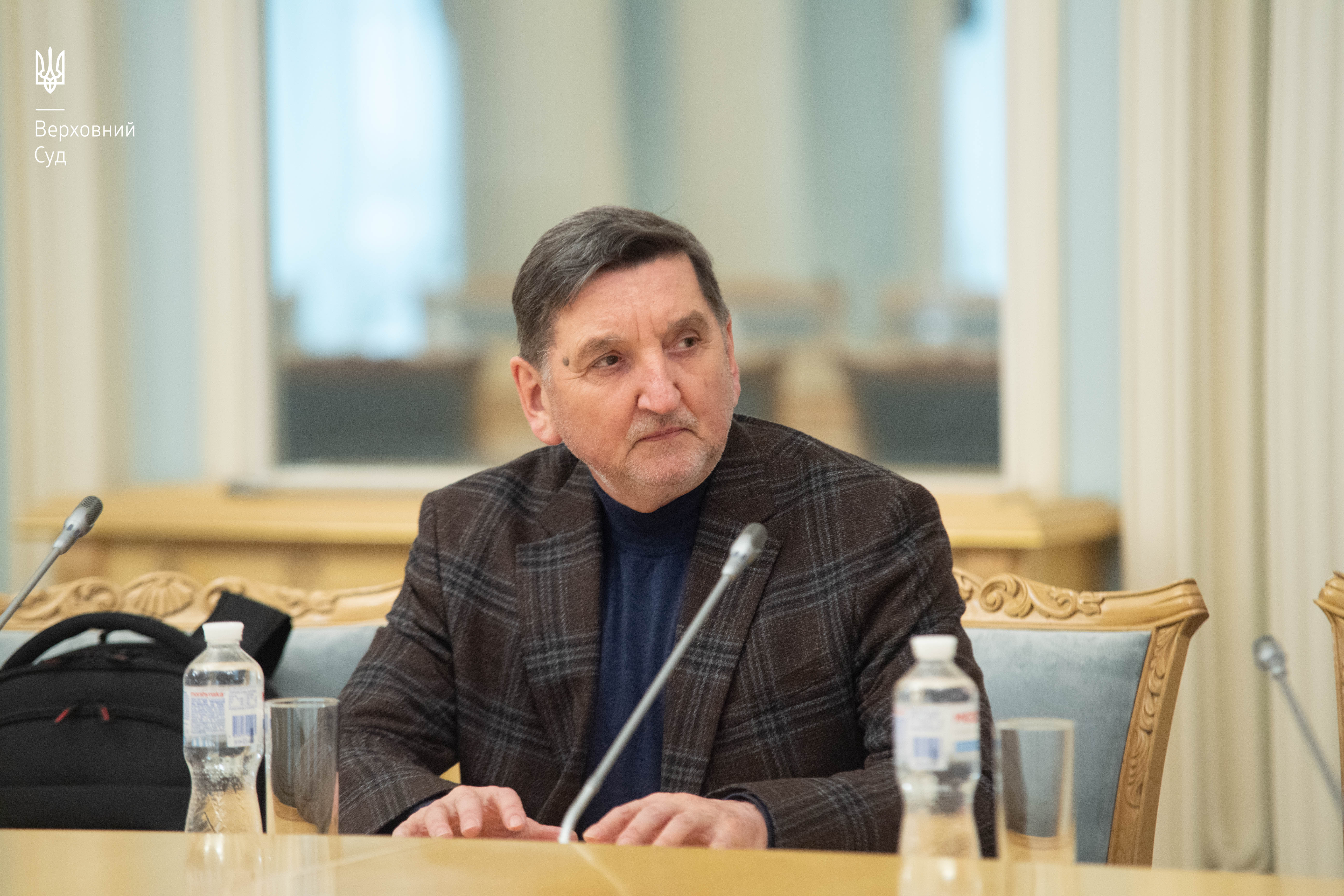
According to Doctor of Law, Professor, Corresponding Member of the National Academy of Legal Sciences of Ukraine Volodymyr Nosyk, when considering theoretical approaches to the qualification of actions and remedies available to real estate market participants, it is important to focus on the legal construction of unauthorized construction, the status of land plots, the lawfulness of construction, and its compliance with regulatory rules.
.jpg)
Doctor of Law, Professor, Corresponding Member of the National Academy of Legal Sciences of Ukraine Andrii Hryniak proposed paying attention to the possibilities of compensatory mechanisms when searching for remedies to protect the rights of construction participants.
.jpg)
PhD in Law Diana Kolomiitseva provided a detailed analysis of the differences between the categories “client”, “developer”, and “investor”. She emphasized the need to interpret three key legislative acts - the Laws of Ukraine “On Regulation of Urban Development Activities”, “On Architectural Activity”, and “On the Fundamentals of Urban Development”. In this context, the speaker pointed out the problem of terminological inconsistency in the legislation.
During the discussion, PhD in Law, Associate Professor Viktor Smorodynskyi noted the necessity for courts to protect only lawful claims.
.jpg)
Doctor of Law Volodymyr Prymak stated that determining the legal status of the developer, client, and investor is primarily key to identifying the proper plaintiff. He outlined theoretical approaches to the qualification of a vindication claim.
As noted by Doctor of Law, Professor Volodymyr Kossak, the key issue in every case is determining who is the investor in the construction project and who finances it. In each specific case, the investor may simultaneously be the client or act purely as an investor.
.jpg)
PhD in Law, Associate Professor Mykhailo Khomenko supported the idea of broader use in cases of compensatory mechanisms and reimbursement of expenses to the person who incurred them.
According to Doctor of Law, Professor, Corresponding Member of the National Academy of Legal Sciences of Ukraine Oleh Podtserkovnyi, the most common lawful remedy for violated rights in the construction sector is the recognition of the exclusive right of the client as the titular subject of construction and, as a consequence, the invalidation of transactions concluded by persons acting without authority.
.jpg)
Doctor of Law, Professor Iryna Sopilko focused on doctrinal approaches to defining the concepts of “developer”, “investor”, and “client”.
%20(1).jpg)
Doctor of Law, Professor Borys Poliakov advised that when adopting a judicial decision, attention should be paid precisely to the subject matter and grounds of the claim.
Judge of the Grand Chamber of the Supreme Court Lev Kyshakevych also participated in the meeting.
.jpg)
.jpg)
_03_03.png)