Contact center of the Ukrainian Judiciary 044 207-35-46
Currently, the Supreme Court, the High Council of Justice, the High Qualification Commission of Judges of Ukraine, and judicial self-governance bodies are finalizing the determination of criteria for judicial integrity.
The defining criterion should be the ability to work selflessly, voluntarily, and systematically in the interests of others. This is what the members of the Scientific Advisory Council at the Supreme Court do year after year. Their scientific conclusions play a very important role in the case adjudication process.
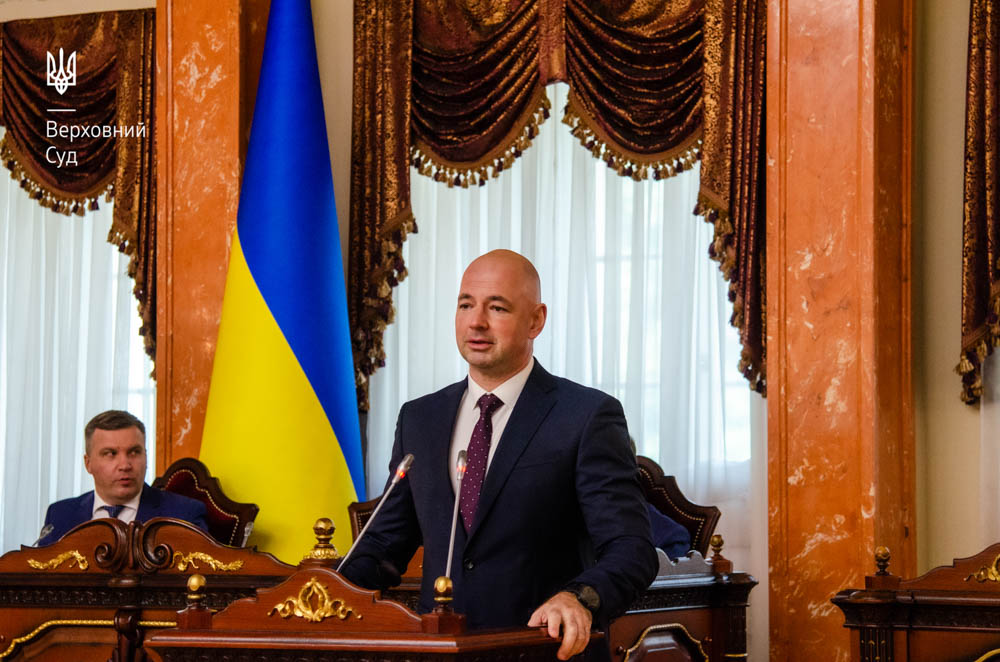
This was stated by the Vice President of the Supreme Court, Oleksandr Mamalui, during the meeting of the Scientific Advisory Council at the Supreme Court, thanking the scholars for their diligent work in providing scientific support for the Supreme Court's activities.
The Scientific Secretary of the SAC at the Supreme Court, Judge of the Grand Chamber of the Supreme Court, Oleh Tkachuk, noted that in 2023, 115 requests were received from Supreme Court judges to the Scientific Advisory Council at the Supreme Court. Based on these requests, 2,544 appeals were sent to the SAC members, resulting in the preparation of 368 scientific conclusions. In 2024, scholars have already prepared 319 scientific conclusions in cases across various jurisdictions.
It is thanks to the involvement of scholars in the work of the SAC that the Supreme Court has formulated well-reasoned conclusions in cases concerning judicial control over the actions of the Verkhovna Rada of Ukraine regarding holding people's deputies accountable for violations of discipline and ethical norms; resolving procedural issues of access to judicial protection; payment and redistribution of court costs; an individual's appeal to the court via the court's official electronic address with a procedural electronic document; the prosecutor's powers in land disputes; the return to state ownership of objects of the nature reserve fund and historical monuments; compensation for damage caused by Russia's aggressive war, its state immunity, and the range of persons subject to criminal liability for unleashing and waging aggressive war; and the protection of intellectual property rights.
.jpg)
The Scientific Advisory Council (SAC), in compliance with legal requirements, has begun working on preliminary opinions of the Plenum of the Supreme Court regarding draft legislative acts related to the judicial system, court proceedings, the status of judges, and other matters connected with the functioning of Ukraine’s judicial system. This work was praised by the Plenum, which acknowledged the validity of the conclusions of the SAC members at the Supreme Court.
The Scientific Advisory Council at the Supreme Court is mastering a new form of work — specialized working groups and their meetings.
Such working meetings were held on April 24, 2023, dedicated to discussing the legal nature of the assignment of a claim and the issues of distinguishing between factoring contracts and cession; on October 9, 2023, the working group meeting addressed judicial practice and legislative regulation of issues concerning the conclusion, performance, and invalidation of mortgage contracts; on March 18, 2024 — the effectiveness of mechanisms of judicial control over the enforcement of decisions of national and international courts; on April 8, 2024 — the comprehensive application of substantive and procedural law norms in resolving disputes concerning the declaration of unlawful and annulment of decisions of local self-government bodies and state executive authorities, the invalidation of contracts for the sale or lease of land plots, as well as the competence of the State Service of Ukraine for Geodesy, Cartography and Cadastre in land legal relations; on May 14, 2024 — the limits of judicial control in the application of sanctions introduced by the National Security and Defence Council of Ukraine and enacted by Decree of the President of Ukraine; on May 27, 2024 — the specifics of judicial control over the procedure for assessing judges’ compliance with the position held and a judge’s ability to administer justice in the respective court.
Many Supreme Court judges consider the work of the SAC within these working groups to be highly effective, as it enables lively discussion, allows for the involvement of a broad range of scholars as well as relevant state and non-governmental institutions, and serves as an important form of internal communication among judges from different cassation courts of the Supreme Court.
.jpg)
Vitalii Urkevych, Secretary of the Grand Chamber of the Supreme Court, noted that the Supreme Court actively utilizes the opportunity to obtain scientific conclusions on various legal issues, as evidenced by the statistics for the first half of 2024. During this period, 50 requests from Supreme Court judges were received by the Scientific Advisory Council (of which 21 came from judges of the Grand Chamber of the Supreme Court), and in response, 88 scientific conclusions were provided.
In addition, during the same period, four meetings of the SAC working groups took place, dedicated to discussing current issues of law application. Such events are extremely important, as this format of cooperation allows for hearing and analyzing different opinions regarding problematic aspects of the application of legal norms.
The Secretary of the Grand Chamber of the Supreme Court emphasized that the process of forming conclusions by the Supreme Court in a specific case is quite complex and influenced by many factors. These include changes in legislation, insufficient clarity of legal norms, the absence of established law application practice, and others. Under such circumstances, a reliable source of knowledge relied upon by Supreme Court judges when forming legal conclusions is legal doctrine — understood as a certain set of ideas, views, and conceptual approaches recognized by the legal community. One of the ways to obtain such knowledge is precisely by addressing relevant requests to members of the Scientific Advisory Council.
At the same time, the Supreme Court cannot request the opinion of scholars in any case pending before it. For such a procedural possibility to arise, the case must be referred for consideration to the relevant judicial chamber, the joint chamber of a cassation court, or the Grand Chamber of the Supreme Court — that is, complex legal issues must arise in the case, or there may be a question of possible departure from previously established legal conclusions of the cassation instance court.
Nevertheless, according to Vitalii Urkevych, a number of issues remain unregulated by current legislation, including: the legal regime of scientific conclusions prepared by SAC members, their binding nature (or lack thereof) for the Supreme Court and the parties to the case; the advisability of including specific factual circumstances of the case under consideration in requests to the SAC; the possibility of obtaining conclusions regarding the application of norms of foreign law; references to such conclusions in Supreme Court resolutions; the possibility of addressing requests to scholars who are not members of the SAC; as well as the regulation of conflicts of interest among SAC members when preparing relevant conclusions.
.jpg)
Furthermore, the Secretary of the Grand Chamber of the Supreme Court expressed his conviction that the interest of the legal community and the public in the activities and conclusions of the Scientific Advisory Council is only increasing. Therefore, since last year, the Supreme Court has been publishing the conclusions provided by scholars in the relevant section on the official website of the Supreme Court.
In conclusion, Vitalii Urkevych emphasized the need to develop a clear mechanism for cooperation between the Supreme Court and the Scientific Advisory Council.
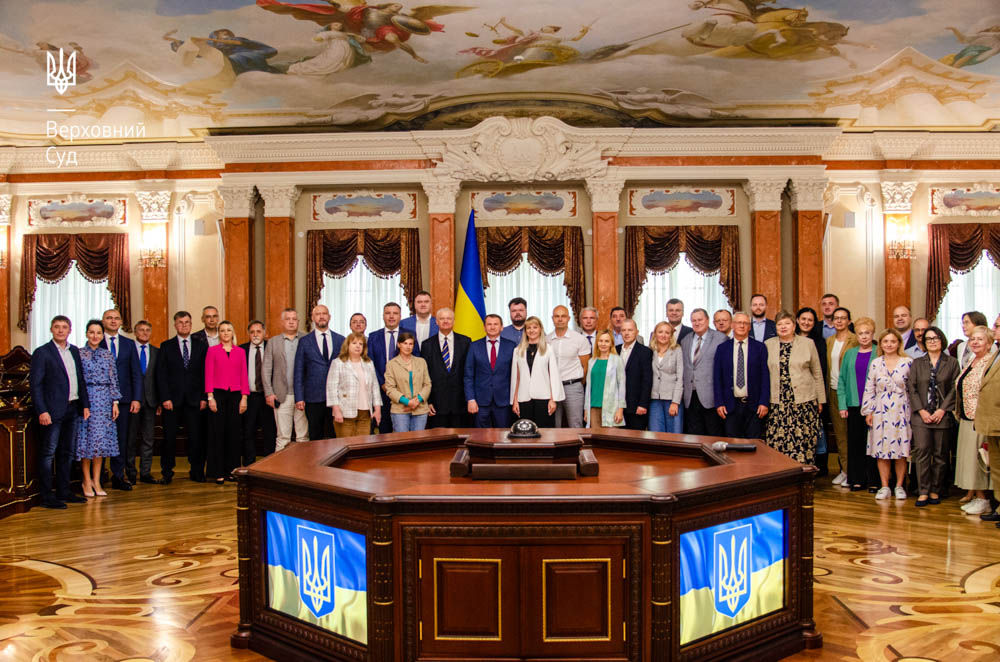
During the meeting, Supreme Court judges and members of the Scientific Advisory Council shared their views on the forms and content of the SAC’s work, and expressed their vision regarding a certain unification of approaches to formulating requests and preparing scientific conclusions based on such requests.
Members of the SAC proposed the establishment of a joint working group with judges to prepare recommendations that would enable more effective cooperation within the framework of the activities of the Scientific Advisory Council at the Supreme Court.
_03_03.png)