Contact center of the Ukrainian Judiciary 044 207-35-46
Individuals undergoing the qualification assessment of judges expect fairness in the relevant procedures. Only a fair assessment procedure is a guarantee of fair consideration of cases that will be handled by judges who have passed such procedures. This was emphasized by the Scientific Secretary of the Scientific Advisory Council at the Supreme Court, Judge of the Grand Chamber of the Supreme Court Oleh Tkachuk, during a meeting of the working group of the Scientific Advisory Council at the Supreme Court dedicated to discussing the specifics of judicial review of the procedure for assessing judges’ compliance with the position held, as well as a judge’s ability to administer justice in the relevant court.
.jpg)
According to Oleh Tkachuk, the Grand Chamber of the Supreme Court and the Administrative Cassation Court within the Supreme Court are currently considering cases related to appeals against decisions of the High Qualification Commission of Judges of Ukraine regarding the results of the qualification assessment of judges. A certain amount of experience has already been accumulated in handling cases related to the qualification assessment of judges; at the same time, numerous issues have arisen that require discussion in academic circles.
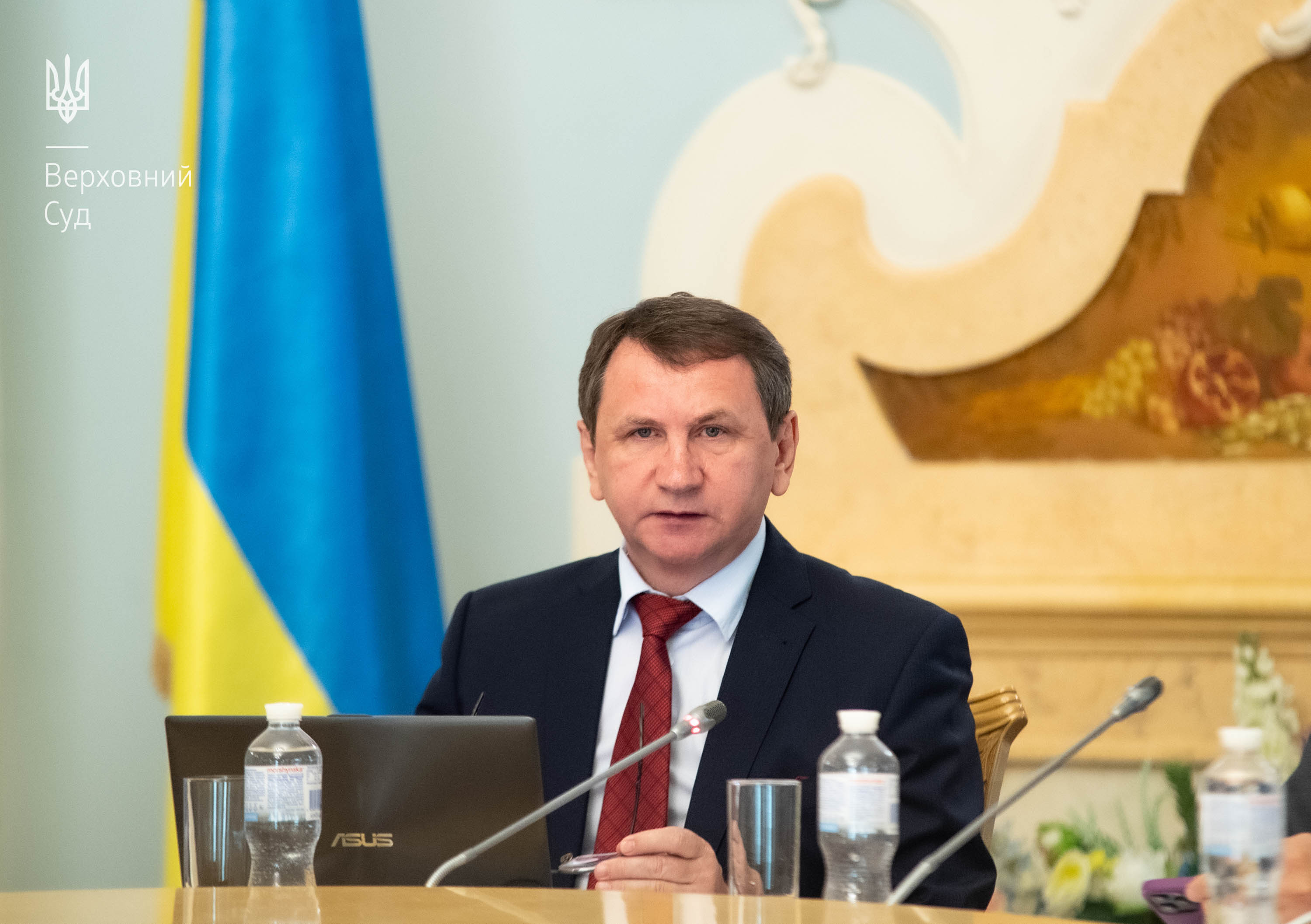
The Secretary of the Grand Chamber of the Supreme Court, Vitalii Urkevych, noted that the issues arising in cases involving the High Qualification Commission of Judges of Ukraine are extremely important. “Today, following the appointment of the new composition of the High Qualification Commission of Judges of Ukraine on June 1, 2023, a corresponding practice of the Commission has already been established. And when the Grand Chamber of the Supreme Court considers such cases, it must formulate appropriate legal conclusions, taking into account, in particular, numerous changes in the legislation. Therefore, we are interested in hearing the opinions of academics specifically regarding which approaches can be applied when considering such cases,” the Secretary of the Grand Chamber of the Supreme Court pointed out.
Judge of the Grand Chamber of the Supreme Court Oleh Kryvenda noted that, in accordance with paragraph 20 of Section XII “Final and Transitional Provisions” of the Law of Ukraine “On the Judiciary and the Status of Judges”, compliance with the position held by a judge was to be assessed by a panel of the High Qualification Commission of Judges of Ukraine in the manner prescribed by law. However, Section V of this Law defines such a procedure for a different process - namely, for confirming a judge’s ability to administer justice in the relevant court. Therefore, as the judge pointed out, questions arise such as:
– whether the procedures for assessing a judge’s compliance with the position held and a judge’s ability to administer justice in the relevant court are identical (i.e., whether both procedures can be considered the same in their legal nature and whether the provisions of Section V of the Law of Ukraine “On the Judiciary and the Status of Judges” apply to both) ;
– whether the decision of the panel of the High Qualification Commission of Judges of Ukraine regarding the assessment of judges’ compliance with the position held is final.
.jpg)
As reported by Judge of the Constitutional Court of Ukraine and Ukraine’s representative in the Consultative Council of European Judges, Viktor Horodovenko, the topic of today’s discussion coincides with the topic that will be the subject of this year’s opinion of the CCJE. He emphasized that issues concerning extraordinary procedures are always under close scrutiny by European colleagues, because such procedures are now actively being introduced into the legislation of Council of Europe member states. During the discussion of such matters, the CCJE working group relies on the conclusions of the European Court of Human Rights that a general disciplinary procedure cannot be equated with an extraordinary procedure, as they differ in their legal nature and content and, accordingly, will have different consequences.
In this context, Oleh Tkachuk drew attention to the fact that the voice of the CCJE is very important for the Supreme Court. “We need to understand the processes of lawmaking and law application in order to adopt balanced and fair decisions that will be accepted by the European legal community,” he concluded.
The meeting was also attended by members of the Scientific Advisory Council at the Supreme Court: Oleh Zaiarnyi, Tetiana Kravtsova, Dmytro Lukianets, Nataliia Onishchenko, Viktor Smorodynskyi, Nadiia Pysarenko, Iryna Sopilko, Anton Monaienko, Nataliia Kovalko, Oleksandr Konstantyi, as well as judges of the Grand Chamber of the Supreme Court: Ihor Zhelieznyi, Yevheniia Usenko, Lev Kyshakevych, Oleksandr Banasko, and Mykola Mazur.
_03_03.png)