Contact center of the Ukrainian Judiciary 044 207-35-46
A regular meeting of the Scientific Advisory Council at the Supreme Court was held. Opening the meeting, the Scientific Secretary of the Council and Judge of the Grand Chamber of the Supreme Court, Oleh Tkachuk, drew the attention of those present to the fact that current legal issues relating to land legal relations, the application of substantive and procedural law in the resolution of the corresponding disputes, and the delineation of the competence of the State Service of Ukraine for Geodesy, Cartography and Cadastre and the prosecution authorities are the subject of close attention on the part of the legal community. When deciding cases, the courts take into account the legal positions formulated by the Grand Chamber of the Supreme Court. At the same time, the judicial practice of that body must be based on a clear understanding not only of the rules of law but also of legal science. The working format of the Scientific Advisory Council, under which judges of all the cassation courts within the Supreme Court, judges of all jurisdictions, the Grand Chamber of the Supreme Court and academic members of the Council discuss at working-group meetings the interpretation and application of the rules of law, is highly effective. Such an approach ensures the necessary professional communication within the highest court in the judicial system of Ukraine with a view to the formation of stable and uniform judicial practice.
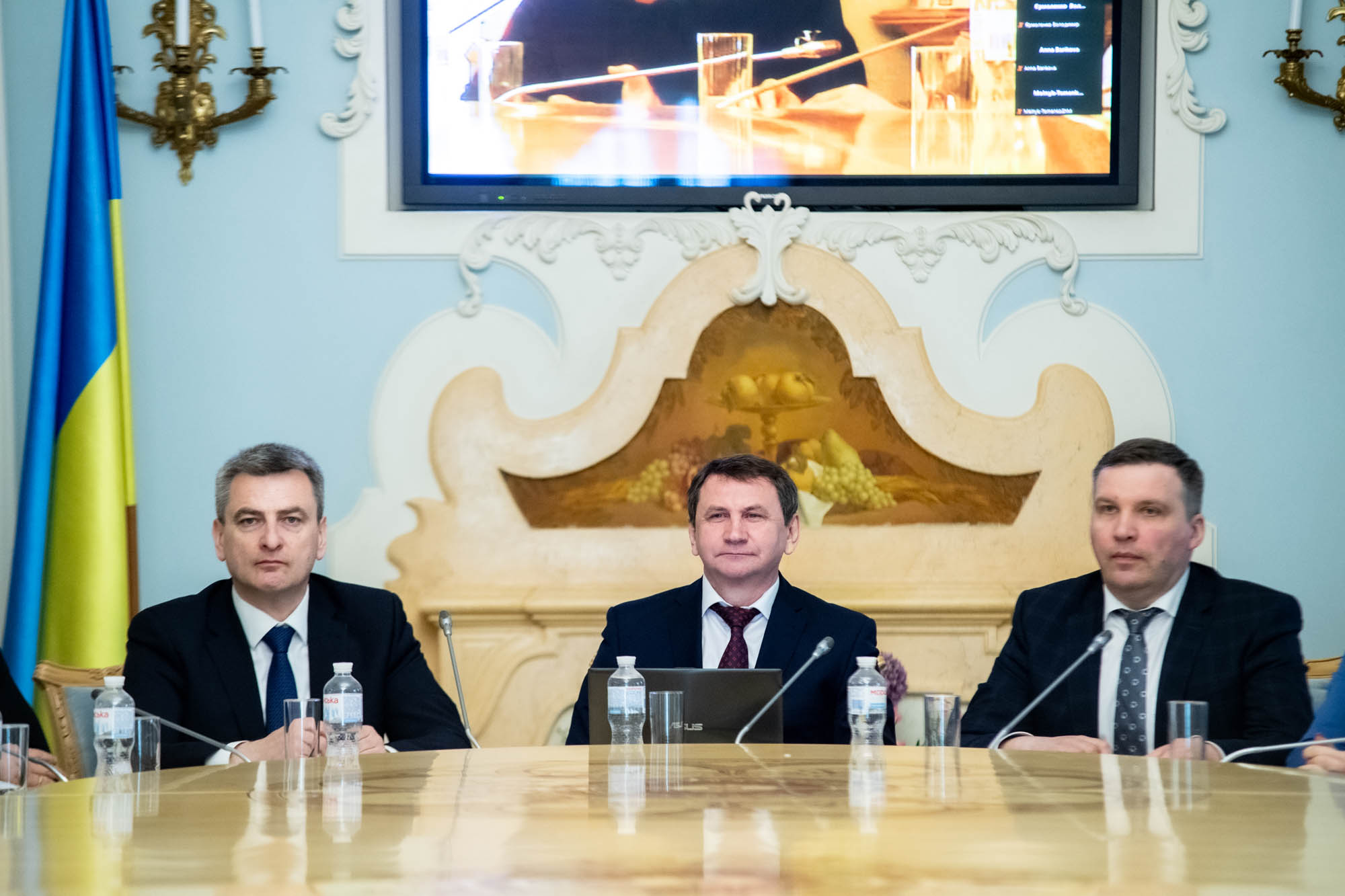
As noted by Judge of the Grand Chamber of the Supreme Court Ihor Tkach, land disputes are resolved by the Commercial Cassation Court, the Civil Cassation Court within the Supreme Court, and the Grand Chamber of the Supreme Court. At the same time, in the proceedings of the judicial chamber for the consideration of cases concerning land relations and property rights of the Commercial Cassation Court of the Supreme Court, approximately two-thirds of the cases concern the powers of the StateGeoCadastre to bring proceedings before the court. It is therefore of great importance to examine these issues and to set the direction for judicial practice.
The Judge of the Grand Chamber of the Supreme Court observed that, as a general rule, where there is a body to whose competence the relevant powers are assigned, it is that body which has the right to apply to the court and which is the claimant in the particular case. If, however, such a body fails to exercise its powers properly, the prosecutor represents the legitimate interests of the State in court after the court has confirmed the existence of grounds for such representation.
Speaking of the powers of the StateGeoCadastre to bring proceedings before the court, Ihor Tkach noted that judicial practice had at one time proceeded on the basis that those powers related to agricultural land. There is, however, another view according to which the powers of the said body are general in nature and any disputed issue concerning land relations falls within the competence of the StateGeoCadastre, which has the right to apply to the court. That position is based, inter alia, on Article 28 of the Law of Ukraine “On Central Bodies of Executive Power”. On the question whether that provision is applicable to the situation discussed at the meeting of the Scientific Advisory Council and to the problematic issues identified, Ihor Tkach proposed that colleagues commence the discussion.
The position of the StateGeoCadastre from the standpoint of its powers and the functions it performs in relation to the protection of land and land legal relations was set out by the Director of the Legal Department, Valerii Daugul. In his words, the judicial practice currently being formed by the Supreme Court is of practical relevance to the authority, since the gaps that exist in the current land legislation are being filled by means of legal positions. Moreover, Article 13(5) of the Law of Ukraine “On the Judiciary and the Status of Judges” obliges a subject of power to apply those legal conclusions that have been formulated in the application of a particular rule of substantive or procedural law. At the same time, the issue remains problematic when the prosecution authorities bring a claim in the interests of local self-government bodies or of the StateGeoCadastre. As at 1 April 2024 there were 2,002 court cases in the system involving prosecutors in which the StateGeoCadastre was the defendant.

In the course of the discussion the Secretary of the Grand Chamber of the Supreme Court, Vitalii Urkevych, and Judge of the Grand Chamber of the Supreme Court Nataliia Shevtsova enquired of the representative of the StateGeoCadastre about the exercise of the powers conferred by legislation, in particular the performance of the functions of state control over the use and protection of land.
Continuing the theme, the Scientific Secretary of the Scientific Advisory Council and Judge of the Grand Chamber of the Supreme Court, Oleh Tkachuk, observed that the practice of the Supreme Court is being shaped in such a way as to restore to state ownership by the shortest possible route land plots that have been withdrawn unlawfully, in breach of the law.
The idea of a simplified mechanism for the protection of rights to land was also supported by a member of the Scientific Advisory Council, Volodymyr Nosik. In his view, the principal subjects exercising rights to land should be the bodies of state power and the bodies of local self-government, which implement the owner’s rights to land on behalf of the Ukrainian people.
As noted by Ihor Tkach, the issue under discussion is not a simple one. The Supreme Court, for its part, is seeking to identify a clear mechanism by which to guide the courts of first instance and of appeal that consider the corresponding disputes.

Judges of the judicial chamber for the consideration of cases concerning land relations and property rights of the Commercial Cassation Court of the Supreme Court, Vitalii Zuiev and Yurii Chumak, expressed their views on the participation of the prosecutor in commercial proceedings. In particular, they shared with their colleagues their reflections on the prosecutor’s observance of reasonable time limits for the competent authority to respond to a violation, and on the application of limitation periods in cases involving the prosecutor. Speaking of the issue of the return or recovery of land plots, Yurii Chumak observed that the principal role in this process should be played by the bodies of state power or of local self-government, and that the defendant should be the person who obtained them.

Judge of the Supreme Court in the Administrative Cassation Court Andrii Rybachuk also focused on the powers of the prosecutor. In his words, both having regard to the judicial practice of the Supreme Court and as follows from the legislation, a prosecutor may apply to the court exclusively in two cases: where the relevant authorised body fails to exercise its powers or exercises them improperly. The system of bodies of state power of Ukraine, he said, is constructed in such a way that in every set of legal relations there is a body vested with the corresponding powers. In land legal relations it is precisely the StateGeoCadastre that is the institution which has charge of the specific legal relations. The Judge of the Supreme Court in the Administrative Cassation Court proposed that such a systemic approach be applied in those cases in which the initiator is the prosecutor. Moreover, the corresponding legal conclusion has already been formulated by the Grand Chamber of the Supreme Court; it clearly delineates that the bodies of the StateGeoCadastre possess broad powers in respect of all categories of land.
The event was also attended by Judges of the Grand Chamber of the Supreme Court Oleksandr Banasko, Yurii Vlasov, Iryna Vorobiova, Kostiantyn Pilkov, Serhii Martiev, Oleh Kryvenda, Olha Stupak and Serhii Pohribnyi; Judges of the Supreme Court in the Civil Cassation Court Andrii Hrushytskyi, Iryna Lytvynenko, Yevhen Petrov, Yevhen Synelnykov, Viktor Prorok and Vadym Ihnatenko; Judges of the Supreme Court in the Administrative Cassation Court Raisa Khanova, Zhanna Melnyk-Tomenko and Ihor Zheleznyi; First Deputy Head of the State Service of Ukraine for Geodesy, Cartography and Cadastre Anatolii Miroshnychenko; Director of the Training Centre for Prosecutors of Ukraine Olesia Otradnova; members of the Scientific Advisory Council Volodymyr Yermolenko, Tetiana Kurman, Pavlo Kulynych and Vadym Belianevych; from the Educational and Scientific Institute of Law of Taras Shevchenko National University of Kyiv – Diana Kolomiitseva, Tamara Sarkisova and Olena Zaiets; and from the National University “Odesa Law Academy” – Tetiana Kharytonova and Khrystyna Hryhorieva.

