Contact center of the Ukrainian Judiciary 044 207-35-46
Judicial decisions must be perceived by Ukrainian society and the world community at large as balanced, fair and well-reasoned. This is facilitated, in particular, by co-operation between judges and academics, which makes it possible to raise the results of the judiciary’s work to a higher qualitative level.
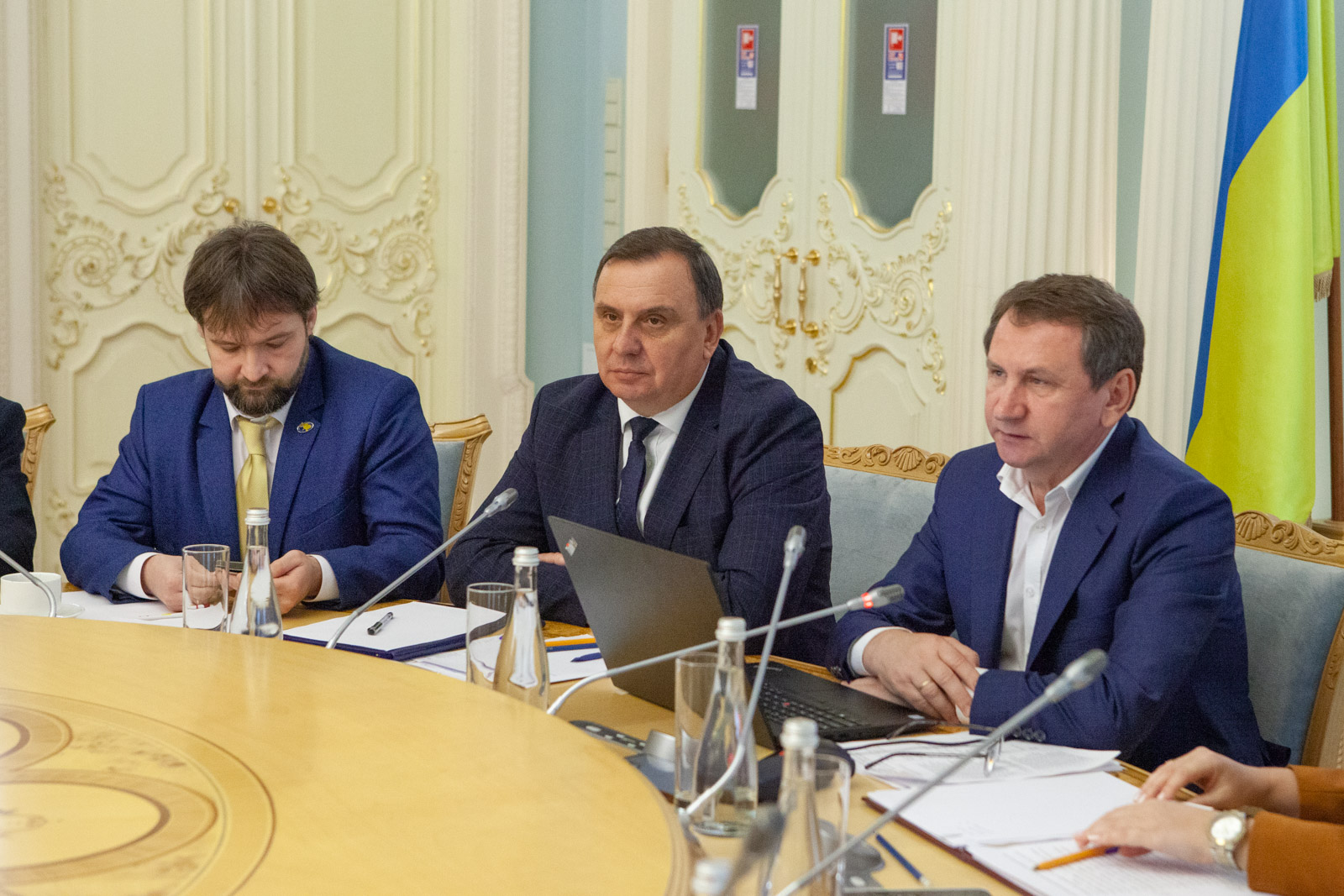
This was stated by the President of the Supreme Court, Stanislav Kravchenko, during a regular meeting of the working group of the Scientific Advisory Council under the Supreme Court.
According to the head of the Supreme Court, in line with the demands of the times, courts of all four jurisdictions are faced with new legal problems, for the resolution of which judges quite frequently turn to legal scholars with corresponding requests.
Stanislav Kravchenko noted that judges highly value the contribution of academics to the development of judicial practice and thanked the members of the Scientific Advisory Council for fruitful co-operation.
On this occasion, the working group’s meeting was devoted to a discussion of judicial practice and the legislative regulation of issues relating to the conclusion, performance and invalidation of mortgage contracts.
The Scientific Secretary of the Scientific Advisory Council, Judge of the Grand Chamber of the Supreme Court Oleh Tkachuk, noted that during its work the Grand Chamber of the Supreme Court has considered approximately 100 cases concerning disputes related to mortgages.
In particular, in the resolution of the Grand Chamber of the Supreme Court of 12 May 2020 in case No. 921/730/13-г/3 a position was formulated regarding the preclusive effect of a court decision in a dispute between a creditor and a debtor and/or surety concerning the recovery of indebtedness. In the resolution of the Grand Chamber of the Supreme Court of 23 June 2020 in case No. 536/1841/15-ц a conclusion was set out that a final court decision on the recovery of indebtedness from the borrower does not constitute grounds for refusing, in another case, to recover indebtedness from the surety. By the resolution of the Grand Chamber of the Supreme Court of 19 May 2020 in case No. 361/7543/17 the procedure for the simultaneous recovery of a debt under the principal obligation and enforcement against the subject-matter of the mortgage was clarified. In addition, in the resolution of 23 June 2020 in case No. 645/1979/15-ц the Grand Chamber of the Supreme Court drew attention to the mortgagee’s duty to send notices – a written demand for the elimination of breaches – to the mortgagor and to the debtor if the latter is different from the mortgagor.
At the same time, the multifaceted nature of economic relations and life situations gives rise to new disputes and the need to take account of legal aspects in cases that are not similar to those previously considered by the Supreme Court. For example, in 2022 the Civil Cassation Court within the Supreme Court had under consideration almost 3,000 cases concerning loans, credit and bank deposits. Of these, in more than 130 cases the issue of recovering indebtedness under a mortgage loan arose. The statistics of the courts of first instance and the appellate courts are even more indicative and confirm the proposition that cases of this category are among the most topical in society. It is for this reason that the question of the legislative regulation of mortgages was placed on the agenda of the working group of the Scientific Advisory Council under the Supreme Court.
Judge of the Grand Chamber of the Supreme Court Serhii Martiev drew attention to the fact that the legislator had twice amended Article 26 of the Law of Ukraine “On State Registration of Proprietary Rights to Immovable Property and Their Encumbrances”, which enumerates the grounds for making changes to the State Registers. The judge also proposed a discussion of the proper and effective methods of judicial protection in cases related to mortgages.
Judge of the Supreme Court in the Civil Cassation Court Vasyl Krat observed that an action challenging a mortgage contract (a rescissory action) cannot be classified as a negatory action. When resolving disputes concerning the invalidity of mortgage contracts, there are essentially three permissible options for classifying the conclusion of a mortgage contract by a mortgagor who is not the owner (in particular, in the event of the invalidation of a sale-and-purchase contract on the basis of which the mortgagor acquired title, or the recognition as unlawful of a decision of a local self-government body and the invalidity of a state act): 1) since at the moment of concluding the mortgage contract the mortgagor was the owner, and the grounds for invalidity must exist at the moment the transaction is performed, there are no grounds for declaring such a transaction invalid; 2) the invalidity of the original legal facts or documents does not entail the invalidity of the mortgage contract, because Ukrainian law does not provide for dependent invalidity in such cases (it occurs only in isolated instances expressly provided for by law). Therefore, the good faith or bad faith of the mortgagee must be taken into account in order to decide the question of the acquisition of the mortgage right by the latter. It is obvious that good faith “cures” such a defect in the acquisition of the mortgage right as the conclusion of the contract by a non-owner; 3) when declaring a mortgage contract invalid, the good faith of the mortgagee must be taken into account. In the absence of grounds for classifying the mortgagee as acting in bad faith, good faith “cures” such a defect of the contract as its conclusion by a non-owner.
Article IX.–2:108 of the Principles, Definitions and Model Rules of European Private Law (DCFR) provides that the creditor did not know and could not have known that, at the moment the security was created, the person who created it had no right or authority to do so. The bona fide acquisition of a security right is excluded where the property was stolen from the owner or from the person to whom the owner had transferred possession of the property. The judge emphasised that the Ukrainian legal order permits the acquisition of title - as the most complete absolute proprietary right - from a non-owner by virtue of the construction established in Article 330 of the Civil Code of Ukraine; accordingly, the acquisition of such a right over another person’s property in the form of a mortgage right should likewise be permitted by the legal order from a non-owner. In the context of Article 26 of the Law of Ukraine “On State Registration of Proprietary Rights to Immovable Property and Their Encumbrances”, he pointed out that it is a public, procedural norm and neither contains nor can contain private-law methods of protection, and at the same time, contrary to the principle of dispositiveness, it cannot oblige a party to combine claims that a private-law norm does not provide for (see the resolution of the Supreme Court composed of a panel of judges of the Second Judicial Chamber of the Civil Cassation Court of 1 February 2023 in case No. 316/2082/19, proceedings No. 61-17264св21).
The Director of the Research Institute of Law-Making and Scientific-Legal Expert Examinations of the National Academy of Legal Sciences of Ukraine, Corresponding Member of the National Academy of Legal Sciences of Ukraine Oleksii Kot, drew attention to the fact that in cases of this category it is important to find a legally balanced method of protecting the owner’s rights.

“The problems resolved by the Grand Chamber of the Supreme Court require a systemic approach, and it is necessary to understand how a decision may affect decisions in all other cases, not only at the level of judicial practice but also at the legislative level,” he stated.
In the opinion of the Head of the Laboratory for the Protection of Subjective Rights of the Department of Private Law Problems of the Academician F. H. Burchak Research Institute of Private Law and Entrepreneurship of the National Academy of Legal Sciences of Ukraine Volodymyr Bobryk, when applying specific methods of protection the court has the power to recognise the nullity of a mortgage contract for the subsequent deletion of data from the register, which removes obstacles to the owner’s exercise of his rights.
The Head of the Department of Scientific-Legal Expert Examinations of the Research Institute of Law-Making and Scientific-Legal Expert Examinations of the National Academy of Legal Sciences of Ukraine Larysa Krasytska observed that, when choosing a method of judicial protection, it is necessary to determine precisely which right has been infringed and from which legal relations this infringement arises.
Judge of the Grand Chamber of the Supreme Court Dmytro Hudyma proposed a discussion of the issue of an “abstract” mortgage in the context of the second sentence of part 1 of Article 24 of the Law of Ukraine “On Mortgage”: “Unless proved otherwise, the assignment of rights under a mortgage contract evidences the assignment of the claim under the principal obligation”. He put a number of questions to those present concerning the application of this provision, in particular: 1) Does it mean that, with the alienation of rights under a mortgage contract, as a general rule the claims under the principal obligation automatically pass even in the absence of another transaction aimed at alienating those claims? 2) What are the legal consequences for the rights under the mortgage contract (for the mortgage right) of the alienation of the claims under the principal obligation secured by the mortgage without the simultaneous alienation of the rights under the mortgage contract? 3) Is it lawful for the mortgagee who has alienated the claims under the principal obligation secured by the mortgage without the simultaneous alienation of the rights under the mortgage contract to retain the mortgage right?
Professor of the Department of Civil Law and Procedure of Vasyl Stus Donetsk National University Olena Belianevych expressed an opinion on the provision of Article 24 of the Law of Ukraine “On Mortgage”, noting that in the event that no contract for the assignment of mortgage rights has been concluded, and only a contract for the assigned right under the credit agreement has been concluded, the mortgage right passes without registration to the person to whom the claims under the principal obligation have been assigned.
An effective method of protection in the legal relations between the parties to a dispute that arose in connection with the conclusion of a mortgage contract by a person whose title to the relevant immovable property has been refuted by a court is the recognition of the mortgage contract as invalid and the recognition of title (as principal claims) and the cancellation of the state registration of the encumbrance (as a derivative claim).
An action brought by the owner of property that was mortgaged by another person (whose lack of rights to that property was established by a court after the conclusion of the relevant mortgage contract) seeking the invalidity of that mortgage contract may be regarded as a negatory action aimed at removing obstacles to the owner’s use of his immovable property. If the owner’s right to the immovable property has been protected by a court through the recognition of the mortgage contract as invalid, the property is in the actual possession of the owner, but a mortgage encumbrance continues to operate in respect of it, there are no grounds for speaking of vindication as a consequence of the invalidity of the transaction.
Effective methods of protecting the owner are the claims for recognition of the mortgage contract as invalid and recognition of title (as principal claims) and cancellation of the state registration of the encumbrance (as a derivative claim). These methods are sufficient to eliminate the infringement of the owner’s rights.
“A mortgage never circulates in isolation from the principal obligation. And since it is one of the most solid forms of security, the assignment of the mortgage right simultaneously means the assignment of the principal obligation. The process also occurs in the reverse order,” explained the Vice Rector for Research of the Kharkiv Institute of Management Personnel Yurii Mytsa.
In his address he also proposed a variant for determining the ratio of the general mortgage debt to the security for the total amount of the principal obligation.
Judge of the Supreme Court in the Civil Cassation Court Vasyl Krat stated that for the assignment of rights under a mortgage contract it is necessary to perform a transaction in written form with notarial certification. The Law of Ukraine “On Mortgage” does not provide for the existence of a construction of an “abstract” mortgage under which a mortgage exists outside any connection with the security for the principal obligation. Both Article 125 of the Civil Code of the Ukrainian SSR of 1922 and part 3 of Article 197 of the Civil Code of the Ukrainian SSR of 1963 contained provisions that the rights securing performance pass to the acquirer of the claim. That is to say, the principle was enshrined that security rights follow the debt which they secure. By contrast, the current Civil Code contains no norm concerning any types of security. Therefore, at the level of the norms of individual laws different approaches to the transfer of security rights are provided for. In particular, this may occur: only by the conclusion of a separate contract (Article 24 of the Law of Ukraine “On Mortgage”); or as a result of automatic transfer (part 2 of Article 23 of the Law of Ukraine “On Securing Creditors’ Claims and Registration of Encumbrances”).
Professor of the Department of Private International Law of the Educational and Scientific Institute of International Relations of Taras Shevchenko National University of Kyiv Oleksandr Biriukov agreed with the previous speaker and observed that the assignment of rights is governed by the same rules as the substitution of the creditor in a contract, and thus the parties themselves determine their own share in the transaction.
Finally, Volodymyr Bobryk noted that Article 24 of the Law of Ukraine “On Mortgage” may be perceived as a presumption that applies in those cases where there is a clear expression of the parties’ will to assign the claim, but there is no assignment of the rights under the principal obligation.
Judges of the Grand Chamber of the Supreme Court Oleksandr Banasko, Yurii Vlasov and Iryna Vorobiova, Judge of the Supreme Court in the Civil Cassation Court Yevhenii Krasnoshchokov, and Professor of the Department of Civil Law No. 1 of Yaroslav Mudryi National Law University, Corresponding Member of the National Academy of Legal Sciences of Ukraine Inna Spasybo-Fatieieva, Associate Professor of the Department of Human Rights and Legal Methodology of Yaroslav Mudryi National Law University Viktor Smorodynskyi, as well as Professor of the Department of Civil Law and Procedure of Uzhhorod National University, Deputy Dean for Research Mariia Mendzhul, also took part in the discussion.
As a result of the meeting of the working group of the Scientific Advisory Council, an information note has been prepared which will be placed in the relevant section on the website of the Supreme Court.
