Contact center of the Ukrainian Judiciary 044 207-35-46
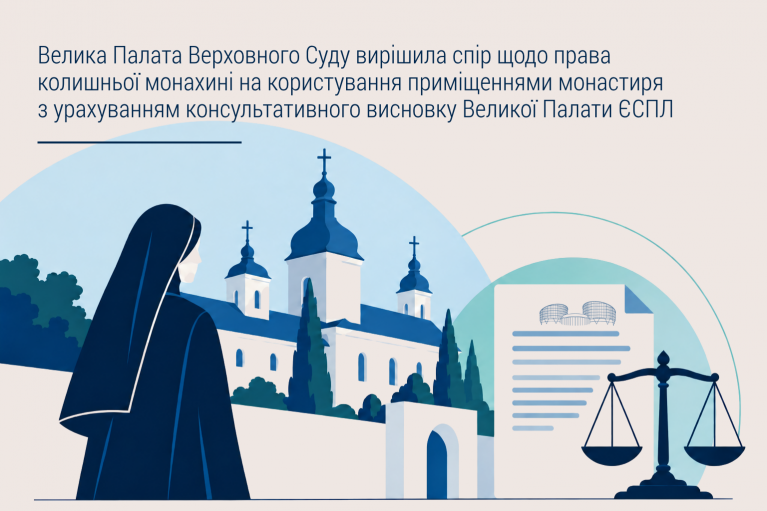
The religious nature of a legal relationship, the status of one of the parties as a religious organisation, and the fact that the premises in dispute are used for worship or have another specific religious purpose do not, in themselves, exclude the jurisdiction of the national courts.
A dispute concerning the use of premises owned by a religious organisation is to be determined in civil proceedings under Article 19 of the Civil Procedure Code of Ukraine where the claimant bases the claim not only on their canonical status, the organisation’s internal rules or decisions, but also on an asserted civil right or legally protected interest which, under national law, may be regarded as recognised, at least on the face of the claim.
When determining such a dispute, a court must not assume the role of the religious organisation’s own authorities in matters of doctrine, a person’s canonical status, internal governance, the rules governing monastic life, discipline, subordination, or the correctness of canonical decisions, as these matters fall within the religious organisation’s autonomy. At the same time, this does not deprive the court of jurisdiction to determine a dispute concerning a civil right or interest by applying national law and the Convention for the Protection of Human Rights and Fundamental Freedoms, while having regard to the autonomy of the religious organisation as a limit on the extent of permissible judicial intervention.
These conclusions were made by the Grand Chamber of the Supreme Court.
The dispute in this case concerned the right of a former nun to use premises (a monastic cell) owned by the Religious Organisation “Spaso-Preobrazhenskyi Monastery of the Ukrainian Greek Catholic Church”. In its original claim, the monastery sought a declaration that the former nun had lost her right to use the premises (cell). In her counterclaim, she sought an order removing the obstacles to her use of those premises, where she had previously lived and been registered as residing.
The case was considered by the courts on several occasions.
After the Supreme Court remitted the case for further consideration, the appellate court dismissed the monastery’s appeal and upheld the first-instance judgment insofar as it granted the claims brought by way of counterclaim.
The issue before the Grand Chamber of the Supreme Court was which body of law – canonical or national – should govern the question of a person’s right to reside in a monastery where that person is or was a member of a religious order and, consequently, which forum – a national court or an ecclesiastical court – has jurisdiction to determine that question.
The Grand Chamber of the Supreme Court sought an advisory opinion from the ECtHR in the context of Articles 6 (the right of access to a court), 8 (the right to respect for one’s home) and 9 (the autonomy of religious organisations) of the Convention.
The Grand Chamber of the ECtHR delivered an advisory opinion, according to which a monastic cell may constitute a “home” where there are sufficient and continuing links with the place, while the applicability of Article 6 of the Convention depends on whether the dispute concerns a “right” which is at least arguable under domestic law. That question is to be assessed by the national courts, having regard to the autonomy of religious organisations guaranteed by the Convention.
In reconsidering the case, the Grand Chamber of the Supreme Court observed that the autonomy of a religious organisation means that a national (secular) court cannot assume the role of ecclesiastical authorities in matters of doctrine, internal organisation, admission to or exclusion from the religious community, or the determination of the conditions governing monastic life. At the same time, such autonomy does not mean that any dispute involving a religious organisation, or concerning property used by it, is automatically outside the jurisdiction of the national courts. In determining jurisdiction, the court must assess whether the particular claim is based exclusively on rules of canon law or whether it also concerns a right or interest recognised, at least on an arguable basis, by domestic law.
Given that the claimant in the counterclaim based her case primarily on rules of secular rather than canon law, and sought not to be reinstated to the religious order but to have what she asserted to be her right to use the premises protected, the Grand Chamber of the Supreme Court concluded that the dispute had a sufficient basis to be determined by a national court in civil proceedings.
In determining the merits of the dispute, the Grand Chamber of the Supreme Court noted that the premises in question were not ordinary residential accommodation made available to an individual under a civil-law contract, warrant, easement or other independent civil-law title. They constituted a monastic cell within a monastery, the functional purpose of which was connected not merely with providing accommodation, but also with supporting the monastic life and religious activities of the community concerned.
The counterclaimant’s previous use of the cell was linked to her membership of the monastic community. It was in that capacity that she lived at the monastery and occupied the premises in question. The registration of her place of residence at the monastery address did not, of itself, confer on her any proprietary, contractual or other independent right to use the cell in dispute. Nor did her previous occupation of the cell give rise to any permanent or indefinite right to continue using the premises.
Recognising such a right solely on the basis of the claimant’s previous occupation of the premises would mean that a person who had lived in a monastery for a period of time by virtue of their status as a member of a religious order would acquire an independent civil right to continue residing in monastery premises, irrespective of whether that status was maintained, the wishes of the religious organisation, its internal governance, or the legal regime applicable to the property concerned.
In light of the above, the Grand Chamber of the Supreme Court held that the first-instance and appellate courts had erred in their conclusions. In allowing the counterclaim, those courts had, in effect, equated the claimant’s previous occupation of the cell and registration of her place of residence at the monastery address with a right to continue using the premises in dispute, without establishing whether she had an independent civil-law title entitling her to demand continuing access to the cell after her relationship with the monastery had come to an end.
Granting the relief sought in this case would not merely have removed an alleged interference with the claimant’s use of the property. It would, in substance, have imposed on the monastery an obligation to provide permanent access to the premises to a person who no longer held the status which had formed the basis of the parties’ understanding that she would reside at the monastery, and to do so within the space in which the monastic community conducts its life.
In the absence of an independent legal basis for the claimant’s right to use the premises in dispute, such an obligation would amount to State interference, through the courts, in the monastery’s internal affairs, including its determination of which persons may have permanent access to an area subject to restricted access – the cloister – use the monastic cells and participate in the communal life of the monastic community.
Accordingly, in the present case, the Grand Chamber of the Supreme Court quashed the judgments of the first-instance and appellate courts and issued a new judgment dismissing the counterclaim.
Grand Chamber of the Supreme Court judgment of 9 September 2026 in case no. 607/15144/20 – https://reyestr.court.gov.ua/Review/139924670.
This and other legal positions of the Supreme Court can be found in the Database of Legal Positions of the Supreme Court - https://lpd.court.gov.ua.
_03_03.png)