Contact center of the Ukrainian Judiciary 044 207-35-46
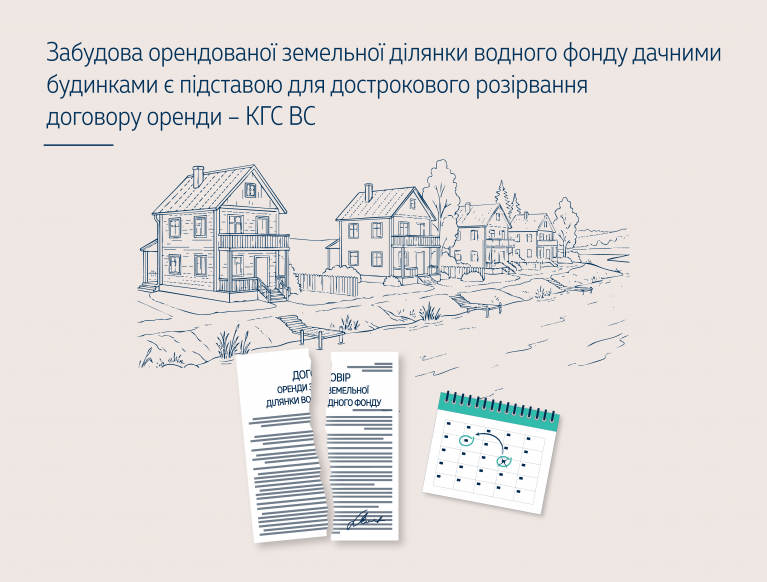
A tenant of land belonging to the water fund is required to comply with the environmental protection regime established for that land. The construction of holiday homes on such land within the coastal protection strip of the Dniester River constitutes use of the land for an unauthorised purpose and is sufficient grounds for early termination of the lease agreement.
This conclusion was reached by the Commercial Cassation Court within the Supreme Court.
In this case, a prosecutor brought an action against a district organisation of the Ukrainian Hunters and Fishermen Society seeking termination of a land lease agreement, cancellation of the state registration of the leasehold right, and termination of that right.
The court of first instance granted the claim. The court of appeal quashed that judgment and dismissed the claim, finding, in particular, that it had not been established that the land in dispute was located within the coastal protection strip of the Dniester River or the Dnistrovski Plavni protected tract.
On review of the case, the Commercial Cassation Court within the Supreme Court noted that the land in dispute was located within the coastal protection strip of the Dniester River and formed part of the Dnistrovski Plavni protected tract, which is a protected natural area. Accordingly, it was subject to a special regime of use and restrictions on economic activity.
At the same time, the minimum distance from the land in dispute to the waterline was only 16 metres, which ruled out the lawful construction of holiday homes there. The Supreme Court also emphasised that the absence of a land management project establishing the coastal protection strip does not, in itself, indicate that no such strip exists, since its dimensions are prescribed by law.
The Supreme Court accepted the prosecutor’s arguments that the two-storey holiday homes located on the land in dispute constituted immovable property and did not qualify as hydraulic, hydrometric or linear structures, the construction of which is permitted within a coastal protection strip. Their construction on the land in dispute was therefore unlawful.
The Commercial Cassation Court also noted that such construction was contrary to the terms of the lease agreement and the requirements of environmental protection legislation and demonstrated that the water fund land was being used for an unauthorised purpose. A tenant is required to comply with the regime governing the use of land designated as protected natural areas and other environmentally protected land, as well as water fund land.
Accordingly, the Supreme Court concluded that the use of leased water fund land for a purpose other than that for which it was designated, including its development with holiday homes, constitutes sufficient grounds for early termination of the lease agreement.
The Commercial Cassation Court of the Supreme Court upheld the cassation appeal lodged by the Deputy Head of the Prosecutor’s Office, quashed the judgment of the commercial court of appeal and reinstated the judgment of the commercial court of first instance.
Judgment of the Commercial Cassation Court within the Supreme Court of 11 August 2026 in case No. 916/926/21 – https://reyestr.court.gov.ua/Review/139144934.
This and other legal opinions of the Supreme Court are available in the Database of Legal Positions of the Supreme Court - https://lpd.court.gov.ua.
_03_03.png)