Contact center of the Ukrainian Judiciary 044 207-35-46
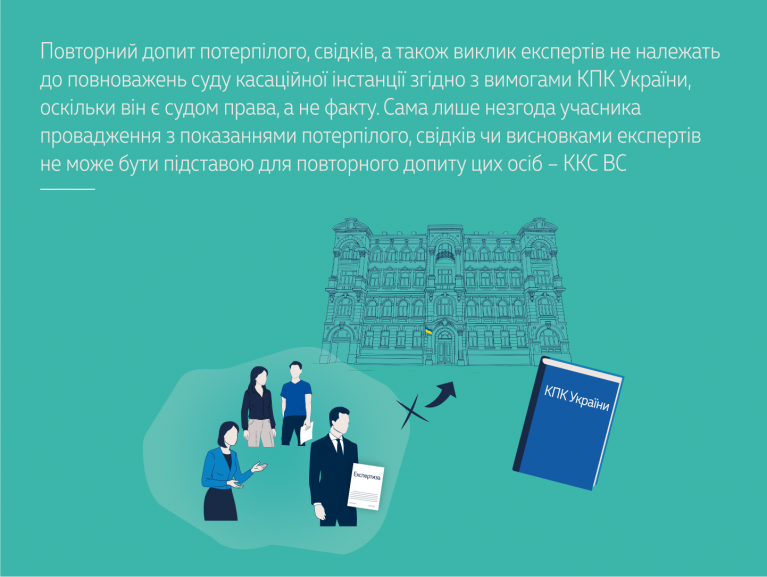
The repeated examination of the victim, witnesses, and the summons of experts do not fall within the powers of the court of cassation instance in accordance with the requirements of the CPC of Ukraine, since it is a court of law rather than of fact. Mere disagreement by a party to the proceedings with the testimony of the victim or witnesses or with the conclusions of experts cannot constitute grounds for the repeated examination of those persons.
In these criminal proceedings the courts of lower instances found the accused guilty and convicted her under Part 2 of Article 121 of the Criminal Code of Ukraine. In her cassation appeal the convicted person stated that the judgment of the local court was based on false testimony of witnesses and therefore insisted on the need to ensure the summons before the court of cassation instance of the experts, the victim and the witnesses for the purpose of conducting a repeated examination and confrontations.
Leaving the decisions of the courts of lower instances unchanged, the Supreme Court pointed out that, under the provisions of the CPC of Ukraine, the repeated examination of the victim and witnesses, as well as the summons of experts, is not mandatory if their testimony and conclusions have already been the subject of a full and comprehensive examination by the court and the applications submitted did not contain proper reasoning as to the existence of new material circumstances. Thus, pursuant to Article 356 of the CPC of Ukraine, an expert is summoned to a court hearing exclusively for the purpose of clarifying an existing conclusion. Procedural actions aimed at reviewing or refuting the results of an expert examination require the existence of well-founded doubts as to the expert’s qualifications or a breach of the examination procedure. Likewise, the repeated examination of the victim and witnesses is permissible only where it has become apparent during the trial that the person may give testimony concerning circumstances about which he or she was not previously examined (Part 14 of Article 352 and Part 2 of Article 353 of the CPC of Ukraine). The repeated examination of persons who have given clear and consistent testimony is contrary to the principles of reasonable time limits and the direct examination of evidence.
In these criminal proceedings the court of first instance fully and comprehensively examined both the testimony of the victim and the witnesses and the conclusions of the expert examinations. The latter are clear, exhaustive and categorical both as to the mechanism and causes of the victim’s death and as to other key circumstances of the case. Mere disagreement by a party to the proceedings with the testimony of the victim, witnesses or the conclusions of experts, and an unwillingness to accept the established facts, cannot constitute a legal ground for the repeated examination of persons or the summons of an expert. A reasoned refusal by the court to grant applications for the examination of experts or the repeated examination of the victim and witnesses does not amount to a restriction of procedural rights or a substantial violation of the requirements of Article 412 of the CPC of Ukraine, since the right to make an application does not mean that the court is obliged to grant any unsubstantiated request of a party.
In the light of the foregoing, the panel of judges of the Criminal Cassation Court of the Supreme Court rejected the demands of the convicted person’s cassation appeal for the summons before the court of cassation instance of the experts, the victim and the witnesses, because the court of cassation instance is a court of law rather than of fact, and the examination of those persons and the assessment of evidence do not fall within its powers under the procedural law.
Resolution of the Criminal Cassation Court of the Supreme Court of 17 August 2026 in case No. 373/1916/21 (proceedings No. 51-815км26) – https://reyestr.court.gov.ua/Review/139178137.
This and other legal opinions of the Supreme Court are available in the Database of Legal Positions of the Supreme Court - https://lpd.court.gov.ua.
_03_03.png)