Contact center of the Ukrainian Judiciary 044 207-35-46

On the occasion of the seventh anniversary of its establishment, the High Anti-Corruption Court held a conference entitled “7 Years of the HACC: Experience Gained and Strategic Challenges for the Future”, which brought together the judicial community, representatives of anti-corruption bodies, lawyers, academics and international experts. The discussion was also attended by President of the Supreme Court Stanislav Kravchenko, Vice President of the Criminal Cassation Court within the Supreme Court Nataliia Antoniuk and Judge of the Supreme Court in the Civil Cassation Court Yevhen Petrov.
Congratulating his colleagues on the anniversary, President of the Supreme Court Stanislav Kravchenko noted that the seven years of the HACC’s work – from the idea of creating a higher specialised court for the consideration of corruption and related criminal offences and its enshrinement in law to the stage of the institution’s full establishment – constitute a significant period. Ahead lies an equally complex stage of maturity and further improvement, since, in the view of the President of the Supreme Court, a court does not exist in isolation: it is part of society and must respond to changes in legislation and legal relations while, of course, adhering to the principles of the rule of law, legality and constitutional norms.
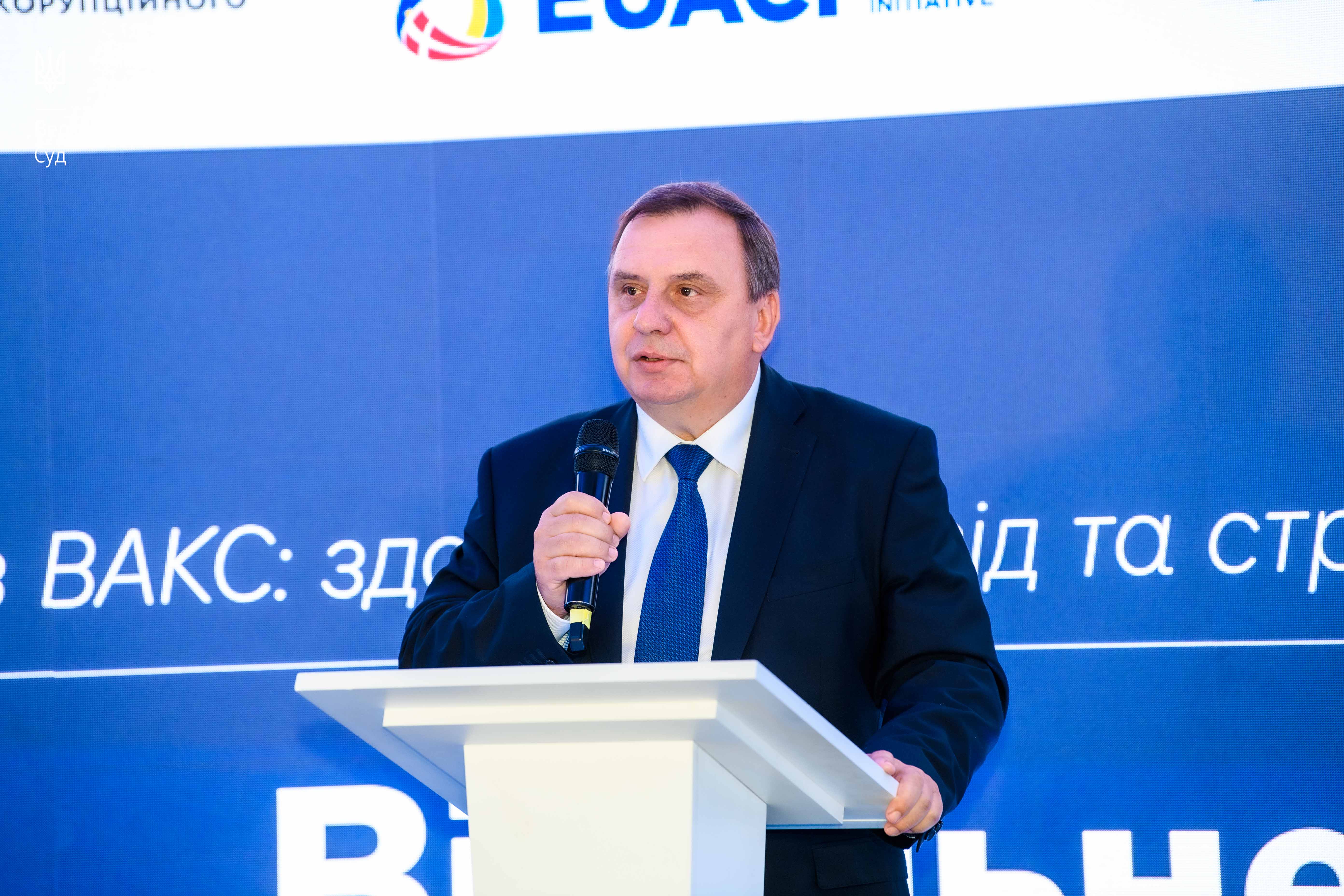
The effective work of the HACC over these years confirms that even under conditions of Russian armed aggression Ukraine’s legal system is not only developing but is also consistently following the path of reforms, upholding European values. National courts today continue to ensure legal stability in the state, and a significant role in this is played precisely by the High Anti-Corruption Court, because the fight against corruption is a priority in peacetime and, in wartime, it is also a matter of the security and resilience of the state, Stanislav Kravchenko emphasised.
The results of the High Anti-Corruption Court’s work over this period were presented by HACC Head Ihor Strohyi. Thus, over the course of seven years the court has delivered 431 judgments in criminal proceedings, 54 decisions in civil cases and 79 decisions in administrative cases, while investigating judges have considered more than 70,000 applications, complaints and requests. “Behind these figures and behind every decision stand human rights and freedoms, the responsibility of judges and the daily coordinated work of the entire court staff,” said the HACC Head.
As noted by Head of the High Council of Justice Hryhorii Usyk, the establishment of the High Anti-Corruption Court was an important step in reforming Ukraine’s judicial system and building a culture of zero tolerance for corruption. “Today we can state: the HACC has established itself as an institution. This is demonstrated by the results of its work. The uninterrupted functioning of the HACC is of great importance for the effective implementation of state policy in the field of combating corruption, ensuring the inevitability of punishment and fulfilling Ukraine’s European integration obligations,” Hryhorii Usyk is convinced.
.jpg)
Head of the European Integration, Governance and Rule of Law, Civil Society Section of the EU Delegation to Ukraine Asier Santillán emphasised that the establishment of the HACC seven years ago was one of the most important decisions in the sphere of combating corruption, and the results of that decision are visible today. At the same time, he added, anti-corruption reforms must continue to be implemented. And not only because the fulfilment of obligations under the negotiation chapters will bring Ukraine closer to membership of the European Union, but primarily because anti-corruption measures themselves constitute a contribution to Ukraine’s defence, to the improvement of the investment and business climate in the state, and to Ukraine’s post-war recovery.
Within the second discussion panel Nataliia Antoniuk and Yevhen Petrov discussed the prospects for increasing the efficiency of judicial proceedings.

According to Nataliia Antoniuk, over seven years the HACC has considered a significant number of complex corruption cases. Regarding the criteria for determining the effectiveness of the work of criminal justice in combating corruption, the Vice President of the Criminal Cassation Court of the Supreme Court distinguished two aspects: effectiveness from the perspective of the present day and effectiveness in the perspective of the future. At present Ukraine has a significant number of corruption proceedings, which means that instances of corruption are not being hushed up but are being exposed, and the fight against this phenomenon continues. However, looking to the future, an indicator of the effective work of criminal justice, in Nataliia Antoniuk’s view, will be a shift of focus towards the prevention of such crimes.
Speaking about safeguards against the abuse of procedural rights by the parties during judicial proceedings, the speaker emphasised the need for a common understanding by all parties of the purpose for which the Criminal Procedure Code of Ukraine grants certain rights and guarantees to the participants. Procedural abuses lead to protracted judicial proceedings, which complicates the possibility of considering cases within a reasonable time.

Yevhen Petrov spoke about the specific features of applying the procedure of civil confiscation. As he explained, the appearance of the institution of civil confiscation (the recognition of assets as unjustified and their recovery into state revenue) in private law has raised many questions, since this institution is more characteristic of public law.
A particular problem is that the recognition of assets as unjustified is based on the principle in rem (against the thing), under which the process is directed against the property (assets) rather than against a specific person. In a situation where a claim has been brought against a special subject who may be a defendant under the law, and such a special subject dies during the consideration of the case, a conflict arises between the principle of civil confiscation in rem (against the thing) and the general institution of succession, according to which an inheritance cannot be accepted in part.
In addition, Yevhen Petrov noted the need already today to reflect on the issue of recognising digital assets as unjustified and on the possibility of the real enforcement of court decisions in such cases.
Overall, the judge observed, a great many issues in the sphere of civil confiscation in private law require joint resolution through dialogue between judges of all instances and the legislator.
A video recording of the event is available at the following link – https://www.youtube.com/watch?v=e3ZWfT847gU.
_03_03.png)