Contact center of the Ukrainian Judiciary 044 207-35-46
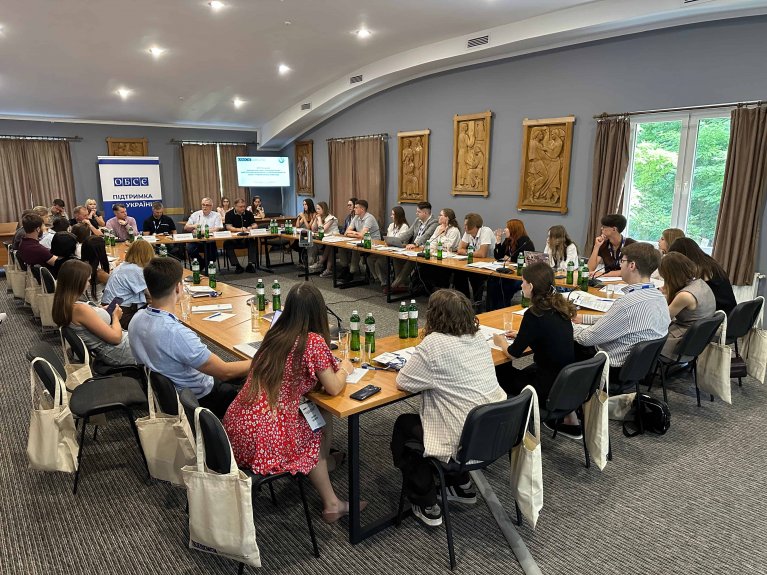
Judge of the Supreme Court in the Administrative Cassation Court Albert Yezerov and Judge of the Supreme Court in the Civil Cassation Court Dmytro Hudyma took part in the work of the 14th Summer School “The Rule of Law and Constitutionalism”, dedicated to issues of the functioning of constitutional democracy in conditions of war, social protection and the protection of the rights of servicemen and women.
Among the lecturers of the Summer School were also judges of the Constitutional Court of Ukraine, representatives of the European Court of Human Rights, experts from international organisations, judges of foreign constitutional courts, leading domestic and foreign scholars, and practising lawyers.
The academic programme covered the following thematic areas:
.jpg)
Judge of the Supreme Court in the Administrative Cassation Court Albert Yezerov delivered a lecture entitled “The Application of the Constitution in the Administration of Justice”.
The speaker drew attention to the phenomenon of the Constitution as a system of fundamental values designed to limit the arbitrariness of public authority in order to guarantee human rights. When applying rules of law, including constitutional ones, the courts ensure a living link between social relations and legal norms.
Pursuant to Article 8 of the Constitution of Ukraine, its provisions have direct effect. This guarantees everyone the right to apply to a court for the protection of their rights and freedoms directly on the basis of the Basic Law.
The lecturer cited the main instances of the direct effect of constitutional norms:
The speaker also drew attention to the criteria for the application by a court of the direct effect of the Constitution:
Within the framework of the lecture the judge analysed the current case law of the Supreme Court on the application of the provisions of the Constitution of Ukraine.
Particular attention was paid to the question of the review of judicial decisions on exceptional grounds. In particular, the grounds for such a review are the unconstitutionality (constitutionality) of a law, another legal act or a separate provision thereof, as established by the Constitutional Court of Ukraine, that was applied (or not applied) by the court when deciding the case, provided that the judicial decision has not yet been enforced.
The speaker also dwelt in detail on the consequences of declaring laws unconstitutional.
Albert Yezerov’s presentation is available at the following link: https://court.gov.ua/storage/portal/supreme/prezent2026/Prezent_Zastos_Konst_zdiisn_pravos.pdf.
In addition, Albert Yezerov delivered a lecture on the topic “The Development of the Doctrine of Enhanced Social Protection of Servicemen and Women in the Administration of Justice”.
The judge explained that the doctrine is based on the key Decision of the Constitutional Court of Ukraine of 6 April 2022 No. 1-r(II)/2022 on the enhanced social protection of servicemen and women. As the speaker noted, the Supreme Court acts as an effective conduit of this constitutional doctrine. In particular, the legal position of the Constitutional Court of Ukraine has been transformed from an instrument for resolving a specific case into a general constitutional principle of direct effect.
The Supreme Court applies the doctrine systematically: from procedural guarantees (Part 4 of Article 7 of the Code of Administrative Procedure of Ukraine) to the profound substantive content of the concept of “enhanced social protection”. An important trend is the expansion of the scope of its application beyond the original context — to issues of pension provision, the status of war veterans and the calculation of time-limits for applying to a court. Judicial practice demonstrates the unity of approaches at all levels: from panels of judges and the Judicial Chamber for the Protection of Social Rights to the Grand Chamber of the Supreme Court.
Further details are available in Albert Yezerov’s presentation at the following link: https://court.gov.ua/storage/portal/supreme/prezent2026/Prezent_Doktr_posul_sotc_zahust.pdf.
.jpg)
Judge of the Supreme Court in the Civil Cassation Court Dmytro Hudyma delivered a report on the topic “Certain Aspects of the Application of the Constitution of Ukraine in the Case Law of the Supreme Court (in the Light of the Protection of Social Rights and the Rights of Servicemen and Women)”.
At the outset the speaker outlined the following procedural problems in the interaction between the Supreme Court and the Constitutional Court of Ukraine:
- the “competition” of the powers of the Constitutional Court of Ukraine and the ordinary courts regarding the assessment of the constitutionality of the provisions of certain acts (the powers of the Constitutional Court of Ukraine relate to the list of acts that it may assess for constitutionality, whereas the corresponding powers of the ordinary courts are not subject to such a limitation);
- the interpretation of the provisions of current legislation and of the Constitution of Ukraine in the activity of the Supreme Court and the Constitutional Court of Ukraine (when assessing the constitutionality of certain acts, the Constitutional Court of Ukraine interprets the provisions both of the Constitution of Ukraine and of the relevant legislative acts);
- the ineffective mechanism for the enforcement of decisions of the Constitutional Court of Ukraine (during the consideration of cases by the ordinary courts and in the special procedure for the review of judicial decisions on exceptional grounds);
- the limits of the argumentation of constitutional complaints and of their consideration (the arguments of such complaints must not go beyond the arguments advanced in the ordinary courts, and the reasoning of the Constitutional Court of Ukraine must not go beyond the arguments of the constitutional complaints).
Speaking of the steps taken by the Constitutional Court of Ukraine to overcome certain shortcomings in such interaction, the judge drew attention to the Court’s Decision of 22 June 2022 No. 6-r(II)/2022 (case No. 3-188/2020(455/20)). In that Decision it is emphasised that ensuring the stability and unity of case law is a fundamental function of the Supreme Court, which cannot be performed by any other body of state power, including the Constitutional Court of Ukraine (paragraph 4 of point 8 of the reasoning part of the Decision).
With a view to eliminating certain problems in the interaction between the Supreme Court and the Constitutional Court of Ukraine, the Civil Cassation Court of the Supreme Court, in its resolution of 17 January 2025 in cases Nos. 343/1869/23 and 616/458/21, indicated that, in accordance with the requirements of Part 6 of Article 10 of the Civil Procedure Code of Ukraine, a court shall not apply a law or other legal act that is contrary to the Constitution of Ukraine, but shall apply the latter’s provisions as norms of direct effect, irrespective of the existence (or absence) of a decision of the Constitutional Court of Ukraine on the unconstitutionality of such a law or other legal act, of the stage of the proceedings, and of the moment at which the disputed legal relations arose.
Dmytro Hudyma noted that in the conditions of full-scale war the problems of the consideration of family disputes involving servicemen and women concerning the dissolution of marriage, the recovery of child maintenance, the deprivation of parental rights, the determination of a child’s place of residence, and so forth, have become significantly more acute.
In particular, the question arose as to whether paragraph 2 of Part 1 of Article 251 of the Civil Procedure Code of Ukraine is contrary to the provisions of Articles 8, 51 and 55 of the Constitution of Ukraine. By way of illustration the lecturer analysed the practice of applying this provision of the Civil Procedure Code of Ukraine in “children’s cases”, drawing attention to the following judicial decisions:
In addition, the judge provided practical recommendations and conducted a session on the drafting of legal texts.
Dmytro Hudyma’s presentation is available at the following link: https://court.gov.ua/storage/portal/supreme/prezent2026/Prezent_Zastos_Konst_prakt_VS.pdf.
The event was organised within the framework of a project of the OSCE Support Programme for Ukraine jointly with the Constitutional Court of Ukraine.
.jpg)
_03_03.png)