Contact center of the Ukrainian Judiciary 044 207-35-46
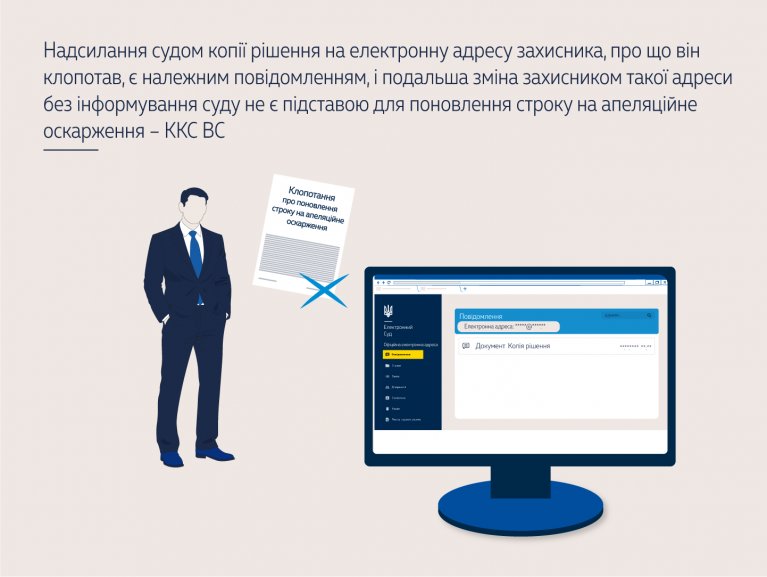
In these criminal proceedings the local court refused to grant the submission of a penal colony concerning the replacement of the unserved part of the term of punishment with a milder one in respect of the convicted person. Disagreeing with the said decision, the defence counsel challenged it by way of appeal. The appellate court refused to grant the defence counsel’s application, lodged in the interests of the convicted person, for the renewal of the time-limit for appealing against that ruling, and returned the appeal together with the accompanying materials to the defence counsel. In the cassation appeal the defence counsel asserted that the local court had not sent a copy of the contested decision to the defence. He stated that he had obtained access to the case materials through the “Electronic Court” subsystem on 13 March 2026, and that therefore the missing of the time-limit for lodging an appeal had been caused by valid reasons.
Leaving the ruling of the appellate court unchanged, the Supreme Court indicated that persons taking part in a case are under a general duty to exercise their procedural rights and to perform their procedural duties in good faith; abuse of procedural rights is not permitted. The Criminal Procedure Code of Ukraine regulates certain issues of communication between the court and the participants in criminal proceedings by means of the Unified Judicial Information and Telecommunication System (part 2 of Article 35, part 1 of Article 135, part 1 of Article 136 of the CPC of Ukraine) and of electronic mail (part 2 of Article 136 of the CPC of Ukraine). These concern the procedure for the sending of copies of materials of criminal proceedings, complaints, applications, petitions and other procedural documents provided for by law that are submitted to the court and may be the subject of judicial consideration, as well as the procedure for effecting a summons in criminal proceedings, and in certain cases defined by the said legal provisions — only upon a written application of the person.
The panel of judges of the Criminal Cassation Court of the Supreme Court observed that an advocate’s application to the court requesting that a copy of the decision be sent to his e-mail address places upon that person the duty to receive the corresponding notifications; consequently, a court that communicates with a participant in the case by means of the means of communication indicated by him acts lawfully and in good faith.
It is apparent from the materials of the proceedings that the local court sent a copy of the contested decision to the defence counsel’s e-mail address (which he had requested), and therefore his reference to a change of his work address as a ground for the renewal of the time-limit for lodging an appeal is unfounded. Accordingly, as a result of the consideration of the said application for the renewal of the time-limit for lodging an appeal, the appellate court reached a well-founded conclusion that there were no valid reasons for missing that time-limit, given the absence of circumstances that would indicate the objective nature of such reasons.
Resolution of the Criminal Cassation Court of the Supreme Court of 19 August 2026 in case No. 766/9946/21 (proceedings No. 51-1517км26) – https://reyestr.court.gov.ua/Review/139206646.
This and other legal positions of the Supreme Court can be found in the Database of Legal Positions of the Supreme Court - https://lpd.court.gov.ua.
_03_03.png)