Contact center of the Ukrainian Judiciary 044 207-35-46
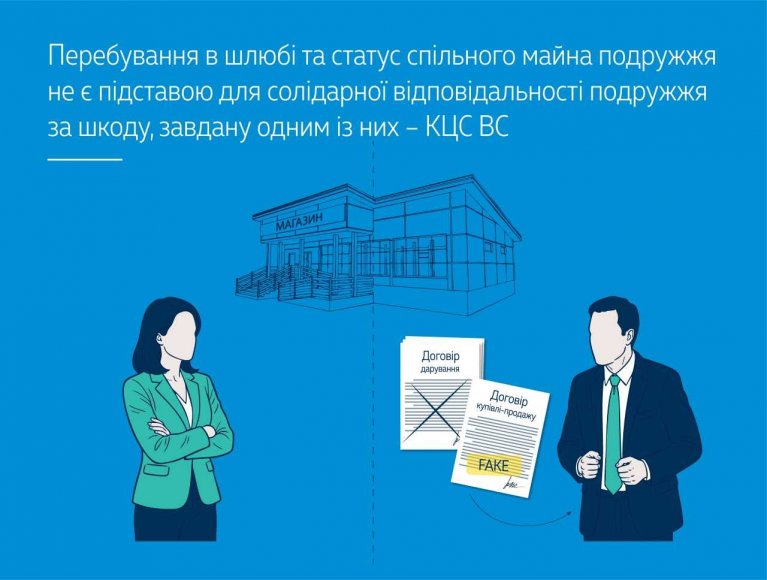
In order to impose joint and several liability on spouses for damage caused (lost profits), it is necessary to establish that the damage was inflicted by the joint actions or omissions of both of them. The mere fact of being married, the joint status of the property or one spouse’s awareness of the other’s actions do not demonstrate the existence of a common intent and do not constitute grounds for joint and several compensation for the damage.
This conclusion was reached by the Supreme Court, sitting as a panel of judges of the First Judicial Chamber of the Civil Cassation Court.
In the case under review, the claimants applied to the court seeking the joint and several recovery of damages (lost profits) from the spouses. The dispute arose because the defendant, on the basis of a knowingly forged sale and purchase agreement, unlawfully acquired ownership of a shop building belonging to the claimants and for 13 years exercised the powers of an owner, receiving income from its lease. The husband’s guilt in committing a criminal offence related to the use of a forged document was established by a court judgment.
After the court decision recognising his ownership of the shop was set aside on the basis of newly discovered circumstances, the defendant entered into a series of gift agreements in favour of his wife and son in respect of immovable property. The claimants regarded these transactions as fraudulent, that is, concluded with the aim of concealing the property from possible enforcement.
The court of first instance partially granted the claim. It recovered the damages only from the husband and declared the gift agreements invalid. The appellate court varied the decision and imposed the obligation to compensate the damages jointly and severally on the spouses, reasoning that the disputed property was in their joint ownership and generated income for the family.
The Civil Cassation Court of the Supreme Court quashed the appellate court’s ruling in the part concerning the joint and several recovery of damages from the wife and upheld the district court’s decision in that part, making the following legal findings.
Pursuant to Article 15 of the Civil Code of Ukraine, every person has the right to protection of their civil rights in the event of their violation, non-recognition, or contestation.
The object of protection is a violated, unrecognised or contested right or civil interest. Violation of a right is linked to the deprivation of its holder of the possibility to exercise (realise) their right fully or partially. In the case of contestation or non-recognition of a right, uncertainty arises in the right, caused by the conduct of another person.
Part 1 of Article 1166 of the Civil Code of Ukraine provides that property damage caused by unlawful decisions, actions or omissions to the personal non-property rights of a natural or legal person, as well as damage caused to the property of a natural or legal person, shall be compensated in full by the person who caused it.
For the application of such a measure of liability as the recovery of damages in the form of lost profits, the presence of all the elements of a civil (commercial) offence is required: 1) the unlawful conduct of the person (debtor); 2) the damages caused by such person; 3) the causal link between the person’s unlawful conduct and the damages; 4) the fault of the person who caused the damages, including the establishment of the measures taken by the creditor to obtain such profit. In the absence of one of the elements of a civil offence, liability for compensation of damages in the form of lost profits does not arise.
The presumption of a person’s fault may be rebutted only on condition that it is established that the damages were caused precisely as a result of the actions or omissions of a specific person. Therefore, only upon the establishment of the specific person who caused the damages does the distribution of the burden of proof occur: a) the claimant must prove the existence of the damages and the causal link; b) the defendant proves the absence of unlawfulness and fault.
The Civil Cassation Court of the Supreme Court noted that pursuant to Article 1190 of the Civil Code of Ukraine, persons by whose joint actions or omissions damage was caused shall bear joint and several liability towards the victim.
The unlawful acquisition of immovable property by means of a forged document was committed by the husband. Evidence that his wife participated in such actions, shared with him a common intent to cause damage to the claimants, or by her actions contributed to its occurrence, was neither submitted to the court nor established.
The mere fact that the property was in the spouses’ joint ownership, the wife’s awareness of its existence or the declaration of such property do not demonstrate that she committed unlawful acts and do not confirm the existence of a causal link between her conduct and the damages caused to the claimants.
At the same time, the Civil Cassation Court of the Supreme Court agreed with the courts’ conclusions regarding the invalidity of the gift agreements in respect of the immovable property. Their conclusion in favour of close relatives after the dispute had arisen and in circumstances where a prohibition on the alienation of the property existed testified to the defendant’s bad faith and to the purpose of the transactions being to avoid the performance of obligations.
Summarising the foregoing, the Civil Cassation Court of the Supreme Court concluded that in order to impose on both spouses a joint and several obligation to compensate for the damage, the mere fact of being married or of the property belonging to them under the right of joint ownership is insufficient. It is necessary to prove the joint nature of their unlawful actions and the causal link between the actions of each of them and the damage caused.
Resolution of the Civil Cassation Court of the Supreme Court of 22 July 2026 in case No. 464/5457/21 (proceedings No. 61-6200св26) – https://reyestr.court.gov.ua/Review/138464485.
This and other legal positions of the Supreme Court can be found in the Database of Legal Positions of the Supreme Court - https://lpd.court.gov.ua.
_03_03.png)