Contact center of the Ukrainian Judiciary 044 207-35-46
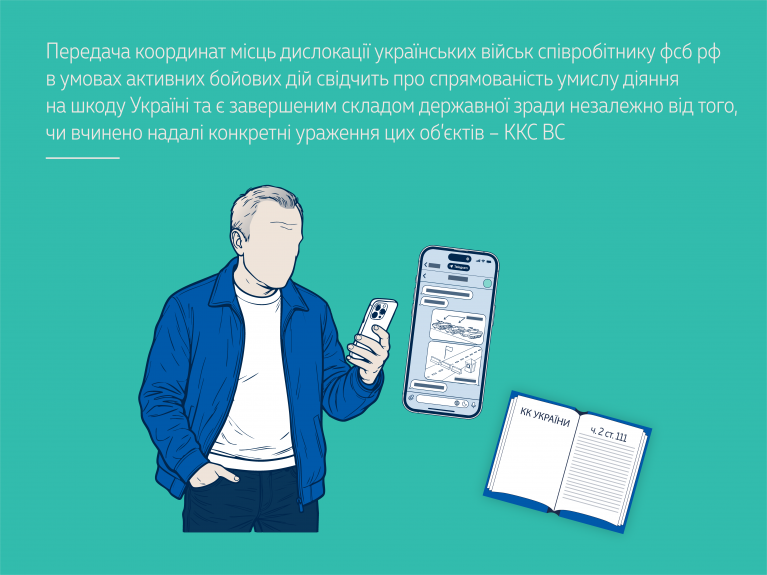
The transmission of coordinates of the locations of Ukrainian troops to an FSB officer of the Russian Federation in conditions of active hostilities demonstrates that the intent of the act was directed against Ukraine and constitutes a completed offence of high treason irrespective of whether specific strikes against those objects were subsequently carried out.
In this criminal proceeding the courts of previous instances found the accused guilty and convicted him under part 2 of Article 111 of the Criminal Code of Ukraine, as he had voluntarily agreed to provide an FSB officer of the Russian Federation with assistance in conducting subversive activities against Ukraine by supplying him with information concerning the locations of units and military equipment of the Armed Forces of Ukraine and other military formations established in accordance with the laws of Ukraine. In the cassation appeal the defence counsel considered that the form and type of fault and the causal link between the accused’s actions and the damage caused by such actions to the sovereignty, territorial integrity and inviolability, defence capability, state, economic or information security of Ukraine had not been established.
The Supreme Court, upholding the decisions of the courts of previous instances, drew attention to the fact that the offence charged against the accused under part 2 of Article 111 of the Criminal Code of Ukraine belongs to criminal offences with a formal corpus delicti, the objective side of which is exhausted by the socially dangerous act provided for in the law. The determining condition for the criminalisation of this offence is the social danger of the act itself specified in the disposition of the criminal-law provision, the mere commission of which causes harm to the object of criminal-law protection and is a sufficient ground for bringing a person to criminal liability within the meaning of the prescriptions of part 1 of Article 2 of the Criminal Code of Ukraine and part 2 of Article 111 of this Code. The legislative construction of the corpus delicti of the said offence does not require the establishment of a causal link, since the mere fact of the intentional commission by a citizen of Ukraine, under martial law, of an act to the detriment of the sovereignty, territorial integrity and inviolability, defence capability, state, economic or information security of Ukraine in the form of providing a foreign state, foreign organisation or their representatives with assistance in conducting subversive activities against Ukraine is sufficient for the qualification of such actions under part 2 of Article 111 of the Criminal Code of Ukraine.
As the appellate court justifiably noted, the mere fact of the voluntary transmission of the coordinates of the locations of Ukrainian troops to a permanent staff member of the FSB of the Russian Federation in conditions of active hostilities demonstrates that the act was directed against the state and constitutes a completed offence of high treason irrespective of whether specific acts of striking those objects were subsequently committed or not. The Supreme Court also takes into account that the striking of the aforementioned objects within the meaning of Article 67 of the Criminal Code of Ukraine could have influenced the imposition of the penalty and other criminal-law consequences of the act committed; however, such circumstances are not referred to in this case as specific consequences of the acts committed by the convicted person.
Resolution of the Criminal Cassation Court of the Supreme Court of 16 July 2026 in case No. 334/10515/24 (proceedings No. 51-732км26) – https://reyestr.court.gov.ua/Review/138363152.
This and other legal positions of the Supreme Court can be found in the Database of Legal Positions of the Supreme Court - https://lpd.court.gov.ua.
_03_03.png)