Contact center of the Ukrainian Judiciary 044 207-35-46
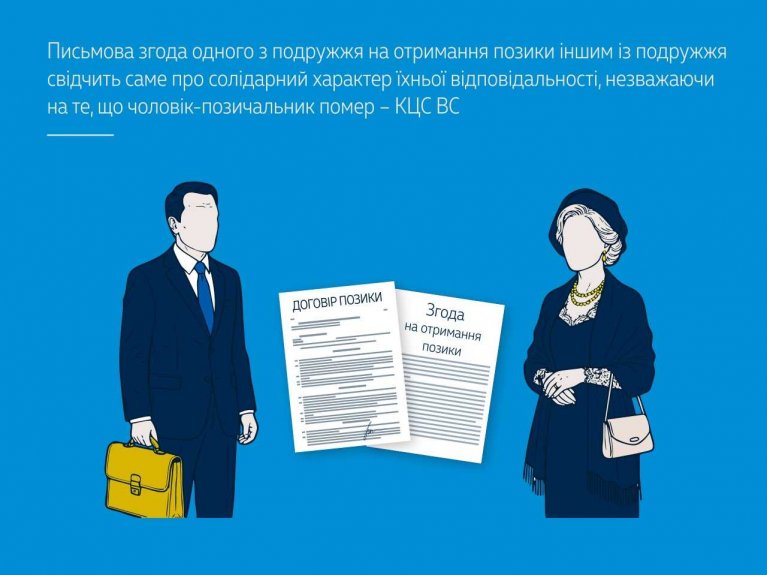
A loan agreement concluded by one of the spouses in the interests of the family creates obligations for the other spouse if the property obtained under the agreement was used in the interests of the family. The existence of a notarised consent form from the wife authorising her husband to borrow money confirms the presumption that the spouses have common interests and gives rise to joint and several liability for the repayment of the debt, even in the event of the principal borrower’s death.
These conclusions were reached by the Supreme Court in the panel of judges of the First Judicial Chamber of the Civil Cassation Court.
In the case under review, the claimant brought a claim against the wife of the deceased debtor seeking recovery of the outstanding debt under a loan agreement. The claim was based on the fact that the husband had received the funds with the written and notarised consent of the defendant, had failed to repay them, and that she was therefore a jointly and severally liable debtor.
The court of first instance dismissed the claim, holding that the agreement had not been concluded in the interests of the family, since the wife had given her consent to her husband receiving the money on terms and at his discretion. The appellate court, however, set aside that decision and allowed the claim, on the ground that the defendant had failed to rebut the presumption that the funds had been used in the interests of the family.
The Civil Cassation Court of the Supreme Court agreed with the conclusions of the appellate court, dismissed the defendant’s cassation appeal, and formulated the following legal conclusions.
Pursuant to Part 1 of Article 1046 of the Civil Code of Ukraine, under a loan agreement one party (the lender) transfers into the ownership of the other party (the borrower) money or other fungible things, and the borrower undertakes to return to the lender the same sum of money (the loan amount) or the same quantity of things of the same kind and quality.
In accordance with Part 1 of Article 36 of the Family Code of Ukraine, marriage is the basis for the emergence of the rights and obligations of the spouses.
At the same time, the nature of family relations does not always make it possible to establish unequivocally when one of the spouses is acting in his or her own interests and when in the interests of the family. It is precisely for this reason that the legislation establishes a presumption of the common interests of the spouses and the family (Article 60 of the Family Code of Ukraine).
This presumption may be rebutted in court. At the same time, the burden of proving that the funds received were not used in the interests of the family (that is, of rebutting the presumption) rests upon the spouse who contests the joint character of the obligation.
The defendant provided written notarially certified consent to her husband obtaining the loan, yet failed to prove that the funds had been used otherwise than in the interests of the family. She is therefore a joint and several debtor under the obligation to repay the loan.
Pursuant to Part 5 of Article 543 of the Civil Code of Ukraine, the liquidation of a joint and several debtor that is a legal person, or the death of a joint and several debtor who is a natural person, does not terminate the obligation of the remaining joint and several debtors towards the creditor and does not alter its scope or the conditions of its performance.
The Civil Cassation Court of the Supreme Court also drew attention to the legal consequences of the death of one of the joint and several debtors, noting that the death of the borrower-husband did not terminate the defendant’s obligation towards the creditor, since her liability arose not as a result of accepting an inheritance but directly from the joint and several nature of the spouses’ obligation.
Moreover, the statement in the notarially certified consent that the funds were received by the husband on terms and at his discretion does not, of itself, indicate that he acquired a personal right to those funds. Such a condition relates to the borrower’s ability to determine independently the manner of performance of the agreement, but does not rebut the presumption that the loan was used in the interests of the family.
In summary, the Civil Cassation Court of the Supreme Court concluded that a person who has given consent to the other spouse obtaining a substantial sum of money by way of loan must be aware of the legal consequences of the emergence of a joint and several obligation. Where it has not been proved that the funds were used otherwise than in the interests of the family, the duty to repay them rests upon both spouses.
Resolution of the Civil Cassation Court of the Supreme Court of 22 July 2026 in case No. 757/1863/25-ц (proceedings No. 61-859св26) – https://reyestr.court.gov.ua/Review/138464514.
This and other legal positions of the Supreme Court can be found in the Database of Legal Positions of the Supreme Court - https://lpd.court.gov.ua.
_03_03.png)