Contact center of the Ukrainian Judiciary 044 207-35-46
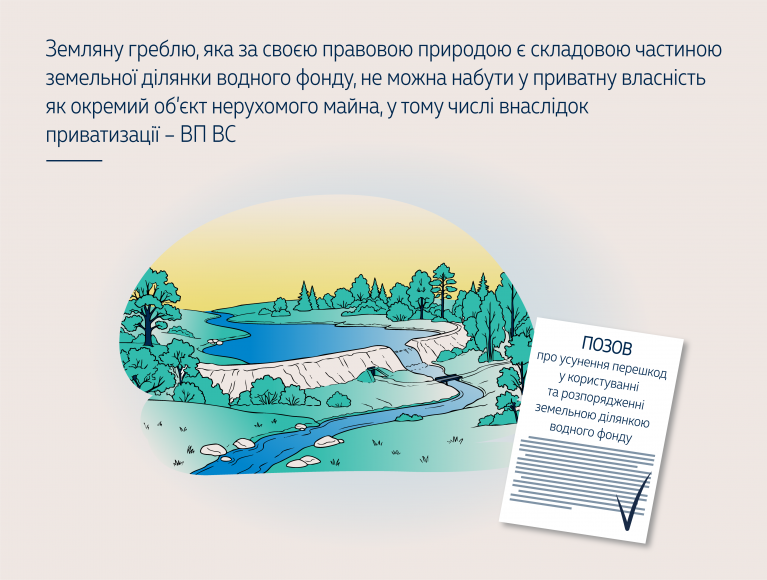
The transfer of an earthen dam into private ownership separately from the water fund land plot of which it forms an integral part cannot be effected, given that an earthen dam is not a separate object of civil circulation.
In order to protect the territorial community’s right of ownership of a water fund land plot, which was infringed as a result of the registration in the State Register of an object that by force of law could not be registered, it is necessary to restore the position that existed prior to the infringement. The cancellation of the state registration of the right of ownership of an integral part of a water fund land plot – a hydraulic engineering structure – with the closure of the relevant section of the State Register mediates the restoration of the position that existed prior to the infringement. This corresponds to the method of protection provided for by paragraph 4 of part 2 of Article 16 of the Civil Code of Ukraine.
These conclusions were made by the Grand Chamber of the Supreme Court.
In the case under consideration the prosecutor brought a claim in the interests of the state seeking the removal of obstacles to the owner – the territorial community – in the use and disposal of a communal property object by recognising as invalid and cancelling the decisions of the village council, recognising as invalid the results of an electronic auction, recognising as invalid the contract of sale and purchase, and compelling the return of the earthen dam (hydraulic engineering structure).
The court of first instance partially granted the claim, recognising as unlawful and cancelling the decision of the village council; recognising as invalid the contract of sale and purchase and compelling the return of the hydraulic engineering structure into the ownership of the village council. The court’s decision was reasoned, inter alia, by the fact that the disputed hydraulic structure, having regard to Articles 181–187 of the Civil Code of Ukraine, is inseparably linked to the water body, constitutes an accessory of the water body (i.e. the principal thing) and, taking into account the specific nature of water resources, cannot be separated from the water body and therefore cannot be a separate object of the right of ownership.
The appellate court, while setting aside the decision of the court of first instance in the part granting the claim, emphasised that the prosecutor had chosen an improper method of protection. The court indicated that the proper method of protecting the territorial community’s right in this case is a vindication claim for the recovery of property from the defendant’s possession.
In reviewing the case, the Grand Chamber of the Supreme Court noted that water bodies are in close physical and legal interrelationship with the lands of the water fund, since the existence and proper functioning of water bodies is impossible without the lands on which they are situated.
Since an earthen dam as a hydraulic engineering structure is inseparably linked to the land plot, and its relocation to another place is impossible without damage, depreciation and change of purpose, such an earthen dam together with the water body (water management system) constitutes an integral part of a water fund land plot.
Consequently, an earthen dam as an integral part of a water fund land plot cannot be regarded as an independent object of the right of ownership that may lawfully leave state or communal ownership and pass into private ownership, including by way of privatisation.
The Grand Chamber of the Supreme Court reiterated its consistent conclusion that the transfer of water fund lands into private ownership is impossible, save for the gratuitous transfer into ownership solely of enclosed natural water bodies with a total area of up to 3 ha (part 2 of Article 59 of the Land Code of Ukraine). State registration of this right does not change the holder of the relevant object – the state or the territorial community. In the present case it was established that the water body (pond) formed by the earthen dam does not belong to enclosed natural water bodies and therefore does not fall within the exception established by part 2 of Article 59 of the Land Code of Ukraine.
The Grand Chamber of the Supreme Court also observed that in legal relations concerning an object the right of ownership of which belongs to the state or a territorial community, and which by the prescriptions of the law cannot be transferred into private ownership, judicial practice proceeds on the basis that neither the state registration of the right of private ownership in favour of the infringer nor the actual occupation of such an object by him results in his acquisition of possession, since the right of private ownership of it cannot arise under any circumstances.
In this case what is involved is not the loss of possession in the proprietary-law sense, but the creation of obstacles to the exercise of the powers of the owner – the state or the territorial community. Therefore a vindication claim, which provides for the return of property from another person’s unlawful possession, cannot be applied in such disputes.
Since in the present case the infringement of the rights of the territorial community as owner of the water fund land plot consisted in the creation of obstacles to it in the use and disposal of that land plot and was occasioned by the existence in the State Register of an entry of the right of ownership of its integral part – the earthen dam (hydraulic engineering structure) – the Grand Chamber of the Supreme Court concluded that a lawful and effective method of protecting the rights of the territorial community is a claim for the removal of obstacles to the use and disposal of the water fund land plot by cancelling the state registration of the right of ownership of its integral part – the hydraulic engineering structure – with the closure of the relevant section of the State Register.
Having regard to the foregoing, the Grand Chamber of the Supreme Court in the present case agreed with the conclusions of the appellate court that the claims for recognition of the contract of sale and purchase as invalid and for the return of the hydraulic engineering structure were not subject to satisfaction, but recognised as erroneous the reasons for the refusal to grant them.
Thus the Grand Chamber of the Supreme Court varied the resolution of the court of appeal by restating its reasoning part in the wording of its own resolution, and in the remaining part left it unchanged.
Resolution of the Grand Chamber of the Supreme Court of 15 July 2026 in case No. 915/268/24 – https://reyestr.court.gov.ua/Review/138916247
This and other legal positions of the Supreme Court can be found in the Database of Legal Positions of the Supreme Court - https://lpd.court.gov.ua.
_03_03.png)