Contact center of the Ukrainian Judiciary 044 207-35-46
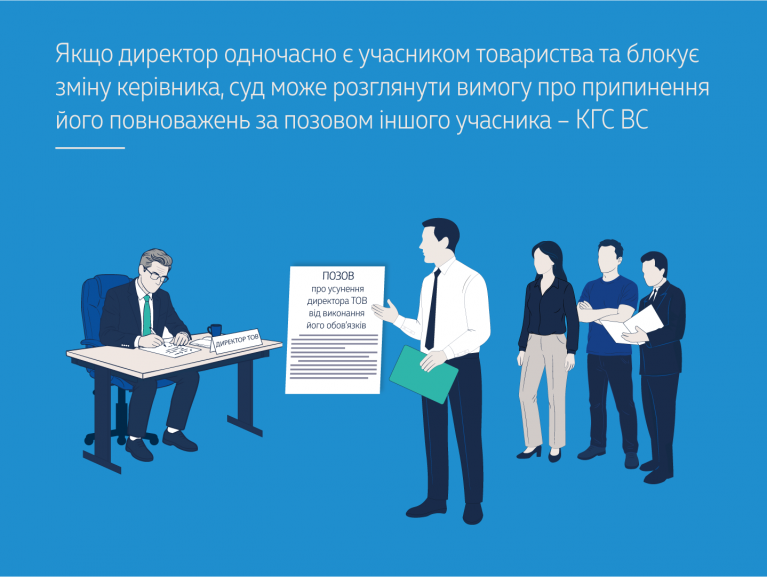
A participant in a company who holds 50 % of the authorised capital may apply to the court with a claim for the termination of the powers of the director if the director is at the same time another participant in the company with a 50 % share, has for a prolonged period failed to perform his duties, has in fact blocked the company’s activities, and the participant has exhausted the corporate mechanisms for changing the director that are provided by law, which has not made it possible to resolve the matter out of court. In such circumstances a claim for the termination of the director’s powers, together with a claim for the determination of a person who will temporarily perform his powers, may constitute a proper and effective means of protecting the participant’s corporate rights.
This conclusion was reached by a panel of judges of the Commercial Cassation Court within the Supreme Court.
A participant in an LLC who holds 50 % of the authorised capital applied to the court with a claim against the director of the LLC, who is also a participant in it with a 50 % share of the authorised capital, seeking the removal of the latter from the performance of the duties of director of the company, the temporary recognition of the claimant as acting director, and the making of the corresponding amendments to the Unified State Register. The claim was based on the fact that the company’s activities had in fact been blocked as a result of the director’s inactivity, in that he had for a prolonged period failed to perform his duties, had created debts and had ignored the requirements of the articles of association and of the law. The claimant also stated that the defendant was in custody and was charged with the commission of a number of criminal offences. The defendant took no part in the consideration of the case; the case materials contained only his application denying the jurisdiction of the Ukrainian courts and the legislation of Ukraine.
The commercial court, with whose decision the appellate court agreed, dismissed the claim on the ground that questions of the removal of a director and the appointment of a new director fall within the exclusive competence of the general meeting of the company, and that the claim had been brought against an improper defendant – the director instead of the LLC.
On reviewing the case, the Supreme Court noted that the courts of the previous instances had failed to take into account the specific nature of the disputed legal relations, had not given proper assessment to the claimant’s arguments concerning the exhaustion of the possibility of changing the director out of court, and had not taken into account the legal position of the Grand Chamber of the Supreme Court concerning the possibility of the judicial termination of a director’s powers where this question cannot be resolved by convening a general meeting.
The panel of judges emphasised that where the shares are divided between two participants in a 50/50 ratio, prolonged blocking of the holding of a general meeting may indicate not only a breach of the participant’s corporate rights but also an actual restriction of his right of ownership of the share in the authorised capital. At the same time, the termination of the powers of a director who is simultaneously the other participant in the company with a 50 % share does not infringe his right of ownership; on the contrary, it secures the protection of the rights of the other participant and of the interests of the company.
The Commercial Cassation Court of the Supreme Court also drew attention to the fact that in conditions of martial law situations may arise in which the director has in fact ceased relations with the company, while it is also impossible to hold a general meeting in order to replace him. In such circumstances a claim for the termination of the director’s powers may constitute a proper and effective means of protection. At the same time the company cannot remain without an executive body, and therefore such a claim must be combined with a claim for the appointment of a new director or of a person who will temporarily perform his duties.
In addition, the Court noted that the conclusion of the courts concerning an improper defendant in the circumstances of this case is a manifestation of excessive formalism which does not contribute to the real resolution of the dispute and is contrary to the tasks of commercial proceedings.
As a result of the cassation review the Commercial Cassation Court of the Supreme Court partially allowed the cassation appeal, set aside the decisions of the courts of the previous instances and remitted the case for a new consideration to the court of first instance.
Resolution of the Commercial Cassation Court of the Supreme Court of 8 July 2026 in case No. 904/2253/24 – https://reyestr.court.gov.ua/Review/138261818.
This and other legal positions of the Supreme Court can be found in the Database of Legal Positions of the Supreme Court - https://lpd.court.gov.ua.
_03_03.png)