Contact center of the Ukrainian Judiciary 044 207-35-46
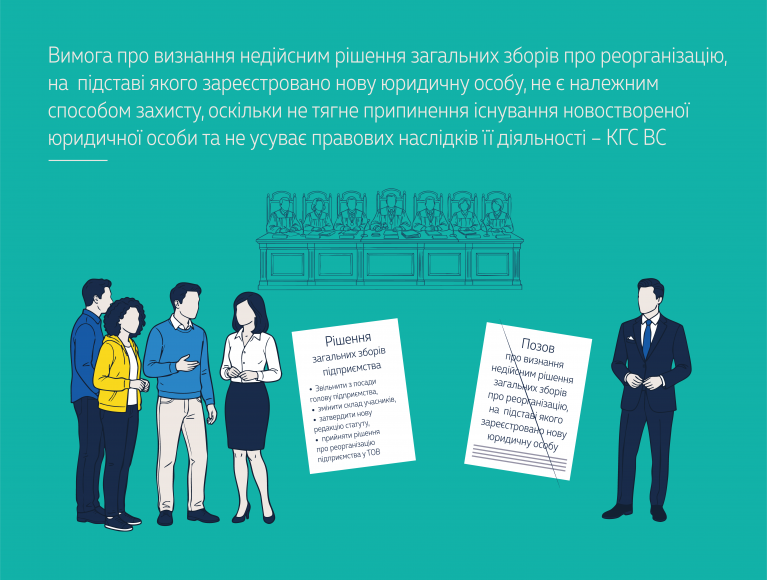
A claim seeking the invalidation of a general meeting’s decision on reorganisation, on the basis of which a new legal entity has been registered, is not a proper remedy, because it does not bring about the termination of the existence of the newly created legal entity and does not eliminate the legal consequences of its activities.
Where a general meeting’s decision on reorganisation has already been implemented and a new legal entity has been registered on its basis, a claim for the invalidation of that decision is not a proper remedy, since it does not result in the termination of the newly created legal entity and does not restore the claimant’s infringed rights. Likewise, the mere disagreement of a director with his or her dismissal does not constitute grounds for setting aside all decisions of the general meeting.
This conclusion was reached by the Commercial Cassation Court within the Supreme Court.
A former director of an enterprise brought a claim seeking the invalidation of decisions of the enterprise’s general meeting by which, inter alia, he had been dismissed from the post of chairman of the enterprise, the composition of the participants had been changed, a new version of the articles of association had been approved, and a decision had been taken to reorganise the enterprise into a limited liability company. The claimant contended that the decisions had been adopted in breach of the procedure for convening and holding the general meeting and that they infringed his corporate rights and interests.
The court of first instance allowed the claim; however, the commercial court of appeal set that decision aside and dismissed the claim.
In reviewing the case, the Commercial Cassation Court of the Supreme Court noted that, following the adoption of the contested decision on the reorganisation of the enterprise, the corresponding changes had been entered in the state register and the legal entity had subsequently undergone a further reorganisation. The Court emphasised that the setting aside of a general meeting’s decision on reorganisation after the state registration of a new legal entity cannot constitute a proper remedy, because it does not terminate the existence of the legal entity and does not eliminate the legal consequences of its activities.
The Commercial Cassation Court of the Supreme Court also observed that a person’s disagreement with a general meeting’s decision, including a decision dismissing him or her from the post of director, does not automatically indicate an infringement of corporate rights.
The Court took into account that almost two years had elapsed between the adoption of the contested decisions and the bringing of the claim, and that the grant of the claim would have created a situation of legal uncertainty for the other participants and for the legal entity itself.
In addition, the Supreme Court refused to refer the case to the Grand Chamber of the Supreme Court. The Court noted that the Grand Chamber’s conclusion concerning the possibility of applying to collective enterprises the provisions governing production cooperatives depends on the specific provisions of the articles of association and the actual characteristics of the enterprise concerned. Consequently, no grounds for departing from that legal position were established in the present case.
Resolution of the Commercial Cassation Court of the Supreme Court of 27 April 2026 in case No. 911/833/24 – https://reyestr.court.gov.ua/Review/136189221.
This and other legal positions of the Supreme Court can be found in the Database of Legal Positions of the Supreme Court - https://lpd.court.gov.ua.
_03_03.png)