Contact center of the Ukrainian Judiciary 044 207-35-46
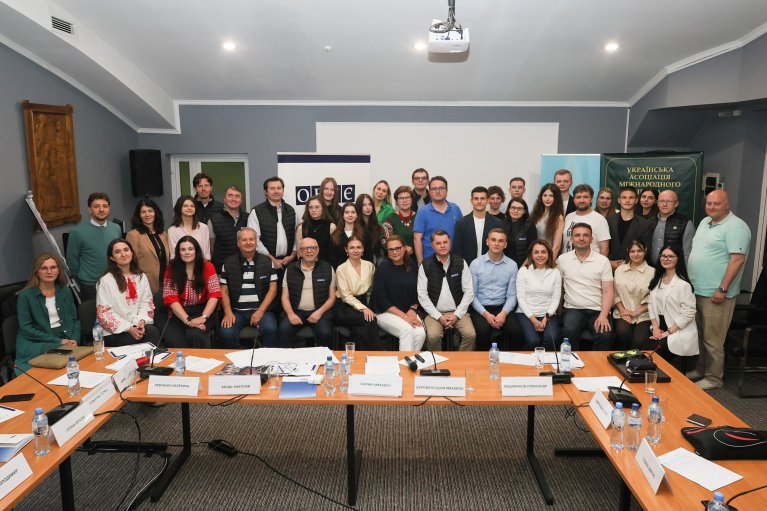
The Fourth Summer Academy of International Law brought together young lawyers, scholars, judges and experts to discuss topical issues of international and European law. The opening of the event was attended by the President of the Supreme Court, Stanislav Kravchenko, who addressed the participants with a welcoming speech.
Welcoming the participants, the President of the Supreme Court thanked the organisers and partners of the event – the OSCE Support Programme for Ukraine within the project “Enhancing the Quality of Justice by Strengthening the Role of the Supreme Court in Ensuring Transparent, Accountable and Inclusive Justice”, the Ukrainian Association of International Law, the National Academy of Legal Sciences of Ukraine and the Raoul Wallenberg Institute of Human Rights and Humanitarian Law – for their consistent support of this educational initiative. He expressed particular gratitude to the lecturers and speakers of the Academy, among whom were judges of the European Court of Human Rights and of the Supreme Court, representatives of international organisations, scholars and practitioners.
Stanislav Kravchenko emphasised that today the professional training of a lawyer can no longer be confined to knowledge of national legislation alone.
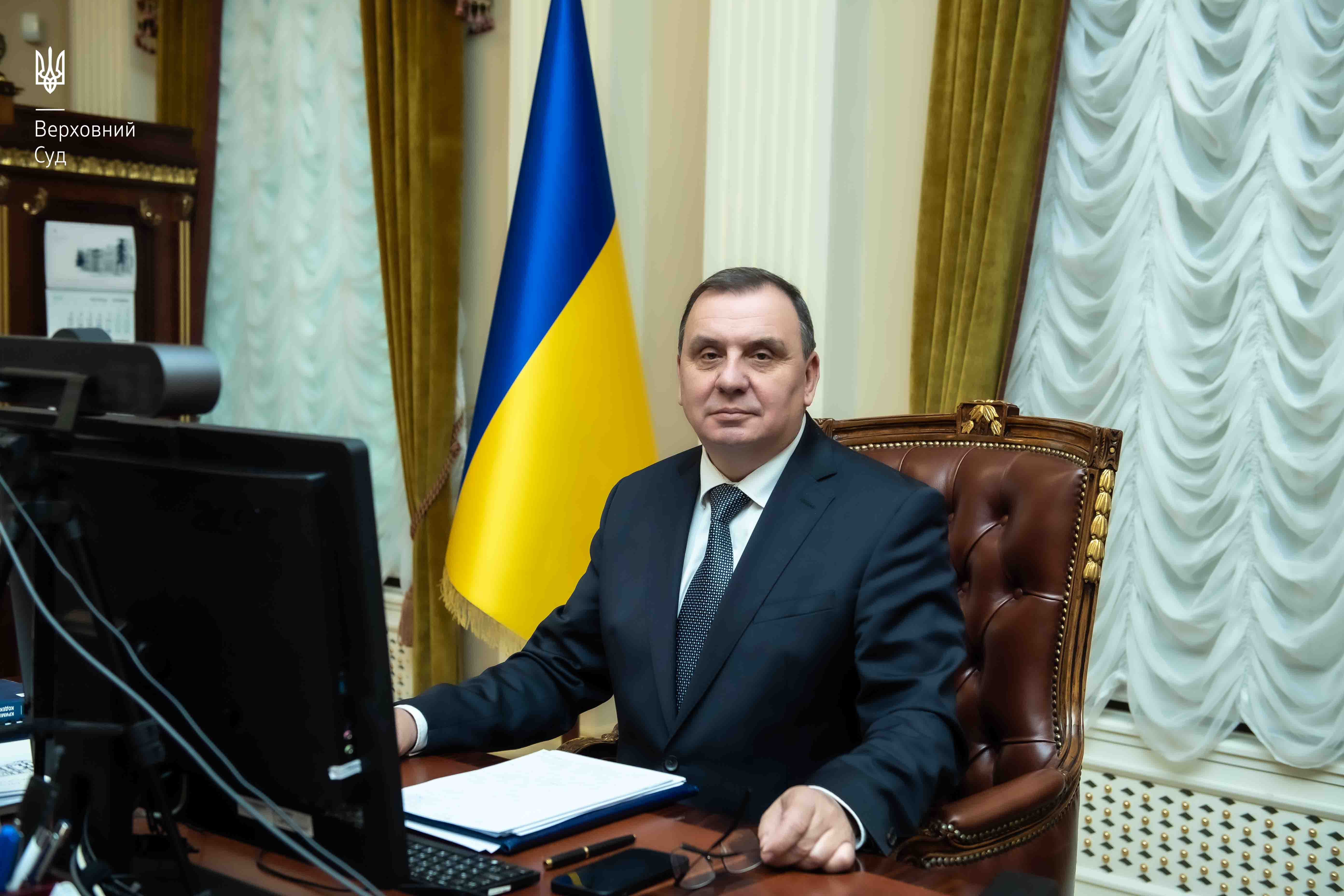
“A modern lawyer must think not only in terms of national law, but also in a broader European and global context,” he noted.
According to the President of the Supreme Court, education shapes not only professional knowledge but also legal culture, values, the capacity for argumentation and decision-making in complex legal situations. It is for this reason that the Summer Academy of International Law is an important platform that contributes to bringing Ukraine closer to European standards of legal education and to its integration into the European legal space.
In his address Stanislav Kravchenko paid particular attention to how the full-scale war has substantially altered the requirements for the professional training of Ukrainian lawyers. He stressed that international law today constitutes an integral part of the daily work of judges and lawyers.
In particular, this concerns the investigation and judicial examination of war crimes and the crime of aggression, the application of the norms of international humanitarian law, the practical use of the provisions of the Geneva Conventions, as well as the reparation of damage, the activities of the Register of Damage, the protection of the rights of internally displaced persons, the issue of judicial immunity and the interaction between national legislation and international law.
.jpg)
The President of the Supreme Court drew attention to the new challenges that have arisen for Ukraine following the ratification of the Rome Statute, which opens a new stage in the development of the national legal system and requires in-depth study of international criminal law and the relevant judicial practice.
Separately, he noted that the Supreme Court has for several years been actively examining the case law of the Court of Justice of the European Union.
“Although the judgments of the Court of Justice of the EU are not a source of law for us in the same way as the judgments of the European Court of Human Rights, they already today help to shape modern approaches in Ukrainian case law,” the President of the Supreme Court stated.
Stanislav Kravchenko also emphasised the importance of international mechanisms for holding perpetrators accountable for the crime of aggression, including the establishment of a special tribunal, and observed that, despite the existing challenges, the development of international justice remains one of the key instruments for protecting the international legal order.
“The Summer Academy is not merely an educational event. It is a space in which a new generation of lawyers is being formed – lawyers capable of working in a complex international legal environment. The knowledge and skills acquired by the participants within the Academy will form the foundation of their future professional activity – in national courts, international institutions, and the scholarly and practical spheres,” the President of the Supreme Court concluded, wishing the participants productive work, professional development and inspiration.
Judge of the Supreme Court in the Civil Cassation Court Dmytro Hudyma delivered a lecture entitled “International Treaties in the Case Law of the Supreme Court”.
.jpg)
He observed that, in view of the topics of the other speakers at the Academy, his presentation does not concern the practice of the Supreme Court in applying the Association Agreement between Ukraine, of the one part, and the European Union, the European Atomic Energy Community and their Member States, of the other part (see, for example, the judgments of the Grand Chamber of the Supreme Court of 3 August 2022 in case No. 910/9627/20 and of 5 March 2025 in case No. 910/8781/23), nor the consistent practice of applying the provisions of the Convention on the Recognition and Enforcement of Foreign Arbitral Awards of 10 June 1958.
The lecturer examined the judgment of 17 January 2024 in case No. 308/7570/18-ц (757/7570/18-ц), in which the Civil Cassation Court of the Supreme Court answered the question whether an author’s rights are infringed by the use, without attribution, of part of his abstract by another person in an educational and methodological complex. The Court applied, inter alia, the Berne Convention for the Protection of Literary and Artistic Works of 1971 and emphasised that a condition of the lawfulness of the use of the relevant fragments is the indication of the author’s name and the source of the borrowing (citation). The author of the educational and methodological complex failed to comply with these conditions; therefore the Civil Cassation Court of the Supreme Court characterised his actions as plagiarism irrespective of the fact that such a complex had an educational purpose, and awarded compensation for the infringement of property and non-property rights.
With regard to the protection of intellectual property rights the speaker also drew attention to the application by the Supreme Court, in its judgment of 13 May 2026 in case No. 757/7508/22-ц, of Article 6 septies of the Paris Convention for the Protection of Industrial Property, and to the attention paid by the Civil Cassation Court of the Supreme Court to the corresponding case law of the Court of Justice of the European Union in Case T-145/22, CEDC International v EUIPO – Underberg AG, of 28 June 2023.
The judge drew attention to a case in which the question arose whether a general consulate of another State may be a defendant before a court of Ukraine in a dispute concerning the unlawful dismissal of an employee from the post of translator at that consulate (judgment of the Civil Cassation Court of the Supreme Court of 20 March 2024 in case No. 466/674/18).
The Vienna Convention on Consular Relations of 1963 provides that consular officers themselves are not subject to the jurisdiction of the authorities of the receiving State in respect of acts performed in the exercise of consular functions, while Article 11 of the United Nations Convention on Jurisdictional Immunities of States and Their Property of 2004, which has not entered into force but whose provisions are regarded as codified customary international law, provides that, in the absence of any other agreement, in disputes concerning contracts of employment between a State and an individual for work performed or to be performed, in whole or in part, in the territory of another State, the employer State cannot invoke immunity from jurisdiction before a court of that other State unless the employee is, inter alia, a consular officer.
Furthermore, the European Court of Human Rights, in its judgment of 23 March 2010 in the case of Cudak v. Lithuania concerning the right of access to a court in a case relating to the unlawfulness of the applicant’s dismissal from the post of switchboard operator at an embassy, found a violation of that right by the application of State judicial immunity. It reasoned, inter alia, that she had not performed any functions closely related to the exercise of governmental authority, had not been a diplomatic agent or a consular employee, and had not been a national of the employer State.
In the light of the foregoing the Civil Cassation Court of the Supreme Court concluded that the employer State cannot invoke judicial immunity in a labour dispute with a citizen of Ukraine if the latter’s post (translator) at the general consulate is not connected with the exercise of the sovereign functions of the State, the contract of employment was concluded by the general consulate independently, without coordination with State authorities, that contract was performed in Ukraine with the application of Ukrainian legislation, and the general consulate took an active part in the judicial proceedings through a representative.
Dmytro Hudyma drew attention to the judgment of the Civil Cassation Court of the Supreme Court of 18 May 2022 in case No. 522/2493/18, in which the Court established that the claimant’s unsatisfactory state of health, which rendered proper treatment in the pre-trial detention centre impossible, had existed at the time of the imposition of the preventive measure of detention and during her detention, and that the pre-trial detention centre had acknowledged the absence of any possibility of providing her with adequate medical care. This confirms a breach by the State of both its negative and positive obligations in conditions of deprivation of liberty and necessitates the award of compensation for damage directly on the basis of Article 3, rather than Articles 5 and 6, of the Convention for the Protection of Human Rights and Fundamental Freedoms of 1950, and irrespective of the provisions of the Law of Ukraine “On the Procedure for Compensation for Damage Caused to a Citizen by the Unlawful Acts of Bodies of Inquiry, Pre-trial Investigation, the Public Prosecutor’s Office and the Court”.
.jpg)
The lecturer also analysed the judgment of the European Court of Human Rights of 28 January 2021 in the case of Satanovska and Rogers v. Ukraine (application No. 12354/19), in which the Court, applying Article 8 of the 1950 Convention, referred to the provisions of Article 13(1)(b) of the Hague Convention on the Civil Aspects of International Child Abduction of 1980 concerning a grave risk of harm to the child in the event of his or her return.
Following the delivery of that judgment the Grand Chamber of the Supreme Court reviewed case No. 2-4237/12 and, in its judgment of 13 April 2021, indicated that a refusal to return a child on the basis of Article 13(1)(b) of the Hague Convention constitutes an interference with the right to respect for family life guaranteed by Article 8 of the Convention. However, such interference is prescribed by law which is of the requisite quality and enabled the claimant to foresee the possibility of a refusal to return the child, in particular because of the existence of a grave risk of harm to the child’s psyche in the event of such return. Moreover, this interference pursues a legitimate aim — the protection of the rights and freedoms of the child, which may justify non-return, inter alia, in the event of a grave risk that the return of the child would expose him or her to physical or psychological harm.
Finally, the speaker examined the application of bilateral treaties in the practice of the Supreme Court, in particular for determining the jurisdiction of civil cases containing a foreign element. Taking as an example the judgment of the Civil Cassation Court of the Supreme Court of 6 May 2026 in case No. 646/8824/19, he explained that the Ukrainian courts correctly recognised that they lacked jurisdiction to resolve a dispute brought by a citizen of Ukraine against a company registered under the law of the Czech Republic, notwithstanding that the parties to the dispute had, in their contract, stipulated the jurisdiction of the courts of Ukraine. The reason for the absence of jurisdiction was that, under the terms of Article 497 of the Civil Procedure Code of Ukraine and Article 48 of the Treaty between Ukraine and the Czech Republic on Legal Assistance in Civil Matters of 2001, the parties had no right to determine the jurisdiction of disputes, but only to choose the applicable law.
In addition, the judge conducted a mini-training session on the writing of legal texts on the basis of a previously prepared factual scenario. As models for the presentation of information he took the judgments of the Civil Cassation Court of the Supreme Court of 29 May 2026 in case No. 743/1920/23, of 13 May 2026 in case No. 753/5734/23, of 29 April 2026 in case No. 303/5427/23, of 20 May 2026 in case No. 125/9/23, of 13 May 2026 in case No. 742/7046/23, and others.
Presentation by Dmytro Hudyma – https://court.gov.ua/storage/portal/supreme/prezent2026/Prezent_Mihznar_dogovor_prakt_VS.pdf
Acting Head of the Administration of the Supreme Court Rasim Babanly presented a review of the case law of the European Court of Human Rights for 2025–2026, offering the participants not merely an analysis of individual judgments but also a vision of how contemporary European legal thought is being formed and what points of reference it sets for Ukrainian law application.
.jpg)
Analysing judgments in cases that raised the issue of a violation of the right to life guaranteed by Article 2 of the Convention, Rasim Babanly referred to the case of Zayets v. Ukraine. In the relevant judgment the European Court of Human Rights found a breach by the State of its positive obligations arising from the death of a child at an unequipped railway crossing in the town of Irpin. The Court emphasised that the local authorities had taken the necessary safety measures only after the tragedy, thereby tolerating an unacceptable delay. The speaker observed that the judgment in this case demonstrates the modern approach of the European Court of Human Rights to the positive obligations of the State: it must not only refrain from violations of the right to life but also timely eliminate known dangers and ensure an effective investigation of deaths.
The issue of a fair trial in the context of the development of digital technologies was illustrated by the judgment in the case of Helme v. Estonia — the first judgment of the European Court of Human Rights assessing the provocation of a crime via the internet.
A separate block of the presentation was devoted by the speaker to the right to respect for private life. In particular, in the case of Manjani v. Albania the European Court of Human Rights affirmed an individual’s right to social reintegration, finding disproportionate the refusal of admission to the School of Magistrates on account of a conviction for theft committed while a minor. As Rasim Babanly emphasised, this judgment demonstrates that the negative consequences of committing an offence cannot pursue a person throughout his or her entire life, and that the right to rehabilitation is an integral component of a democratic society.
Speaking of freedom of expression, the speaker analysed the judgment in the case of Boyarov and Others v. Ukraine, in which the Court found justified the restriction of access to Russian social networks in view of threats to national security, control over those resources by the special services of the aggressor State, and the availability of alternative means of disseminating information.
The theme of digital rights was continued by the case of Miladze v. Georgia, in which the European Court of Human Rights found lawful the holding of a person to account for disseminating on a social network a video containing personalised obscene insults directed at the mayor of Tbilisi, emphasising that even a debate of public importance does not justify such forms of expression.
Concluding the review, the speaker analysed the development of the case law concerning the protection of the right to property by reference to the cases of Noga v. Ukraine and Zvonar v. Ukraine. He focused on the concept of due diligence formulated by the European Court of Human Rights, according to which a person who acquires property at an obviously undervalued price or in circumstances indicative of possible breaches of the law must be aware of the associated risks. In the absence of such diligence the adverse consequences may be borne by the acquirer.
Summing up his presentation, Rasim Babanly emphasised that the case law of the European Court of Human Rights must be applied not formally but relevantly – taking into account the full content of the judicial decision, its factual circumstances and the national legal context. In his words, it is precisely such an approach that contributes to the development of modern Ukrainian legal understanding, the implementation of European standards and constitutes an important precondition for the successful integration of Ukraine into the European legal space.
.jpg)
_03_03.png)