Contact center of the Ukrainian Judiciary 044 207-35-46
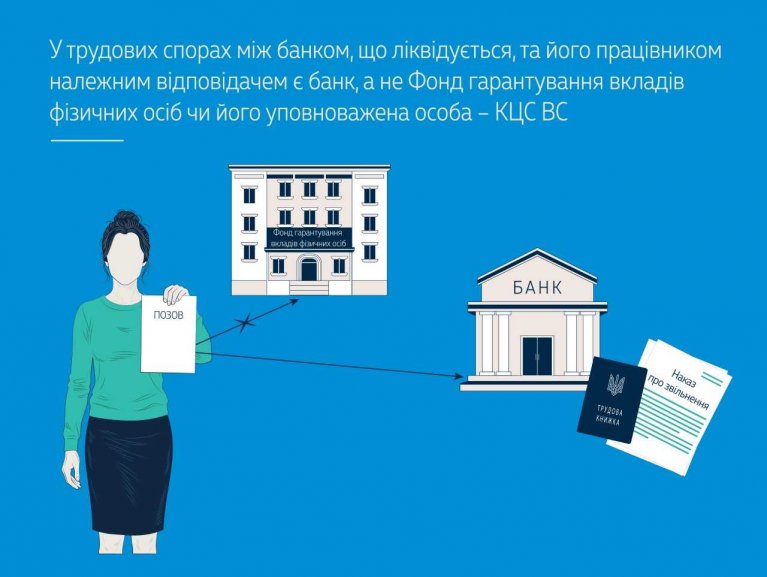
A bank that is being withdrawn from the market retains its legal personality until the state registration of its termination and remains an independent participant in legal relations. Since labour relations arise directly between the employee and the bank as a legal entity, claims regarding the performance of the employer’s obligations must be brought against the bank itself. The Deposit Guarantee Fund and its authorised person only represent the bank and perform the functions of its management bodies; therefore, they do not acquire independent rights and obligations in these legal relations.
These conclusions were reached by the Supreme Court in the panel of judges of the First Judicial Chamber of the Civil Cassation Court.
In the case under review, the claimant filed a lawsuit against the Deposit Guarantee Fund and its authorised person for the liquidation of the bank, seeking the issuance of her employment record book, an order of dismissal due to the employer’s violation of labour legislation, and the recovery of wage arrears together with compensatory payments. She justified her claims on the grounds that after the introduction of downtime at the institution, payments had ceased, and her application for voluntary dismissal had been ignored.
The court of first instance, with whose conclusions the appellate court agreed, partially satisfied the claim. The courts established a violation of the employee’s labour rights and placed the obligation to issue documents and make monetary payments directly on the Fund and its authorised person, considering them the proper defendants in the case.
The Civil Cassation Court of the Supreme Court overturned the decisions of the previous courts and adopted a new ruling refusing to satisfy the claim against the Fund and its authorised person. The cassation court held that imposing liability for non-payment of wages directly on the Fund and the bank’s liquidator is erroneous, as it does not take into account the legal nature of the representation of a bank being withdrawn from the market.
According to Part 1 of Article 21 of the Labour Code of Ukraine, an employment contract is an agreement between an employee and the owner of an enterprise, institution or organisation, or a body or natural person authorised by the owner, whereby the employee undertakes to perform the work defined by this agreement and to comply with internal labour regulations, while the owner of the enterprise, institution or organisation, or the body or natural person authorised by the owner, undertakes to pay the employee wages and to provide the working conditions necessary for the performance of the work, as provided for by labour legislation, the collective agreement and the agreement of the parties.
Justifying its legal position, the Civil Cassation Court of the Supreme Court explained that a bank in the liquidation procedure retains its legal personality until the state registration of its termination and remains an independent participant in legal relations. In these relations, the Fund and its authorised person act exclusively as representatives of the bank, performing the functions of its management bodies on the basis of the law. Since they do not act as independent entities (employers), the obligations regarding the recovery of arrears or the issuance of the employment record book must be imposed on the bank itself.
In accordance with Part 3 of Article 37 of the Law of Ukraine “On the System of Guarantee of Deposits of Natural Persons”, the authorised person of the Fund acts on behalf of the bank within the powers of the Fund.
The Civil Cassation Court of the Supreme Court emphasised that the determination of defendants in a claim is the right of the claimant, but establishing their proper status is the duty of the court, which is performed during the consideration of the case. Given that the claims were brought against representatives (the Fund itself and the authorised person of the Fund for the liquidation of the bank) instead of the bank as an independent legal entity and the claimant’s employer, the Civil Cassation Court of the Supreme Court noted that filing a claim against an improper defendant constitutes an independent ground for refusing to satisfy the claims.
Resolution of the Civil Cassation Court of the Supreme Court dated 27 May 2026 in case No. 761/36941/20 (proceedings No. 61-8071св25) – https://reyestr.court.gov.ua/Review/136946171.
This and other legal positions of the Supreme Court can be found in the Database of Legal Positions of the Supreme Court - https://lpd.court.gov.ua.
_03_03.png)