Contact center of the Ukrainian Judiciary 044 207-35-46
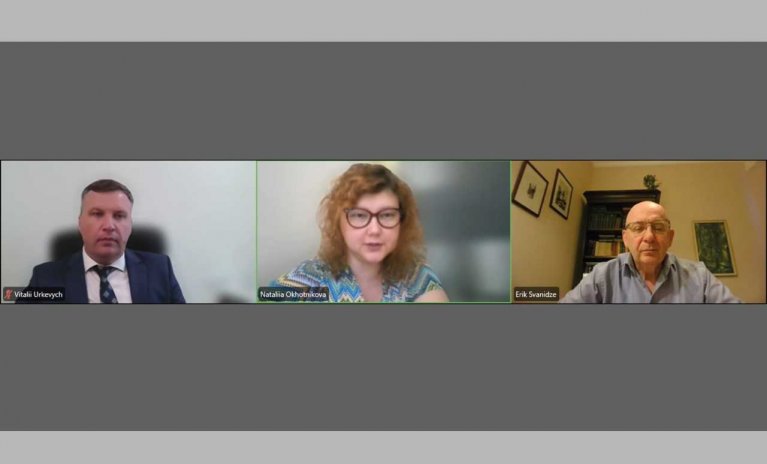
Judge of the Grand Chamber of the Supreme Court Vitalii Urkevych held an online meeting with the Council of Europe international expert and author of the draft Second Expert Report on Legal Remedies and Compensation Mechanisms for Persons Affected by the War in Ukraine, Eric Svanidze. During the conversation, the participants discussed current case law related to compensation for damage caused by the armed aggression of the Russian Federation, as well as recommendations for the final version of the expert report.
The meeting took place within the framework of the Council of Europe project “Enhancing Judicial and Non-Judicial Remedies for Persons Affected by the War in Ukraine”. Its aim was to ensure direct and open dialogue between the international expert and the national partners of the project on current challenges in the area of legal remedies and compensation for persons affected by the war in Ukraine, taking into account judicial practice on the matter.
During the meeting, Vitalii Urkevych outlined the problematic aspects faced by Ukrainian courts when considering disputes related to compensation for damage caused by the armed aggression of the Russian Federation. In particular, he drew attention to the specifics of handling claims brought against both the Russian Federation and Ukraine, as well as the practical aspects of applying national legislation in this category of cases.
The author of the draft Second Expert Report, Eric Svanidze, noted that during the finalisation of the document, particular attention was paid to the latest case law of the Supreme Court developed after the start of the full-scale invasion. He emphasised the importance of the Supreme Court’s most recent legal positions regarding state liability and compensation for damage, and highlighted issues concerning the international recognition of Ukrainian court decisions.
In response to the issues raised, Vitalii Urkevych noted that citizens and businesses are filing claims with Ukrainian courts for compensation for damage against both the Russian Federation and Ukraine. According to him, the consideration of claims against the State of Ukraine is particularly complex, as the courts are operating under conditions of an ongoing war, while specific regulatory frameworks for such legal relations remain limited.
The international expert drew attention to the practice of compensating moral damage. He inquired whether the national judicial system has developed consistent approaches to determining its amount and raised the issue of international recognition of Ukrainian court decisions.
Vitalii Urkevych emphasised that the position of the Supreme Court is that national courts may consider claims against the Russian Federation for compensation of war-related damage without applying the state immunity of the aggressor state. At the same time, he noted that this approach has sparked discussion among international experts in light of existing principles of international law.
The judge also drew attention to the enforcement of Ukrainian court decisions ordering the recovery of damages from the Russian Federation. He stated that Ukrainian courts have already delivered more than 1,500 such decisions; however, their enforcement remains problematic due to the absence of assets on the territory of Ukraine that could be used to satisfy the relevant claims. At the same time, the speaker expressed hope that such decisions will be taken into account by the international compensation mechanism currently being developed, as they contain facts established by the court, an assessment of the evidence, and a determined amount of damage caused.
Regarding compensation for moral damage, Vitalii Urkevych explained that, in determining its amount, the courts assess the totality of circumstances of each specific case. In particular, they take into account the claimant’s place of residence, proximity to the area of hostilities, harm caused to health, destruction of property or housing, as well as the duration of the person’s exposure to the effects of military events. At the same time, there are currently no unified tables or scales for determining the amount of moral damage in Ukraine, so each case is decided on the basis of its individual circumstances.
The participants also touched upon issues concerning the documentation of the consequences of military actions that have caused significant damage to the environment, legal problems related to compensation for environmental damage, the need for the Supreme Court to develop general approaches to the consideration of cases involving compensation for damage caused by the armed aggression of the Russian Federation, and the importance of Ukrainian courts’ developments for the international compensation mechanism.
In conclusion, Vitalii Urkevych expressed gratitude for the expert support provided by the Council of Europe in the search for appropriate legal remedies and compensation mechanisms for damage caused by the war in Ukraine, and voiced his hope that decisions of national courts will be taken into account in the work of the compensation commission and in the preparation of the final version of the Council of Europe’s Second Expert Report.
_03_03.png)