Contact center of the Ukrainian Judiciary 044 207-35-46
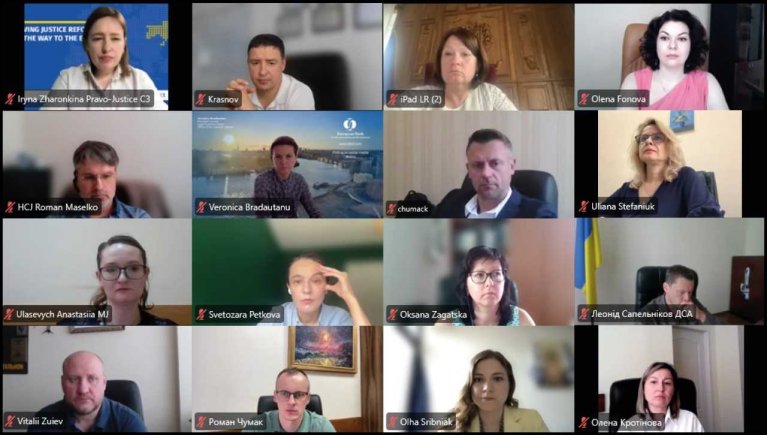
Larysa Rohach, President of the Commercial Cassation Court within the Supreme Court, Yurii Chumak, Secretary of the Judicial Chamber for Land Relations and Property Rights Cases of the Commercial Cassation Court, and Supreme Court judges Yehor Krasnov and Vitalii Zuiev participated in an expert discussion on the concept of the pilot project "Cross-Territorial Jurisdiction in Commercial Proceedings in Ukraine".
The event focused on the possibility of introducing a pilot project on cross-territorial jurisdiction with the aim of balancing the caseload among commercial courts and ensuring a more efficient use of judicial resources.
The pilot project was presented by Olena Fonova, President of the Commercial Court of the Luhansk Region. The discussion of the project's legal, organisational, institutional and technical aspects brought together Supreme Court judges, representatives of the Ministry of Justice of Ukraine, the High Council of Justice, the High Qualification Commission of Judges of Ukraine, the Council of Judges of Ukraine, the State Judicial Administration of Ukraine, members of the judiciary and legal experts.
In her opening remarks, Larysa Rohach noted that adjudicating cases outside the ordinary rules of territorial jurisdiction has become particularly relevant under martial law. She emphasised that, following the start of Russia's full-scale aggression against Ukraine, the commercial courts have faced not only new categories of disputes but also significant judicial administration challenges arising from changes in the distribution of caseloads. In particular, the relocation of businesses from areas of active hostilities to safer regions has resulted in a substantial decline in the number of cases before the commercial courts of the Donetsk and Luhansk Regions. At the same time, a number of courts in other parts of the country, including the Commercial Court of the Zakarpattia Region, the Commercial Court of the Vinnytsia Region and the Commercial Court of the City of Kyiv, are operating under considerable pressure due to increased workloads.
To address this imbalance, Ms. Rohach explained, a number of staffing measures are already being implemented. These include the completion of judicial selection procedures and the use of temporary secondments of judges to other courts. At the same time, efforts continue to identify additional mechanisms that could contribute to the more efficient and expeditious adjudication of cases. She noted that, under the current circumstances, the prompt resolution of commercial disputes, which is essential for the proper functioning of the economy, has become a key priority.
The President of the Commercial Cassation Court concluded by observing that the discussion of the pilot project forms part of a broader effort to identify the judiciary's internal capacity to improve the efficiency of case management. In this context, cross-territorial jurisdiction may serve as one of the possible mechanisms for enhancing access to justice and achieving a more balanced distribution of cases among commercial courts.
Ms Rohach also referred to the development of digital tools within the justice system. She noted that the commercial courts make extensive use of the Unified Judicial Information and Telecommunication System (UJITS), the Electronic Court service and video conferencing facilities. In particular, during 2025, nearly 82,400 court documents were delivered to the electronic accounts of court users, while 53 per cent of cases before the Commercial Cassation Court within the Supreme Court were heard by video conference. Between January and May 2026, more than 1,000 court hearings were conducted remotely.
According to Ms Rohach, the proposed mechanism of cross-territorial jurisdiction represents a new challenge for commercial justice. She expressed the hope that the professional discussion surrounding the project would contribute to the development of practical solutions for improving the efficiency of the judicial system while safeguarding procedural guarantees, the standards of a fair trial and the constitutional principles governing the administration of justice.
Yurii Chumak observed that the issue of adjudicating cases outside the ordinary territorial jurisdiction requires comprehensive consideration from both a legislative and a technical perspective. At the same time, he expressed the view that the current level of digitalisation of the judiciary, and of the commercial courts in particular, has already created the conditions necessary for introducing new approaches to the organisation of judicial proceedings.
He also highlighted the growing trend towards the wider use of remote participation in court proceedings and the determination of cases without the physical presence of the parties' representatives, noting that this approach is both convenient for court users and consistent with the capabilities of modern electronic justice. According to the judge, the continued development of electronic services and the gradual introduction of new modules within the Unified Judicial Information and Telecommunication System demonstrate the judiciary's readiness for further reform.
Mr Chumak stressed that the introduction of a mechanism for cross-territorial jurisdiction should be gradual and should take full account of all potential risks and practical considerations. In his view, a pilot project would provide the most appropriate means of testing the effectiveness of such an approach, assessing its acceptance by court users and judges, and determining the prospects for extending the mechanism to other categories of cases.
At the same time, the judge emphasised the importance of taking staffing considerations and the long-term implications of any proposed changes into account, underlining that decisions in this area must be carefully weighed. He concluded that the phased introduction of new mechanisms, which has already proved effective during the development of electronic justice services, represents the most appropriate approach for implementing the proposed cross-territorial jurisdiction initiative.
Judge Yehor Krasnov expressed the view that discussions on the proposed mechanism of cross-territorial jurisdiction should focus first of all on the practical issues it is intended to address. In his opinion, the uneven distribution of caseloads among the commercial courts is an objective challenge, and addressing it could improve both the speed and the quality of commercial dispute resolution.
The judge also devoted particular attention to the development of electronic justice. He noted that the current level of digitalisation of the judicial system, particularly the operation of the Unified Judicial Information and Telecommunication System (UJITS), already enables the introduction of new models for organising judicial proceedings. In his view, experience with electronic services has demonstrated their effectiveness, while the number of complaints concerning improper notification of parties to proceedings has fallen significantly.
Judge Krasnov observed that modern technologies should facilitate swifter court proceedings and enable more efficient use of the judiciary's existing resources.
Supporting the idea of a pilot project on cross-territorial jurisdiction, he stressed the importance of its phased implementation. He drew a parallel with the rollout of the UJITS subsystems, which were also developed gradually. In his view, it would be advisable first to test the effectiveness of the proposed mechanism as part of a pilot project on summary proceedings, and only if the results are positive and the mechanism is well received by those involved in the process should the possibility of extending it to other categories of cases be considered.
Joining the discussion, Judge Vitalii Zuiev emphasised the need to define clearly both the objectives of the pilot project on cross-territorial jurisdiction and the criteria by which its outcomes should be assessed. In his view, even if the mechanism proves effective within the commercial courts, this would not necessarily justify its extension to other branches of the judiciary, as each jurisdiction has its own distinctive features and procedural framework.
The speaker observed that balancing judicial workloads should primarily be achieved through appropriate judicial staffing and by determining the optimal number of judges required in each court. At the same time, he drew attention to the potential impact of the proposed changes on the statistical indicators used to measure the performance of judges and courts. Consequently, he suggested that, in the longer term, it may become necessary to review certain approaches adopted by the High Qualification Commission of Judges of Ukraine and the High Council of Justice when assessing judges, particularly in relation to judicial evaluation, appointments and certain disciplinary procedures.
Judge Zuiev also stressed the importance of taking into account the circumstances of courts that, as a result of the full-scale war, continue to administer justice in respect of territories where the volume of litigation has objectively declined. In his view, alongside ensuring an efficient distribution of caseloads, it is equally important to preserve the judicial capacity of such courts so that they will be able to resume their full operations in the future.
The event was organised by the EU Project Pravo-Justice.
_03_03.png)