Contact center of the Ukrainian Judiciary 044 207-35-46
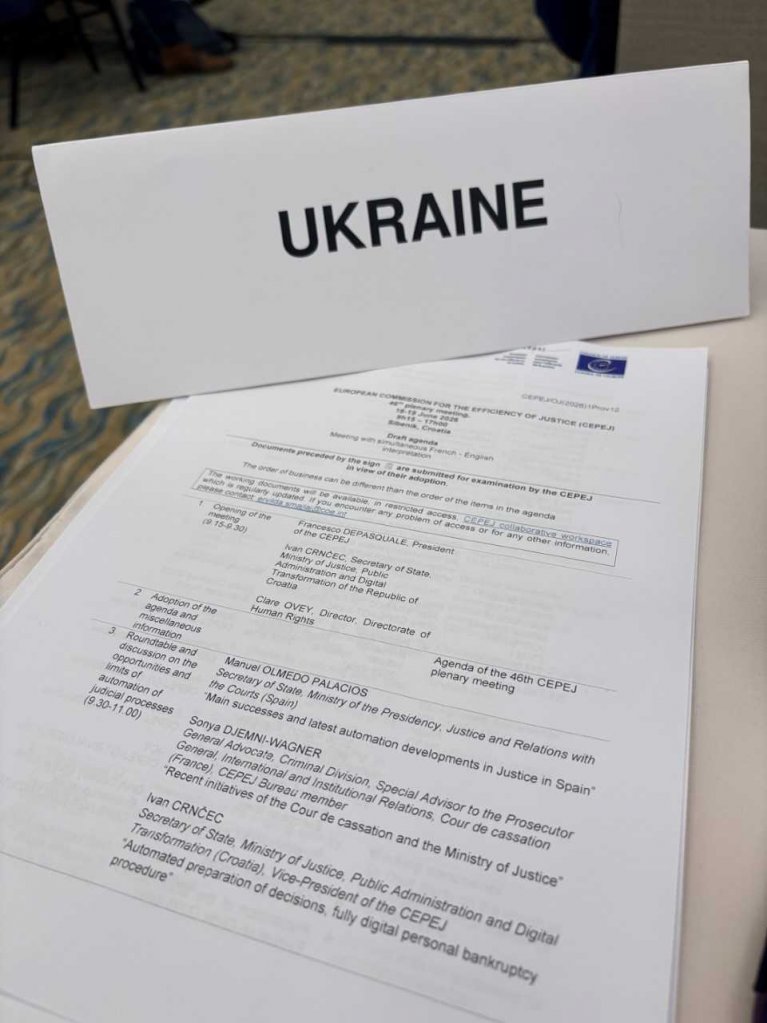
Supreme Court Judge at the Criminal Cassation Court and Ukraine’s member of the European Commission for the Efficiency of Justice (CEPEJ), Oleksandra Yanovska, participated in the 46th plenary session of CEPEJ, which took place on 18–19 June 2026 in Šibenik, Croatia.
During the event, participants discussed topical issues related to improving the efficiency of justice in European countries. In particular, they addressed the automation of judicial proceedings, evaluation of judicial systems, ensuring the quality of justice, increasing the efficiency of court proceedings, the development of cyber justice and the use of artificial intelligence in the judicial system, as well as improving approaches to assessing court workload and developing international cooperation in the field of justice.
Speaking at the plenary session, Oleksandra Yanovska emphasised that the Ukrainian judicial system continues to deliver justice despite the full-scale war unleashed by Russia, rocket attacks, power outages, and the temporary occupation of part of Ukraine’s territory. At the same time, judicial reforms are ongoing, and cooperation with European institutions is of particular importance.

The judge drew attention to the launch of the negotiation process for Ukraine’s accession to the European Union, noting that this is evidence of our state’s commitment to the principles of democracy, the rule of law, judicial independence, and the protection of human rights.
For the Ukrainian judicial system, European integration serves as a practical guideline for further reform and strengthening public trust in justice. Oleksandra Yanovska expressed gratitude to European partners for their solidarity and professional support, and reaffirmed Ukraine’s readiness to share its experience in ensuring access to justice and the functioning of courts under unprecedented challenges.
CEPEJ Project Coordinator Anastasiia Nohovytsyna outlined the results of the Commission’s cooperation with Ukrainian judicial institutions under martial law, which is carried out in response to requests from the High Council of Justice, the Supreme Court, the Kyiv Court of Appeal, the Zakarpattia Court of Appeal, the Novovolynsk City Court of Volyn Region, and the Pechersk District Court of Kyiv. In March this year, CEPEJ facilitated an exchange of experience with representatives of these institutions and discussed the most relevant areas of support for the Ukrainian judicial system. The Commission confirmed its intention to continue and deepen cooperation with Ukraine.
As part of its further work, CEPEJ conducted an analysis of judicial statistics and staffing indicators for 2024–2025, particularly regarding judges’ workload, court efficiency, and other performance indicators. Based on the data received, individual recommendations were prepared for judicial institutions. Previous CEPEJ recommendations on the formation of statistical reporting were also taken into account, which enabled the provision of data in a format closer to European standards for assessing court performance.
_03_03.png)