Contact center of the Ukrainian Judiciary 044 207-35-46
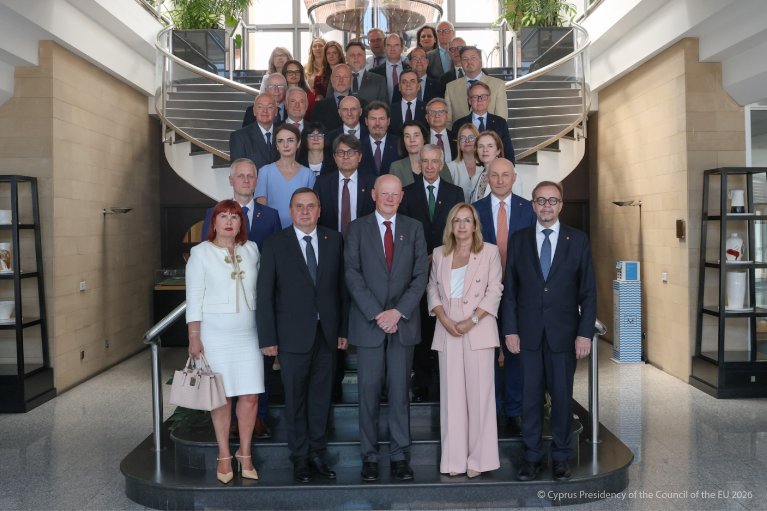
The Conference of the Network of Presidents of Supreme Judicial Courts of the European Union took place in Limassol, Republic of Cyprus, from 11 to 13 June 2026 The event was dedicated to the key challenges facing the highest judicial institutions today. This year’s event, to which Stanislav Kravchenko, President of the Supreme Court, was also invited, was held under the auspices of the Supreme Court of Cyprus in cooperation with the Secretariat of the Cyprus Presidency of the Council of the EU in 2026.
The Conference addressed 21st-century challenges to the rule of law and the protection of human rights in the digital space.
During the first panel discussion, participants examined manifestations of democratic regression in the modern world, including:
.jpg)
Opening the discussion, the President of the Network of Presidents of Supreme Judicial Courts of the European Union and President of the Supreme Court of Ireland, Donal O’Donnell, emphasized that, unlike authoritarian regimes based on the unconditional adherence to a single ideology, a democratic society must remain a space for free discussion, critical analysis, and the search for new solutions.
The impact of war on the rule of law was the focus of the address by the President of the Supreme Court of Finland, Tatu Leppänen. According to him, Russia’s full-scale war against Ukraine demonstrates that occupation of territories and violations of international humanitarian law effectively make the existence of the rule of law and proper protection of human rights impossible.
Síofra O'Leary, President of the European Court of Human Rights in 2022–2024 and currently a researcher at New York University, stressed that the rule of law is one of the greatest achievements of postwar Europe. At the same time, she warned against viewing these values as immutable or permanently guaranteed, noting that even established democratic systems can face the gradual erosion of trust in institutions and the weakening of legal safeguards.
During the discussion, Maciej Szpunar, First Advocate General at the Court of Justice of the European Union, noted that the independence of national judges is a necessary condition for the functioning of the entire European legal system. The speaker explained that, in response to the phenomenon of democratic regression, the CJEU has developed new legal instruments to address such processes. One of them is the doctrine of irreversibility, according to which a Member State cannot amend its legislation in a way that reduces the already achieved level of guarantees of judicial independence and the protection of the rule of law.
In the context of mechanisms for protecting judicial independence amid growing political pressure on judicial institutions, President of the European Court of Human Rights Mattias Guyomar outlined three key directions for responding to contemporary challenges to the rule of law:
Chief Justice of the Supreme Court of Canada Richard Wagner devoted his speech to the criticism of judicial decisions as a necessary element of public dialogue. At the same time, he warned against situations where criticism turns into campaigns to discredit courts or undermine their legitimacy, which creates threats to the independence of the judiciary.
Conference participants also discussed prospects for restoring the rule of law after its systemic weakening, ways to establish communication between the courts and society, and the importance of timely strengthening of constitutional guarantees of judicial independence.
Within the second panel session, a detailed discussion was held on the transformation of the digital legal order, the responsibility of online platforms, and the challenges related to the application of multi-level regulation in the field of digital rights. Participants emphasized that algorithms are increasingly determining the availability, visibility, and reach of information, which has a direct impact on the exercise of freedom of expression and freedom of speech.
The Conference was attended by members, associate members, and observers of the Network, as well as representatives of the Court of Justice of the European Union, the European Court of Human Rights, and the Supreme Court of Canada. It should be recalled that on 14 October 2022, by decision of the General Assembly of the Network of Presidents of Supreme Courts of the European Union, the Supreme Court of Ukraine was granted observer status within the Network.
_03_03.png)