Contact center of the Ukrainian Judiciary 044 207-35-46
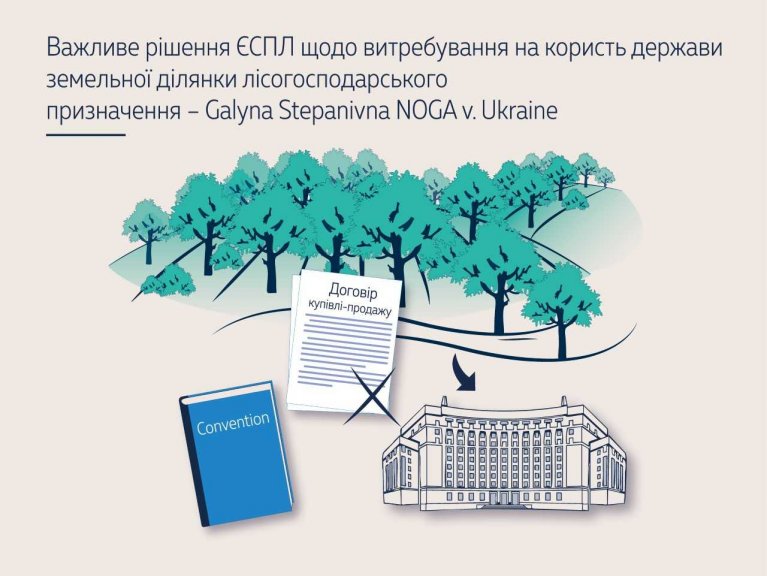
The European Court of Human Rights has concluded that the return of the disputed forest land plot to state ownership pursued the legitimate aim of ensuring compliance with the rule of law and corresponded to the public interest. The applicant, when purchasing the plot, did not exercise due diligence and knowingly accepted the risks associated with its acquisition.
According to the circumstances of the case, in 2008 the applicant purchased a land plot from “N” company under a sale and purchase agreement. In May 2011, a prosecutor filed a lawsuit in the interests of the state seeking the reclamation of this land plot from “N” company and the applicant, on the grounds that the land belonged to the forest fund and was state property.
The final decision in the case was adopted on June 22, 2016: courts of three instances upheld the claim, establishing that the disputed land plot belonged to lands of forest management designation, which only the Cabinet of Ministers of Ukraine is authorized to dispose of, and not the village council, which had removed the plot from the state forest fund and reclassified it as recreational land.
Later, in June 2017, the applicant filed a lawsuit against the village council and the Cabinet of Ministers seeking compensation for the value of the property. The courts rejected the claim, stating that compensation claims should have been filed against her counterparty under the sale and purchase agreement – “N” company.
Assessing compliance with the principle of proportionality, the ECtHR found no violation of the fair balance between public and private interests.
The Court emphasized that the applicant should have exercised particular diligence before concluding the sale and purchase agreement, as she could have known about the plot’s belonging to a special category of land and the risk of termination of ownership rights, given the ongoing court proceedings regarding the right to dispose of this land in 2004–2010.
The ECtHR also drew attention to the significant difference between the price paid by the applicant for the land plot (UAH 75,055, approximately EUR 6,800) and its estimated value (UAH 528,366, approximately EUR 48,500), which raised doubts about the legality of the concluded sale and purchase agreement.
In view of these circumstances, the ECtHR concluded that, despite the lack of prospects for receiving compensation for the expropriated property, the applicant failed to exercise due diligence and knowingly accepted the risks associated with the acquisition of the disputed land plot. Therefore, there are no grounds to find a violation of the fair balance of interests in this case.
The official text of the judgment in the case of Galyna Stepanivna NOGA v. Ukraine is available on the website of the European Court of Human Rights at the following link: https://hudoc.echr.coe.int/eng?i=001-249740.
We also remind readers about the ECHR Knowledge Sharing Platform (ECHR-KS), which contains materials on the case law of the European Court of Human Rights in Ukrainian, available at: https://ks.echr.coe.int/uk/web/echr-ks/.
_03_03.png)