Contact center of the Ukrainian Judiciary 044 207-35-46
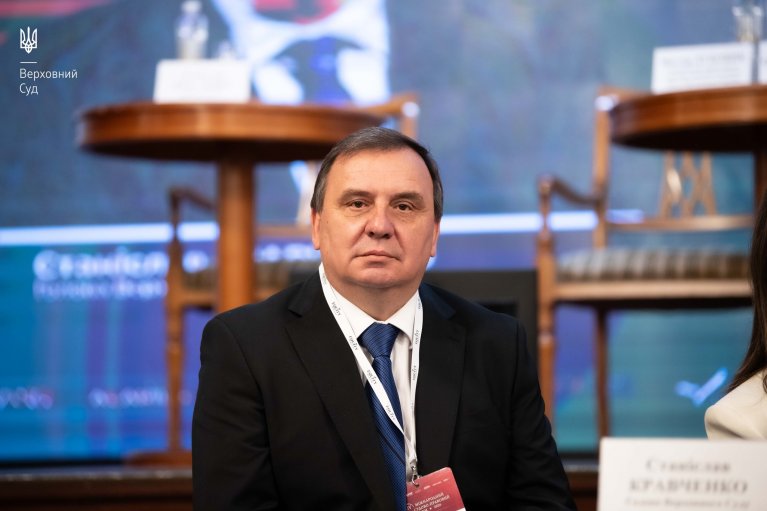
The Ukrainian judicial system has successfully met the challenge of war – the challenge of uncertainty and threats. During this time, the national judicial system has gained unique experience for global practice in administering justice under conditions of full-scale war, a transitional period, and the formation of mechanisms to hold the aggressor state accountable. This experience will undoubtedly become an integral part of world legal history.
This topic, along with the present and future of Ukrainian justice in general, was discussed by President of the Supreme Court Stanislav Kravchenko and Deputy Head of the Office of the President of Ukraine Iryna Mudra during the open interview “Judicial Track – 2026: The State of the Judicial System and Prospects for Reform”. The discussion took place on the first day of the XIV International Judicial and Legal Forum, organized by the publishing house “Yurydychna Praktyka” in partnership with the Association of Ukrainian Corporate Lawyers. The conversation was moderated by EQUITY managing partner Oleh Malinevskyi.
According to Stanislav Kravchenko, the national judicial system can take pride in its achievements and its contribution to the development of international law.
Under the conditions of full-scale war, every judicial jurisdiction – administrative, commercial, criminal, and civil – has developed and continues to develop relevant case law in cases related to the armed aggression of the Russian Federation against Ukraine. These developments not only ensure proper protection of the rights and interests of citizens and the state but also contribute to the advancement of national and international legal doctrine.
One example of this contribution is the formation of legal approaches to defining the characteristics of the perpetrator of the crime under Article 437 of the Criminal Code of Ukraine (“Crime of Aggression”). On February 28, 2024, the Grand Chamber of the Supreme Court delivered a landmark decision in case No. 415/2182/20 in the context of international law. It established that the acts defined in Article 437 of the Criminal Code of Ukraine can be committed by persons who, by virtue of their official powers or actual social standing, are capable of exercising effective control over political or military actions or directing them, and/or significantly influencing political, military, economic, financial, informational, and other processes within their own state or beyond its borders, and/or directing specific areas of political or military actions.
At the same time, another important area of activity for Ukrainian courts is the development of case law on the application of Article 438 of the Criminal Code of Ukraine (“War Crimes”) when considering cases of this category. It is the national courts that are today laying the foundation for future law enforcement practice in the field of international criminal law.
At the same time, the judicial system faces complex legal challenges. Among them are overcoming the judicial immunity of the aggressor state, as well as conducting proceedings under the special in absentia procedure in conditions where it is impossible to properly notify the accused, who are representatives of the aggressor state.
Solving these issues, noted the President of the Supreme Court, lies in finding a balance between full compliance with all international standards of justice and the practical enforcement of court decisions and holding the aggressor state accountable. The goal is to demonstrate that anyone who unleashes war in the modern democratic world will face fair punishment.
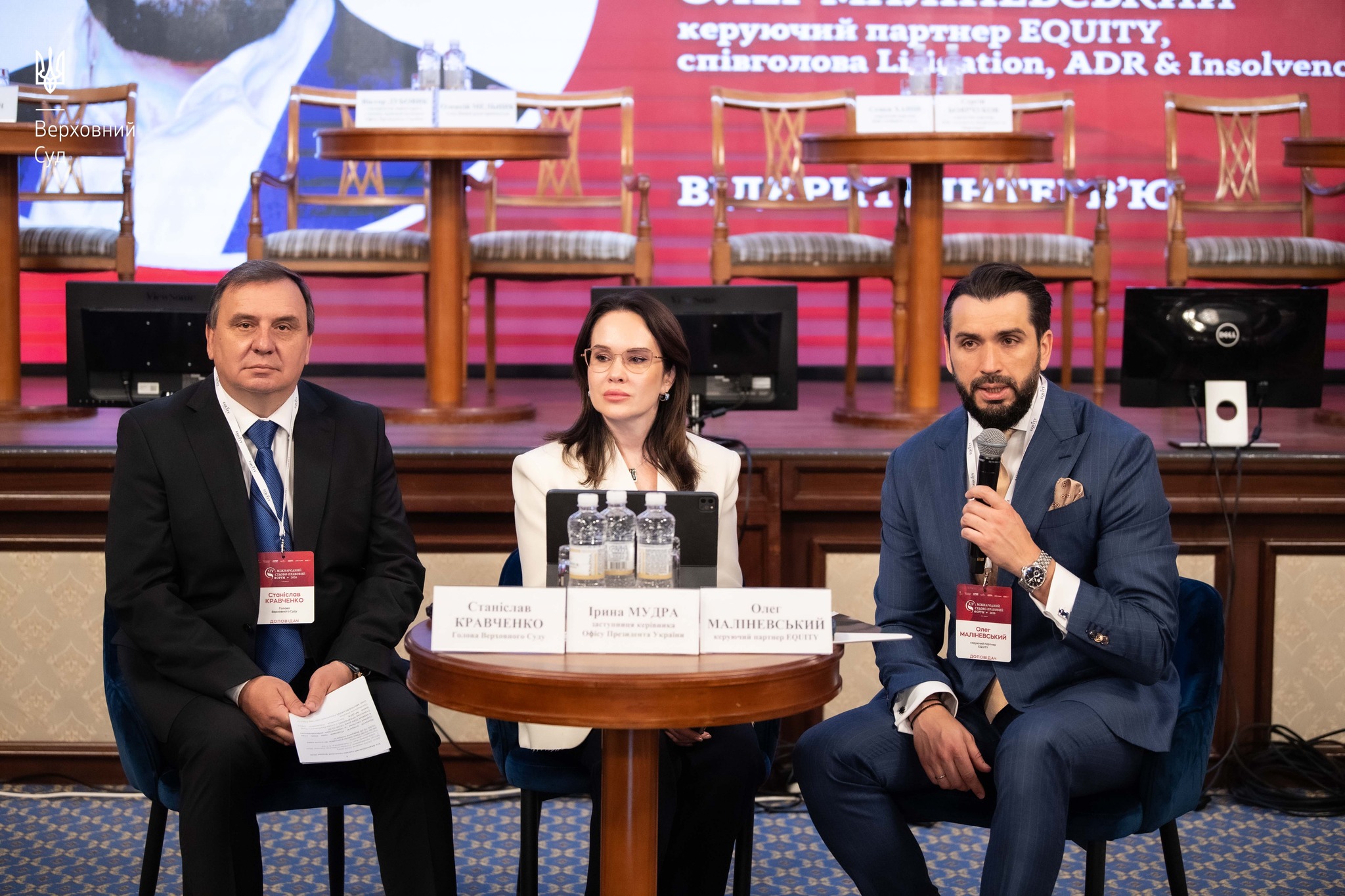
Iryna Mudra emphasized that the time has come for Ukraine to show the world how justice can be developed amid an ongoing crime of aggression – not by halting reforms, but by accelerating their implementation.
She highlighted three dimensions that demonstrate the effectiveness of the national judicial system:
1) Operational resilience of institutions: competitions for vacant judicial positions continue, bodies of judicial governance and self-governance function uninterruptedly, and justice is administered without fail;
2) Implementation of transitional justice mechanisms already today, not after the war ends: ensuring access to justice for internally displaced persons (IDPs), developing compensation mechanisms, restoring property rights, relocating courts, and providing psychosocial support to war victims;
3) Searching for ways to hold the aggressor state accountable.
The Deputy Head of the Office of the President of Ukraine stressed the need for the legal documentation of the crimes of the aggressor state: “A nation that does not enshrine the trauma of war in legal mechanisms is doomed to repeat such an experience. Ukraine, on the contrary, demonstrates that justice is a preventive measure against potential wars in the future”.
Speaking about the priority steps needed to improve the functioning of Ukraine’s judicial system – particularly in the context of fulfilling the requirements of the Roadmap on the Rule of Law in the process of European integration – Stanislav Kravchenko emphasized that overcoming the shortage of judges remains one of the key priorities. The SC President also drew attention to the need to improve and simplify the procedures for selecting judges, including to the Supreme Court, which is an important prerequisite for ensuring high-quality, efficient, and timely case consideration.
Among other pressing tasks, Stanislav Kravchenko singled out ensuring the unity of case law, as well as forming a new network of courts in accordance with the new administrative-territorial structure of the state.
Iryna Mudra noted that, in addition to the shortage of judges in the courts, challenges include the need to optimize the number of disciplinary cases against judges and further digitalization of justice to ensure equal access to court.
_03_03.png)