Contact center of the Ukrainian Judiciary 044 207-35-46
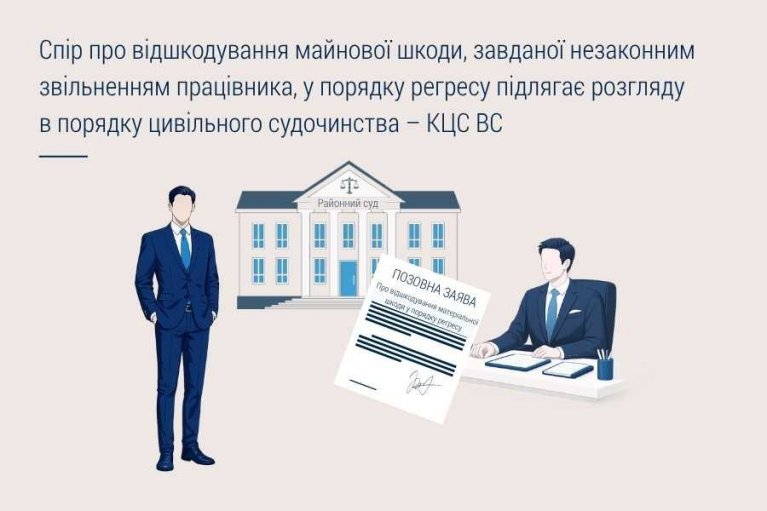
A dispute over the recovery of property damage from a city mayor caused by the payment of average earnings for the period of forced absence from work resulting from the unlawful dismissal of an employee (the illegality of which has already been established by a court decision in an administrative case) by way of recourse is a private law dispute and is subject to consideration under civil procedure.
This conclusion was reached by the Supreme Court, sitting as a panel of judges of the First Judicial Chamber of the Civil Cassation Court.
In the case under review, the prosecutor, acting in the interests of the city military administration and the city council, filed a lawsuit against the city mayor for the recovery of damages by way of recourse. The lawsuit was motivated by the fact that due to an unlawful order on the dismissal of an employee, average earnings for the period of forced absence were paid from the budget based on a court decision.
The court of first instance upheld the claim.
The court of appeal overturned the decision of the court of first instance and terminated the proceedings in the case, considering that the dispute was of a public law nature and subject to consideration under administrative procedure.
The Civil Cassation Court of the Supreme Court overturned the resolution of the court of appeal and remanded the case for a new trial to the court of appeal, making the following legal conclusions.
The right of access to justice is one of the fundamental human rights. It is provided for in Article 6 of the Convention for the Protection of Human Rights and Fundamental Freedoms, ratified by Ukraine.
The concept of "a court established by law" concerns not only the legal basis for the existence of a court, but also its compliance with the rules governing its activities (para. 24 of the judgment of the European Court of Human Rights of July 20, 2006, in the case of Sokurenko and Strygun v. Ukraine, applications No. 29458/04 and No. 29465/04).
Within the meaning of Article 6(1) of the Convention, the right to a trial means the right of every person to apply to a court and the right to have their case heard and decided by a court.
The above provides grounds for the conclusion that "a court established by law" encompasses the concept of the court's jurisdiction as defined by procedural legislation.
The Civil Cassation Court of the Supreme Court noted that the court of appeal reached an erroneous conclusion that the specified dispute was subject to consideration under administrative procedure.
When determining the subject-matter jurisdiction of cases, courts must proceed from the essence of the right and/or interest for the protection of which a person has applied, the claimed demands, the nature of the disputed legal relations, the content and legal nature of the circumstances of the case, and not only from the subject composition of the participants in the case.
The plaintiff's right (which is the city military administration and the city council) to compensation for damage caused by the unlawful dismissal of an employee from office is enshrined in Articles 134 and 237 of the Labour Code of Ukraine, to which, among other things, the prosecutor referred in the statement of claim.
According to these norms, officials guilty of the unlawful dismissal of an employee bear financial liability in the full amount of the damage caused by the payment of average earnings for the period of forced absence.
The Civil Cassation Court of the Supreme Court clarified that when applying financial liability in the full amount of damage on the basis of paragraph 8 of Article 134 of the Labour Code of Ukraine, courts must bear in mind that under this law, the obligation to compensate for damage caused to an enterprise, institution, or organization in connection with the payment to an unlawfully dismissed or unlawfully transferred employee for the time of forced absence or the time of performing lower-paid work is imposed on the guilty officials by whose order or instruction the dismissal or transfer was carried out in violation of the law or who delayed the execution of the court decision on reinstatement.
Therefore, labour legislation does not contain additional grounds for the compensation of property damage from guilty officials by whose order or instruction the employee's dismissal was carried out in violation of the law or the execution of the court decision on reinstatement was delayed.
The Civil Cassation Court of the Supreme Court emphasized that the issue of the lawfulness of the employee's dismissal is not subject to resolution in this case, as the illegality of the city mayor's order has already been established in the administrative case. The subject matter of the dispute is exclusively the compensation for damage by way of recourse.
Referring to the above, the Civil Cassation Court of the Supreme Court concluded that, given the subject matter of the dispute, the nature of the legal relations, and the method of protection, the dispute is of a private law nature and is subject to consideration under the rules of civil procedure.
Resolution of the Civil Cassation Court of the Supreme Court dated April 29, 2026, in case No. 334/8491/24 (proceedings No. 61-3403св26)– https://reyestr.court.gov.ua/Review/136114323.
This and other legal positions of the Supreme Court can be found in the Database of Legal Positions of the Supreme Court - https://lpd.court.gov.ua.
_03_03.png)