Contact center of the Ukrainian Judiciary 044 207-35-46
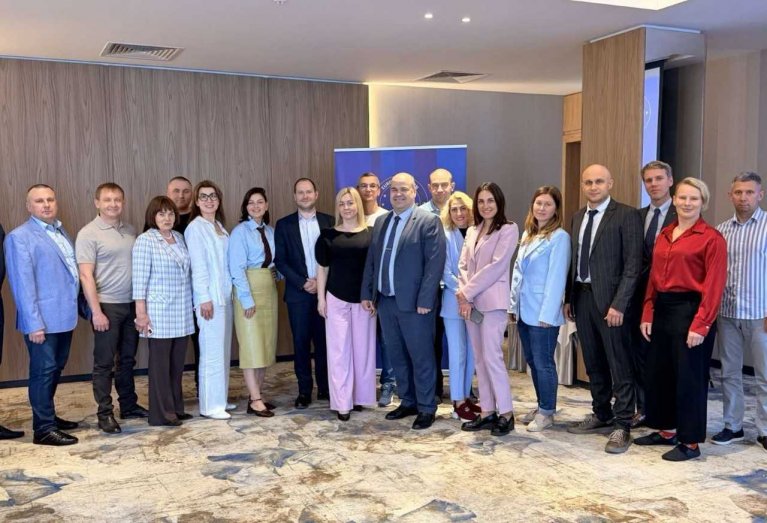
Mykola Mazur, Judge of the Grand Chamber of the Supreme Court, delivered a lecture to first-instance judges on the topic “Rights of the Defence During Criminal Proceedings” and took part in the presentation of a specialized educational and methodological manual titled “Conducting Criminal Proceedings In Absentia”. The event was organized by the National School of Judges of Ukraine with the support of the European Union Advisory Mission in Ukraine.
At the beginning of his speech, Mykola Mazur addressed a fundamental philosophical and legal issue — the relationship and potential conflict between substantive (material) justice and procedural justice. In the judge’s opinion, in a democratic society these two categories are usually complementary; however, in practice, courts often face complex ethical and legal dilemmas when strict adherence to procedural rules may threaten a fair decision on the merits.
To illustrate, the speaker presented a hypothetical case involving the abduction of a person, in which a law enforcement agency, by violating rules of jurisdiction, uncovered a serious crime and rescued the victim. The court is then faced with a difficult question: what should be given priority — the procedural guarantees of the accused or the interests of society and the victim.
The speaker emphasised that such dilemmas do not arise in authoritarian regimes, as the law is used there as a tool of repression. The judge recalled the historical experience of legislation under Nazi Germany, referenced the Gustav Radbruch formula, and stressed that law cannot be separated from justice. At the same time, ignoring procedural guarantees is unacceptable. Using the example of the European Court of Human Rights case Mikheyev v. Russia and the plot of the film “Unthinkable”, Mykola Mazur demonstrated that the legalization of torture or tolerance of procedural rights violations in pursuit of a “quick result” inevitably leads to arbitrariness and the conviction of innocent persons. As U.S. Supreme Court Justice Felix Frankfurter noted in McNabb v. United States (1943), “the history of liberty has largely been the history of observance of procedural safeguards”.
A significant part of the lecture was devoted to the transformation of the court’s role in the modern criminal process. Mykola Mazur emphasized that the court cannot remain a passive arbitrator or mere observer. In accordance with the standards of the European Court of Human Rights, the court acts as a guarantor that the defence has a real, not illusory, opportunity to influence the course of the proceedings and ensure the principle of equality of arms.
The rights provided for by the Criminal Procedure Code of Ukraine and Article 6 of the Convention for the Protection of Human Rights and Fundamental Freedoms must be practical and effective. If a state-appointed defenсe counsel (including in in absentia proceedings) performs inadequately, the court is obliged to intervene to ensure effective defenсe of the accused. At the same time, the speaker emphasized the concept of procedural integrity: the exercise of rights by the defenсe must not turn into an abuse of procedural rights. The court’s task is to find and maintain a balance between the interests of justice and the interests of the defense, compensating for procedural disadvantages of the parties in an adversarial process.
As the European Court of Human Rights determined in the case Ibrahim and Others v. the United Kingdom, the overall fairness of the trial cannot be subject to a single unchanging rule, but depends on the circumstances of the particular case. At the same time, according to the ECtHR’s position in Mirilashvili v. Russia, the cumulative effect of minor procedural shortcomings may indicate a violation of Article 6 of the Convention as a whole, even if each shortcoming individually is not critical.
A separate part of the lecture was devoted to the analysis of the right to examine witnesses (subparagraph “d” of paragraph 3 of Article 6 of the Convention, Part 4 of Article 95 of the Criminal Procedure Code of Ukraine). The principle of direct examination of evidence requires that the court base its conclusions only on testimony that it has directly perceived during the court hearing.
Mykola Mazur analyzed the case law of the Criminal Cassation Court of the Supreme Court. In particular, in its resolution of March 27, 2024, in case No. 730/717/21, the court formulated the position that the term “testimony” covers not only a classic interrogation report, but also any statements made by a person during investigative actions (for example, during a search). The court has no right to base a finding of guilt on such statements without directly examining the person. Moreover, the objective impossibility of examining a witness in court (including due to their death) does not automatically make their pre-trial testimony admissible (resolution of February 10, 2021, in case No. 619/1895/18).
The speaker also drew attention to the requirements of Article 225 of the Criminal Procedure Code of Ukraine regarding the interrogation of a witness by an investigating judge during the pre-trial investigation. According to the resolution of the Criminal Cassation Court of the Supreme Court dated June 18, 2020, in case No. 310/1098/18, when hearing the case on the merits, the court must verify whether exceptional circumstances (threat to life, illness, etc.) actually existed for conducting such an interrogation by the investigating judge and cannot ignore the arguments of the defence on this matter. In the context of martial law (Part 11 of Article 615 of the Criminal Procedure Code of Ukraine), the use of statements obtained during the pre-trial investigation is permitted only on condition that the conduct and results of the interrogation are recorded on video.
In the context of ensuring the right to a fair trial, Mykola Mazur examined in detail the ECtHR case law on the use of statements by witnesses who did not appear in court. Based on the judgment in the case Al-Khawaja and Tahery v. the United Kingdom, a three-part test was presented:
This approach was further developed in the case Schatschaschwili v. Germany (where the absence of compelling reasons for non-appearance is an important but not the only factor in assessing overall fairness), as well as in decisions concerning Ukraine — Boyets v. Ukraine and Chernika v. Ukraine. In these cases, the ECtHR found a violation of Article 6 of the Convention due to the state’s failure to prove that all reasonable measures had been taken to summon the witnesses and the lack of guarantees for verifying their pre-trial statements.
A sensitive aspect is the competition of rights in proceedings involving sexual violence against children. Using the example of the ECtHR case R.B. v. Estonia, the judge explained that the formal application of interrogation rules (in particular, the requirement to explain to a 4-year-old child the right not to testify against her father-abuser) led to the loss of key evidence and the closure of the proceedings. In this case, the ECtHR found a violation of Articles 3 and 8 of the Convention, noting that the state had failed to fulfill its positive obligation to protect the child. At the same time, national case law (resolution of the Criminal Cassation Court of the Supreme Court dated January 17, 2023, in case No. 753/13113/18) demonstrates that refusing to examine a minor victim in order to avoid re-traumatization is justified, but courts must ensure compensatory guarantees for the defence: carefully verify the quality of the pre-trial interview, the admissibility of derivative evidence, and the conclusions of expert examinations. If such guarantees are not provided, the process is considered unfair.
Concluding the lecture, Mykola Mazur emphasized that conducting criminal proceedings, especially under the special in absentia procedure, requires the highest level of legal expertise from a judge, unwavering adherence to Convention standards, and the ability to perform complex balancing of interests in order to achieve true justice.
In addition, at this event, the educational and methodological manual “Conducting Criminal Proceedings In Absentia” was presented. It was prepared by a team of authors: Judge of the Grand Chamber of the Supreme Court, PhD in Law, Associate Professor Mykola Mazur; Judge of the Pokrovsky District Court of Kryvyi Rih Mykhailo Zimin; Judge of the Derhachi District Court of Kharkiv Region Vladyslav Ovsiannikov; and Judge of the Dnipro District Court of Dnipropetrovsk Region, PhD in Law Iryna Shapovalova.
The manual provides a comprehensive study of the procedure for conducting criminal proceedings in the absence of a suspect or accused person (in absentia), which is an important tool for ensuring the inevitability of punishment, especially in cases of corruption, crimes against the foundations of national security, and international public order.
The main content of the publication covers the following key aspects:
The publication is intended for judges, prosecutors, lawyers, and investigators. It contains practical advice and action algorithms for the effective application of the in absentia procedure in accordance with modern rule of law standards.
_03_03.png)