Contact center of the Ukrainian Judiciary 044 207-35-46
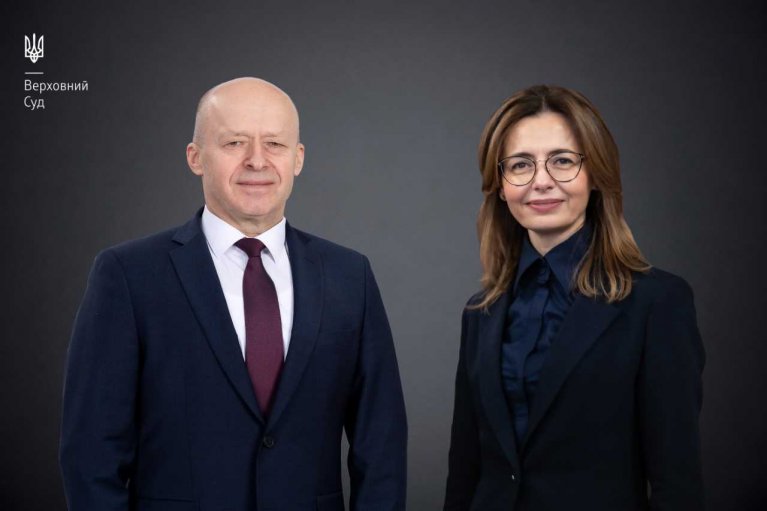
Judges of the Supreme Court in the Administrative Cassation Court Mykhailo Smokovych and Myroslava Bilak delivered speeches at the II International Scientific and Practical Seminar-Workshop titled “Constitutional Foundations of Due Process: Challenges and Prospects of European Integration”.
Mykhailo Smokovych emphasized that the Constitution of Ukraine establishes the fundamental legal principles governing the activities of public authorities (in particular, Articles 3, 5, 6, 8, and 19) and obliges all entities vested with state power to act exclusively in accordance with defined goals. It is the constitutional principles of the rule of law, legality, equality before the law, legal certainty, proportionality, and good governance that define the content and direction of administrative procedure.
The speaker noted that the Law of Ukraine “On Administrative Procedure” has undergone repeated international and national legal expertise. Its compliance with European standards is widely recognized, including the requirements of the Convention for the Protection of Human Rights and Fundamental Freedoms, the Council of Europe’s recommendations on good governance, and the Charter of Fundamental Rights of the European Union.
Mykhailo Smokovych recalled the difficult history of the law’s adoption. In his opinion, the decisive role in its passage was played by the constitutional enshrinement of Ukraine’s European integration course: it was the requirements of the European Union that effectively provided the impetus to finally adopt this document.
At the same time, the judge acknowledged that passing the law is only half the battle. It is the administrative courts, through their decisions, that actually compel public authorities to comply with the law’s requirements — just as judicial practice previously ensured the implementation of freedom of access to public information and freedom of expression.
The speaker also expressed regret that the Parliament did not enshrine in the Law the mandatory pre-trial settlement of disputes within state authorities, even though the Constitution of Ukraine explicitly permits it. In his conviction, such a mechanism would significantly accelerate the practical implementation of the Law.
Separately, Mykhailo Smokovych drew attention to the problem of legal awareness of the Law’s provisions, particularly among representatives of regional structures of state bodies.
The speaker noted that the Ukrainian law is based on the German model of administrative procedure. He also referenced the experience of Latvia, where a similar law has been in force for over 20 years, and the experience of Estonia. He pointed out that after the Latvian law entered into force, the number of administrative disputes increased. This is a natural outcome, as it indicates an expansion of citizens’ opportunities to protect their rights.
In conclusion, Mykhailo Smokovych emphasized that administrative procedure today is a tool for effective public administration and an effective means of dialogue between the individual and the administration. The Law has already extended its effect to social relations that previously lacked proper legal regulation, particularly regarding the revocation of administrative acts and the protection of individuals’ legitimate interests. In connection with the adoption of the Law, amendments were made to nearly 196 legislative acts. Work is also currently underway on a draft of the new Law of Ukraine “On Citizens’ Appeals”, which aims to optimize the relevant administrative procedures.
Summing up, the speaker noted that adopting high-quality laws is not enough — what matters most is who implements them and how. It is this that determines whether Ukrainian society and the state are ready for full integration into the European Union.
Myroslava Bilak delivered a speech dedicated to the doctrinal foundations of due process and their application in Ukrainian constitutional and administrative justice in the context of European integration.
She noted that in Ukraine, the discussion around due process has reached a new doctrinal level. At its centre are two main concepts: the American doctrine of due process and the European doctrine of fair procedures. Both originate from the same source — the principles of natural justice, which form the basis of the rule of law. The primary responsibility for the institutional protection of this principle lies with constitutional and administrative justice.
The speaker pointed out that the principle of the rule of law first emerged precisely as an ideal of procedural justice. Justice, as a component of the rule of law, is intended to improve the quality of the exercise of administrative powers: the principles of natural justice guarantee the objectivity and impartiality of decisions made by public authorities, and ensure proportionality between the objectives of a decision and the prevention of abuse of power with regard to human rights and freedoms.
The judge identified Article 125 of the Constitution of Ukraine as the cornerstone of protecting individuals from arbitrary power. This article defines the purpose of administrative courts as the protection of the rights, freedoms, and interests of individuals in the sphere of public-law relations. It guarantees not only the realization of a person’s rights, but also the adoption of fair acts and the performance of fair actions toward them — especially in areas where human rights are most vulnerable to negative influence by administrative bodies.
The judge cited examples of the application of the fair procedures doctrine by Ukrainian courts.
In particular, in its resolution of November 9, 2021, in case No. 440/2111/19, the Administrative Cassation Court of the Supreme Court emphasized that legal procedure is primarily important for individuals who seek to feel the state’s accountability for its decisions, to have confidence in the observance of the rule of law, and to expect fair treatment and respect for their dignity from the state.
In its resolution dated June 1, 2022, in case No. 826/11507/17, the Administrative Cassation Court of the Supreme Court stated that the established legal procedure for conducting an inspection defines the limits of a state authority’s powers and serves as an important safeguard against abuse in the adoption of decisions that must ensure fair treatment of the individual.
Additionally, the Grand Chamber of the Supreme Court, in its resolution of November 28, 2024, in case No. 990/92/24, noted in particular that granting the High Qualification Commission of Judges of Ukraine discretionary power in assessing a candidate for a judicial position based on the criterion of integrity does not mean that such discretion is unlimited.
Thus, the rule of law is a normative path in the pursuit of justice, which in the public-law sphere is realized through the principle of legality together with proportionality, the right to be heard, the reasonableness of a decision, and good faith. Thanks to the fair procedures doctrine, public authorities are compelled to move away from procedural formalism, making the system of power more transparent and predictable for people.
Myroslava Bilak also drew attention to the decision of the Constitutional Court of Ukraine dated July 18, 2024, in which the Court determined that the right to be heard, as a component of the right to judicial protection, must be realized before the state takes any measures that may negatively affect the individual. This right derives from the fundamental principles of justice (Part 2 of Article 129 of the Constitution of Ukraine) and does not depend on its detailed regulation in special legislation.
The judge emphasised that it is of fundamental importance that the established criteria for a fair trial are not limited to court proceedings; they apply equally to pre-trial proceedings.
Referring to the works of Oxford University Professor Denis Galligan, the speaker provided a detailed distinction between the two doctrines. Due process prohibits the state from restricting the right to life, liberty, and property without applying due legal procedure. Fair procedures, by contrast, is not limited to the protection of the right to life, liberty, or property — it extends to all administrative acts and actions. This is confirmed by the case law of the Court of Justice of the EU, which consistently applies this very doctrine, relying on Article 41 of the EU Charter of Fundamental Rights.
Common to both doctrines are the principles of natural justice, which oblige public authorities to protect human dignity even when adopting a negative decision: the individual must understand the reasons for it, the decision must be properly reasoned, adopted transparently, and the party must be heard not merely formally, but with due consideration of their best interests.
Administrative law always seeks a balance between human rights and the needs of the state. Where public authorities are granted unlimited discretion, it is precisely fair procedures that places their decisions within the doctrinal boundaries of natural justice. This is why a judicial mechanism exists for reviewing administrative acts in accordance with the principles of Article 2 of the Code of Administrative Procedure of Ukraine.
Myroslava Bilak noted that the Supreme Court, being aware of its responsibility on Ukraine’s path toward EU membership, consistently applies these principles in line with EU standards, referring not only to the case law of the European Court of Human Rights but also to the approaches of the Court of Justice of the EU. Given the nature of the due process and fair procedures doctrines, they can be viewed as two sides of the same coin (natural justice), with the difference lying only in the aspect of their application.
The event was organized by Yuriy Fedkovych Chernivtsi National University in cooperation with the Constitutional Court of Ukraine, with the support of projects of the Organization for Security and Co-operation in Europe (OSCE).
_03_03.png)