Contact center of the Ukrainian Judiciary 044 207-35-46
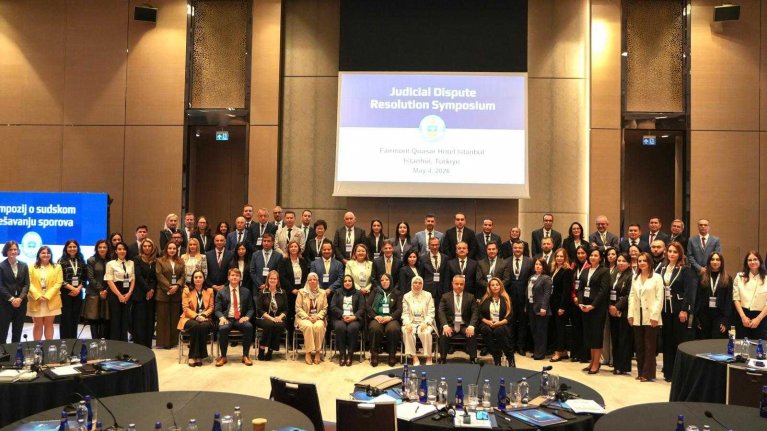
Larysa Rohach, President of the Commercial Cassation Court within the Supreme Court, and Kostiantyn Pilkov, Judge of the Grand Chamber of the Supreme Court, took part in a two-day regional judicial exchange on Alternative Dispute Resolution (ADR) and the Global Colloquium on ADR. The events were held in Istanbul (Republic of Türkiye) with the support of the Commercial Law Development Program (CLDP) of the U.S. Department of Commerce.
The events brought together judges, representatives of alternative dispute resolution centers, bar associations, and judicial training institutions from the United States, European countries, Asia, the Middle East, and North Africa. The professional discussions focused on the recognition and enforcement of foreign arbitral awards, the role of state courts in supporting arbitration and mediation, and the development of specialized training for judges in the field of ADR.
The regional judicial exchange, dedicated to key challenges in the field of alternative dispute resolution, took place on May 4–5, 2026. The Global Colloquium on ADR was held on May 6, 2026, with the participation of judges, representatives of ADR centers, and leaders of professional bar associations. During the colloquium, a new manual titled Alternative Dispute Resolution: Practice & Governance for States was presented. It summarizes practical approaches to alternative dispute resolution for policymakers and participants in legal proceedings. The manual includes best practices for every stage of both mediation and arbitration, as well as recommendations for improving the legal regulation of ADR, taking into account the many years of reform experience developed by the Commercial Law Development Program (CLDP).
As part of the program, Kostiantyn Pilkov spoke during the discussion on modern approaches to alternative dispute resolution, the development of international arbitration and mediation. In his speech, the judge highlighted the peculiarities of building a culture of resolving commercial disputes in Ukraine, the obstacles to the effective use of ADR (particularly mediation), and recent pro-arbitration practices of the Supreme Court. He also shared with colleagues from other countries Ukraine’s experience in addressing issues related to supporting arbitration.
During the events, Larysa Rohach discussed with the organizers the prospects for further development of alternative dispute resolution in Ukraine, particularly regarding support for relevant educational and institutional initiatives, the development of specialized training for judges, and the wider adoption of ADR practices in commercial litigation.
In addition, participants reviewed current trends in international commercial and investment disputes, the role of institutional design in responding to new challenges, and the prospects for developing specialized training programs and Training of Trainers (ToT) initiatives in the field of ADR, tailored to the specific needs of each jurisdiction.
Participation in such international professional events helps familiarize participants with current approaches to alternative dispute resolution, the practice of applying peaceful dispute settlement procedures in various jurisdictions, and developments that can be used to further advance and improve national judicial practice.
_03_03.png)