Contact center of the Ukrainian Judiciary 044 207-35-46
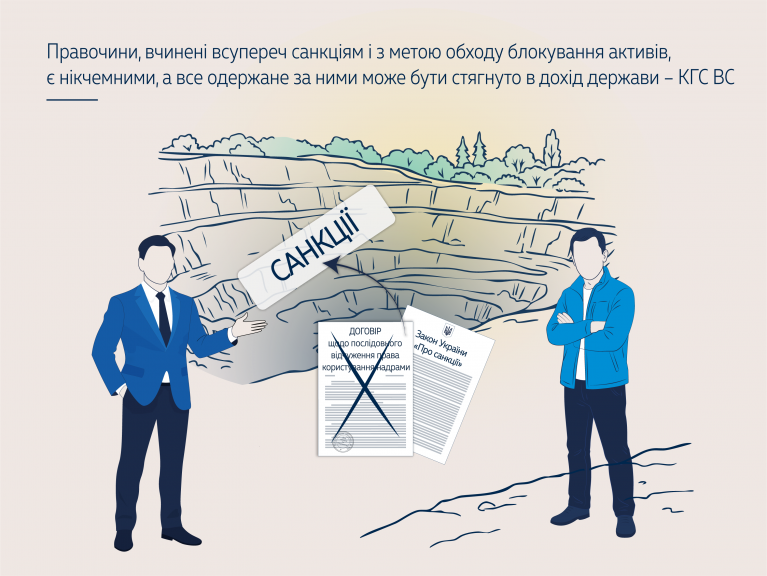
Transactions aimed at alienating assets in violation of sanctions imposed by the Law of Ukraine “On Sanctions” contravene public order and are null and void regardless of their formal invalidation by a court. If the parties’ intent to commit such transactions is established, the court may apply special consequences of invalidity, in particular, the recovery of everything received under the transaction to the state revenue.
This conclusion was reached by the Commercial Cassation Court within the Supreme Court.
The plaintiff company filed a lawsuit seeking to invalidate contracts for the successive alienation of the right to use subsoil resources, formalized by a special permit for the use of the Korosten (Stremyhorod) deposit, and to apply the consequences of the invalidity of these transactions.
The courts established that the special permit belonged to JSC “Korostensky Quarry”, whose controlling stake was under the control of individuals against whom the National Security and Defence Council of Ukraine had imposed sanctions in the form of asset blocking. After the sanctions were applied, the right to use the subsoil was successively alienated between related entities: first to LLC “Novel Prom” for UAH 1 million, and later to LLC “Korostenska Vydobuvna Kompaniya” for UAH 2.1 million, whereas the real value of the special permit exceeded UAH 32 million.
The court of first instance, with which the appellate commercial court agreed, dismissed the claims for invalidation of the contracts on the grounds that such transactions are null and void.
When reviewing the case, the Commercial Cassation Court of the Supreme Court noted that sanctions in the form of asset blocking apply not only to the formal owner of the asset, but also to assets over which the sanctioned person may directly or indirectly exercise control or disposal. The court rejected the appellants’ arguments that changing the beneficial owner eliminated the violation of sanctions legislation. The Commercial Cassation Court emphasized that sanctions were applied both to the beneficiaries and directly to the companies associated with the disputed assets, and therefore their effect continued to extend to the relevant legal relations.
The Commercial Cassation Court of the Supreme Court stressed that public order encompasses the fundamental interests of the state and society, including economic security, and that transactions aimed at circumventing sanctions and withdrawing assets from blocking are null and void.
The Court drew attention to circumstances indicating the artificial nature of the disputed transactions: the successive alienation of the special permit within a short period of time, the sale of the asset at an undervalued price, the absence of actual use of the subsoil use right by the first acquirer, and the subsequent alienation of the special permit on the same day it was re-registered.
The Commercial Cassation Court of the Supreme Court agreed with the conclusions of the lower courts regarding the existence of intent on the part of the defendants to commit transactions that contradict the interests of the state and society, and confirmed the existence of grounds for applying the special consequences provided for in Part 3 of Article 228 of the Civil Code of Ukraine. The Court separately emphasized that such consequences constitute a type of confiscation sanction by the state.
In addition, the Supreme Court agreed with the conclusions of the previous instances that there were no grounds for transferring the dispute to be considered within the bankruptcy case of LLC “Korostenska Vydobuvna Kompaniya”, taking into account the circumstances indicating the artificial creation of debt and the initiation of bankruptcy proceedings.
Following the review, the cassation appeals were left unsatisfied, and the decisions of the previous courts were upheld without changes.
Resolution of the Commercial Cassation Court of the Supreme Court dated March 31, 2026, in case No. 910/11526/24 — http://reyestr.court.gov.ua/Review/136280578.
This and other legal positions of the Supreme Court can be found in the Database of Legal Positions of the Supreme Court - https://lpd.court.gov.ua.
_03_03.png)