Contact center of the Ukrainian Judiciary 044 207-35-46
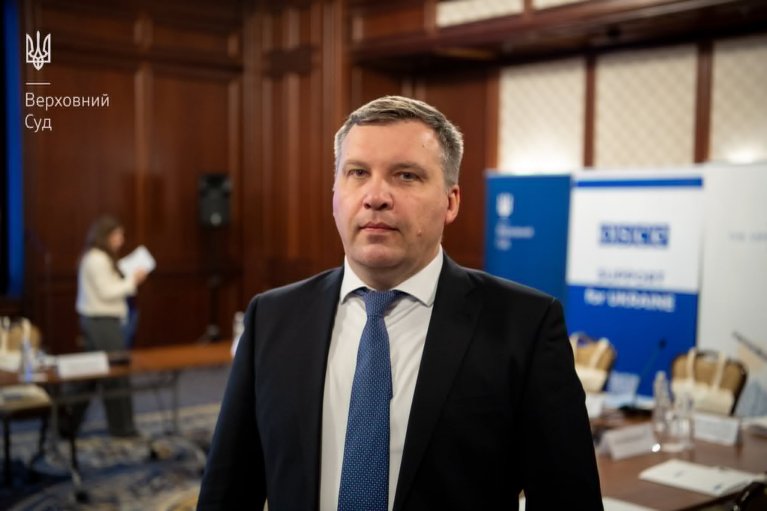
The case law of the Court of Justice of the European Union serves as an important guideline for Ukrainian courts when interpreting national legislation in the process of Ukraine’s European integration and the further application of EU law provisions. This was emphasized by Vitalii Urkevych, Judge of the Grand Chamber of the Supreme Court, during a session dedicated to the use of Court of Justice of the EU decisions in the practice of the Supreme Court. The session was held as part of the certificate educational programme Invisible University for Ukraine, established in spring 2022 at the Central European University.
Vitalii Urkevych recalled that Ukraine officially received candidate status for European Union membership on June 23, 2022, and in December 2023, the European Council decided to open official accession negotiations with Ukraine. The judge noted that the Association Agreement between Ukraine and the EU was signed back in 2014, which provides for a mechanism of gradual approximation of Ukrainian legislation to EU law (acquis communautaire).
According to the speaker, the Association Agreement not only declares cooperation between Ukraine and the European Union but also establishes legal obligations for the effective implementation and application of European standards in national law. He paid particular attention to the fact that in certain areas, the provisions of the Agreement directly require the interpretation of norms in accordance with the practice of the Court of Justice of the EU.
As an example of this approach, Vitalii Urkevych cited the ruling in case No. 910/9627/20 concerning the unlawfulness of charging fees for electricity transmission services during its export. The Grand Chamber of the Supreme Court took into account the provisions of the Treaty establishing the Energy Community, as well as the judgment of the Court of Justice of the EU in the case FENS v. Slovak Republic, in which the Court emphasized that any payments related to the crossing of goods across the border may create obstacles to the free movement of goods. As a result, the Grand Chamber of the Supreme Court concluded that the disputed tariff did not comply with Article 41 of the Treaty establishing the Energy Community.
The judge also referred to the case law of the Grand Chamber of the Supreme Court in intellectual property rights protection disputes. In particular, in the ruling in case No. 910/13988/20 concerning the recognition of a trade mark as well-known and the invalidation of the certificate for a mark for goods and services, the Supreme Court referred to the judgment of the Court of Justice of the EU in the case Budějovický Budvar v. Anheuser-Busch regarding the interpretation of the doctrine of acquiescence. Vitalii Urkevych noted that although this doctrine is not enshrined in Ukrainian legislation, the practice of the Court of Justice of the EU demonstrates an approach according to which the long-term good-faith coexistence of two trade marks may be permissible.
Another example was the ruling in case No. 910/8781/23 regarding the early termination of a trade mark certificate due to its non-use. The Grand Chamber of the Supreme Court took into account the provisions of EU Regulation No. 2017/1001 and the case law of the Court of Justice of the EU in the case Markus Schneider v. European Union Intellectual Property Office, according to which the five-year period of trade mark use includes its use by all owners, and not only by the last rights holder.
In conclusion, Vitalii Urkevych noted that the Supreme Court emphasizes that decisions of the Court of Justice of the EU make it possible to establish the content of the provisions of EU legislative acts, and the principles formulated in these decisions may be taken into account by Ukrainian courts when resolving similar legal issues, even in cases concerning other states.
The presentation by Vitalii Urkevych is available in English at https://court.gov.ua/storage/portal/supreme/prezent2026/Judgements_of_the_Court_of_Justice_of_the_EU_13_05_2026.pdf.
_03_03.png)