Contact center of the Ukrainian Judiciary 044 207-35-46
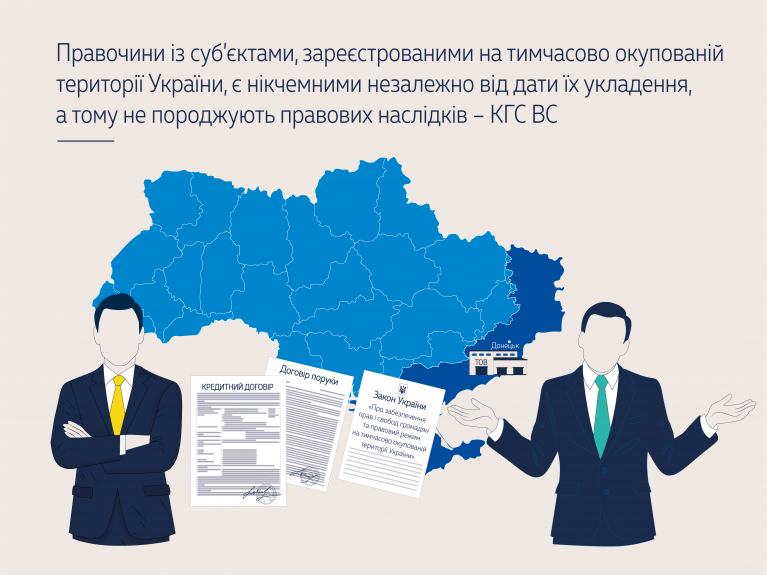
A legal transaction to which a business entity located in the temporarily occupied territory of Ukraine is a party is void in accordance with Art. 13 of the Law of Ukraine "On Ensuring the Rights and Freedoms of Citizens and the Legal Regime in the Temporarily Occupied Territory of Ukraine" in the wording that entered into force on November 21, 2021, regardless of the date of conclusion of such a legal transaction, since the specific features of the state policy to ensure the state sovereignty of Ukraine in the temporarily occupied territories apply to the entire period of occupation, which excludes the application of the general rule of non-retroactivity of the law in time.
Such a conclusion was reached by the panel of judges of the Commercial Cassation Court within the Supreme Court.
The bank filed a lawsuit against an LLC and a guarantor for the joint and several recovery of debt under a loan agreement. The lawsuit is substantiated by the borrower's improper performance of obligations under the loan agreement and the guarantee agreement.
By the decision of the commercial court, left unchanged by the resolution of the appellate commercial court, the claims were dismissed. The courts proceeded from the fact that the supplementary agreements to the loan agreement and the guarantee agreement, concluded after April 7, 2014, are void in accordance with Art. 13 of the Law of Ukraine "On Ensuring the Rights and Freedoms of Citizens and the Legal Regime in the Temporarily Occupied Territory of Ukraine", since the defendant is registered in the city of Donetsk – in the temporarily occupied territory.
The courts noted that legal transactions with a business entity whose location is the temporarily occupied territory are void, and therefore cannot serve as a proper legal basis for the asserted claims. At the same time, the plaintiff did not assert claims for the recovery of funds as unjustly enriched (Art. 1212 of the Civil Code of Ukraine) or for the application of the consequences of the voidness of a legal transaction (Art. 216 of the Civil Code of Ukraine).
In addition, the courts established that the guarantee had terminated, in particular, due to changes in the obligation without the proper consent of the guarantor and the voidness of the respective supplementary agreements.
The SC CommCC noted that the provisions of Art. 13 of the Law of Ukraine "On Ensuring the Rights and Freedoms of Citizens and the Legal Regime in the Temporarily Occupied Territory of Ukraine" are subject to application taking into account the special legal regime of occupation, which covers the entire period of such occupation. Accordingly, the voidness of legal transactions with entities registered in the temporarily occupied territory extends to the disputed legal relations as well.
The Cassation Court agreed with the conclusions of the courts of lower instances to dismiss the lawsuit, noting that the legal basis chosen by the plaintiff is improper due to the voidness of the respective legal transactions.
Resolution of the Commercial Cassation Court within the Supreme Court dated 19 March 2026 in case No. 905/238/23 https://reyestr.court.gov.ua/Review/135155908.
This and other legal conclusions of the Supreme Court can be found in the Database of Legal Positions of the Supreme Court – https://lpd.court.gov.ua.
_03_03.png)