Contact center of the Ukrainian Judiciary 044 207-35-46
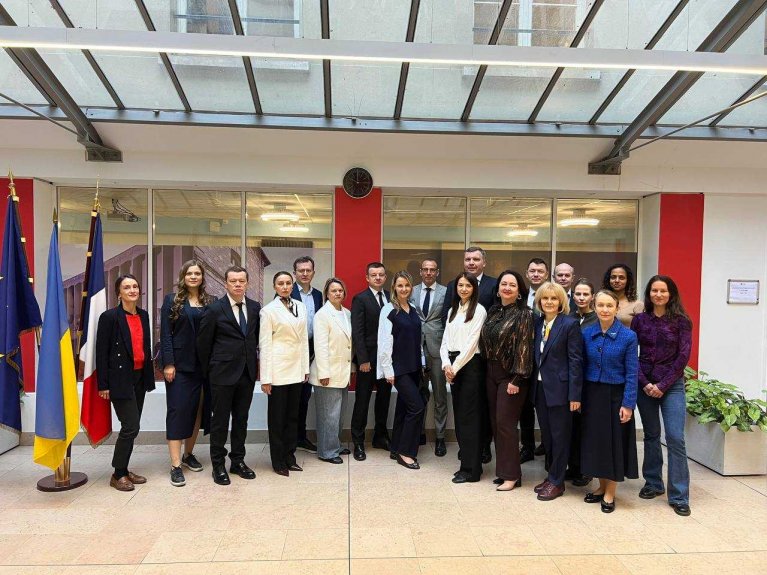
President of the Administrative Cassation Court within the Supreme Court Ihor Dashutin, Judge of the Grand Chamber of the Supreme Court Vitalii Urkevych, and Judge of the Supreme Court in the Criminal Cassation Court Nataliia Bilyk joined a study visit to Paris (French Republic). The purpose of the visit was to practically examine the mechanisms for implementing the rule of law standards and to study best practices in the justice systems of EU countries.
During the event, the Supreme Court judges visited the Court of Cassation, the Directorate of Judicial Services of the Ministry of Justice, the Council of State, the High Council of the Judiciary, and the National School of the Judiciary of France. The participants learned about French approaches to ensuring judicial independence, disciplinary liability and the appointment of judges, the role of the cassation instance in ensuring uniformity of case law, the digitalization of justice, and other areas. Particular attention was paid to establishing dialogue between the judiciary, society, and the media, as well as tools for building public trust in the justice system.

During the study visit, the President of the Administrative Cassation Court Ihor Dashutin thanked the hosts for their systematic support in strengthening the rule of law in Ukraine. He emphasized the special importance of Ukrainian-French cooperation during the war and highlighted the value of professional dialogue and experience exchange.
The speaker noted that the independence of the judiciary is a fundamental constitutional principle, but its real implementation becomes especially important in the face of modern challenges. He stated that the Ukrainian judicial system operates under unprecedented challenges caused by the war: heightened security risks, damage to court infrastructure, significant procedural workload, staff shortages, and public and informational pressure. In this context, France’s experience regarding institutional guarantees of judicial independence is extremely valuable for Ukraine.
Speaking about the development of effective disciplinary mechanisms, Ihor Dashutin noted that trust in the judiciary directly depends on the transparency, objectivity, and professionalism of procedures for holding judges accountable. At the same time, he emphasized that such mechanisms should not be used as a tool to exert influence on judges. The priority must be to strike a balance between judicial accountability and guarantees of their independence.

The speaker paid particular attention to the digital transformation of the judicial system. For Ukraine, digitalization is not just a development vector, but a necessary condition for ensuring the continuity of justice under martial law. For administrative courts, this was particularly important, as it has allowed citizens to maintain access to justice even in situations of evacuation, forced displacement, or temporary occupation of territories.
Judge of the Grand Chamber of the Supreme Court Vitalii Urkevych, during the visit to the Court of Cassation of France, emphasized the role of the cassation instance as a key element in ensuring the uniformity of case law. He noted that it is the Supreme Court that is responsible for ensuring uniform interpretation of legal norms, the consistency of legal positions, and legal certainty. Therefore, the experience of the French cassation courts is of great importance for Ukraine.

During a professional discussion at the highest judicial body of France, in which Supreme Court Judge Nataliia Bilyk took part, the Supreme Court judges discussed with their French colleagues the mechanism of preliminary rulings (prejudicial requests) by judges of first and appellate instances to the Court of Cassation, the application of “cassation filters”, approaches to formulating conclusions on the application of legal norms by the cassation court, as well as the prospective and retrospective effect of such legal conclusions.
The event was organized by the EU Project Pravo-Justice.

_03_03.png)