Contact center of the Ukrainian Judiciary 044 207-35-46
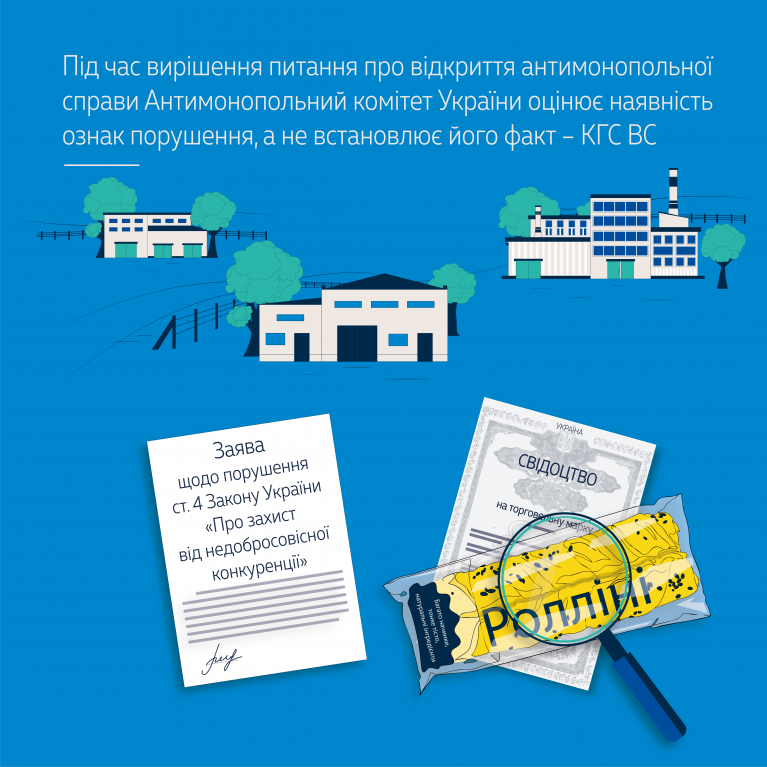
When resolving the issue of refusing to consider an application regarding a violation of Article 4 of the Law of Ukraine “On Protection against Unfair Competition”, the Antimonopoly Committee of Ukraine is obliged to verify the presence of signs of the objective elements of the offence, and not to establish the fact of its commission on the merits. Failure to fulfill this obligation, in particular through a formal or incomplete examination of the application, constitutes grounds for canceling the relevant decision of the Committee.
This conclusion was reached by a panel of judges of the Commercial Cassation Court within the Supreme Court.
The claimant’s company is a manufacturer of semi-finished products under the trade mark “Rollini” (since 2017). The natural person is the owner of the trade mark and industrial design for the relevant semi-finished products, while the LLC received exclusive licenses for their use. In 2024, it was discovered that two other enterprises were selling similar products with similar designations and had filed applications for registration in the same Nice Classification classes as “Rollini”.
The LLC filed a complaint with the Antimonopoly Committee of Ukraine (AMCU) regarding unfair competition. However, the AMCU issued an order refusing to consider the application on the grounds that the external appearance of the product was not recognized as a designation, the use of the disputed sign had not been proven, and no signs of violation had been established. Subsequently, the natural person and the LLC filed a lawsuit against the AMCU seeking to cancel the aforementioned order and to compel the Committee to consider the application.
The commercial court granted the claim in its decision, which was upheld by the ruling of the appellate commercial court. The courts of previous instances found that the AMCU had not thoroughly and comprehensively investigated the facts, in particular: the priority of use of the trade mark and the form of the claimant’s product; the possibility of confusion of business activities due to the similarity of the products; the applications filed by third parties for the same Nice Classification classes as “Rollini”; distribution agreements confirming the commercial use of the disputed form.
The Commercial Cassation Court of the Supreme Court, upholding the court decisions of the previous instances, stated that at the stage of deciding on the opening of proceedings, the AMCU must establish the presence of signs of a violation, rather than prove the fact of the offence on the merits. At the same time, any refusal to consider the case must be properly motivated and based on a full examination of the circumstances set out in the application.
The Court emphasized that the AMCU is obliged to provide an exhaustive and reasoned assessment of all the applicant’s arguments; a formal approach to the analysis of evidence is unacceptable; the lack of proper investigation of the circumstances (in particular, regarding the use of designations and the similarity of products) indicates a violation of the requirements of the legislation. Courts do not interfere with the discretion of the AMCU but check the legality of its exercise.
The Commercial Cassation Court of the Supreme Court noted that the contested order of the AMCU did not meet the criteria of substantiation and completeness, and therefore was lawfully canceled with an obligation for a new consideration of the application.
Thus, the Supreme Court confirmed that improper motivation and incomplete clarification of the circumstances when refusing to open a case on unfair competition constitute an independent ground for canceling the relevant decision of the AMCU.
Resolution of the Commercial Cassation Court of the Supreme Court dated 19 March 2026 in case No. 910/980/25 – http://reyestr.court.gov.ua/Review/135082697.
This and other legal positions of the Supreme Court can be found in the Database of Legal Positions of the Supreme Court - https://lpd.court.gov.ua.
_03_03.png)