Contact center of the Ukrainian Judiciary 044 207-35-46
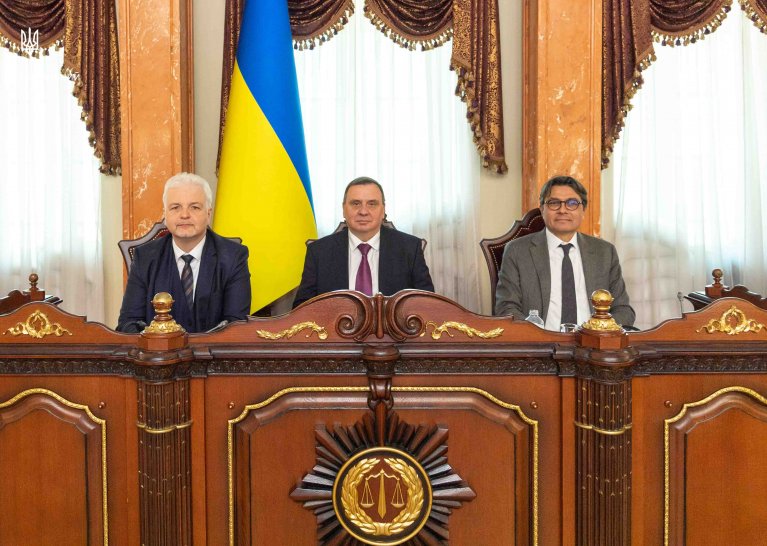
The case law of the European Court of Human Rights has become for Ukraine not only a guideline in shaping a modern European model of justice, but also a powerful catalyst for systemic changes. Its impact has long gone beyond individual judgments — today it shapes the very architecture of justice.
This was emphasized by the President of the Supreme Court, Stanislav Kravchenko, during the opening of the international conference "National Courts and the ECtHR: The Role of Each, Interaction, Dialogue" — an event that brought together a wide professional community: judges of the Supreme Court, of the European Court of Human Rights, the Constitutional Court of Ukraine, local and appellate courts, representatives of judicial authorities, ministries, international and non-governmental organizations, diplomatic missions, as well as scholars and students.
The President of the Supreme Court emphasized that the visit of the President of the ECtHR, Mattias Guyomar, and his participation in this event testify to the deep interaction between the national and European judicial systems, as well as the unwavering support for Ukraine.
.jpg)
"Today, the Ukrainian judicial system is an integral part of the European legal space — a space of shared values and standards. We do not merely apply the case law of the ECtHR — we integrate it into our way of thinking and daily work. The future of the European legal space is created through judicial dialogue, mutual trust, and shared responsibility for the protection of human rights. And it is of great value to us that the Ukrainian judicial system and the ECtHR are walking this path together," – Stanislav Kravchenko noted.
The President of the Supreme Court also expressed his gratitude to the Council of Europe for its expert support, particularly regarding law enforcement under martial law, its leading role in establishing the Register of Damage Caused by the Aggression of the Russian Federation Against Ukraine, and the Special Tribunal for the Crime of Aggression.
The formation of an international compensation mechanism and holding the perpetrators accountable, in Stanislav Kravchenko's conviction, are essential elements of ensuring justice, and in this process, the interaction between the national judicial system and the ECtHR is extremely important: its case law will become part of Europe's collective response to unprecedented violations of human rights and international law.
In this context, the President of the Supreme Court remarked that the decision in the case of Ukraine and the Netherlands v. Russia is, without exaggeration, historic, as it goes beyond a purely legal act and serves as a powerful moral and political signal from Europe to the aggressor state, confirming the moral authority of the ECtHR and its role in defending the principles of peace, dignity, and the rule of law.
At the same time, according to Stanislav Kravchenko, despite the ongoing armed aggression, Ukraine has not abandoned its European integration aspirations and consistently continues to implement the necessary reforms. Harmonization of approaches, consistency of judicial practice, and integration of the standards of the Convention for the Protection of Human Rights and Fundamental Freedoms are the reality in which every Ukrainian judge operates, and in this reality, the key is not only the application of norms but a mutual understanding of legal approaches formed both at the national level and at the level of the European Court of Human Rights.
And today it is obvious: the quality of justice is impossible without the unity of law enforcement, and unity is impossible without knowledge. That is why the Supreme Court pays special attention to educational activities. Within the framework of cooperation with international partners, in particular the Council of Europe, the Supreme Court has established a system of continuous professional development, which includes regular nationwide roundtables, specialized training programs, and international conferences. The direct participation of ECtHR judges in these events is of particular value, providing an opportunity to foster a live dialogue that builds trust and a shared understanding of law.
Furthermore, as the President of the Supreme Court noted, the Supreme Court systematically works to ensure that the case law of the ECtHR is accessible and understandable to the Ukrainian legal community: it translates judgments and prepares overviews of ECtHR practice, publishes analytical materials, and regularly develops digital tools that enable quick and convenient searches for relevant ECtHR case law on specific issues.
Thus, in February 2025, as a result of cooperation with the ECtHR, the Ukrainian-language version of the ECtHR Knowledge Sharing Platform was launched. This is not merely a technical project — it is a new format of institutional interaction that provides systematic access for Ukrainian judges and legal professionals to the Court's case law, analytical materials, and consolidated approaches to the application of the Convention.
Another important stage in deepening the interaction between the Supreme Court and the ECtHR was the application of Protocol No. 16 to the Convention. For the first time in the history of Ukraine, the Supreme Court submitted two requests to the ECtHR for advisory opinions, pioneering a new format of direct legal dialogue between the courts.
In conclusion, Stanislav Kravchenko expressed his gratitude to the CoE Human Rights and Justice Cooperation Department within the framework of the projects "Support to Ukraine in Implementation of the Council of Europe Standards on the Judiciary" and "Enhancing Judicial and Non-Judicial Remedies for the Protection of the Rights of War-Affected Persons in Ukraine" for their support in organizing this event.
.jpg)
The moderator of the welcoming part of the conference — Judge of the Supreme Court in the Cassation Criminal Court, Oleksandra Yanovska — emphasized that under the conditions of full-scale Russian armed aggression against Ukraine, it is extremely important for national courts to remain faithful to the principle of the rule of law. By administering justice even under such extremely difficult circumstances, we remain part of the European space. And in this space, the European Court of Human Rights is a core, system-forming institution.
Addressing the participants of the event with a welcoming speech, the President of the European Court of Human Rights, Mattias Guyomar, assured that his visit to Ukraine and the Supreme Court in particular is, above all, an expression of solidarity from the ECtHR judges with the Ukrainian judicial community at a time when Ukraine is resisting russian armed aggression. Furthermore, it is a contribution to supporting judicial dialogue, as well as highlighting the role of the ECHR in holding russia accountable for gross violations of human rights.
The European Court of Human Rights, Mattias Guyomar noted, recognizes the resilience of the Ukrainian judicial system and its ability to adapt to wartime conditions. "For us judges, it is important to stand together in the face of external existential threats: war and increasing attacks on multilateralism and the rule of law," the President of the ECtHR stated.
.jpg)
In the context of maintaining interpersonal and institutional dialogue within the judicial community of Europe, Mattias Guyomar emphasized that it is shared responsibility that ensures compliance with the Convention for the Protection of Human Rights and Fundamental Freedoms and serves as the driving force of the conventional system — a system that relies on a shared understanding of human rights and draws inspiration from the political and legal traditions of member states.
For such shared responsibility to be effective, as envisaged in the 2018 Copenhagen Declaration, interaction must prevail at both national and European levels. Constructive and open dialogue is needed to help judicial systems define their respective roles in the implementation and development of the conventional system.
As the President of the ECtHR recalled, an example of such an effective and substantive dialogue is the Supreme Court's referral to the European Court of Human Rights for advisory opinions under Protocol No. 16. According to him, the ECHR delivers such opinions and adopts decisions taking into account the principle of subsidiarity and respect for the role of national judicial systems in implementing conventional norms.
For instance, in its judgment in the case of Borzykh v. Ukraine, the Court noted that national authorities should be afforded due deference in assessing matters that can be fully understood only by those embedded in the specific historical, social, and political context, particularly in situations involving the need to protect national security.
Furthermore, recently in its judgment in the case of Boyarov and Others v. Ukraine, the ECtHR recognized that the state has the right to respond to the threats of digital and information warfare, including by restricting access to Russian digital platforms that can be used as tools of influence.
Mattias Guyomar also spoke on the role of the ECtHR in ensuring justice for those who suffered human rights violations as a result of the russian federation's war against Ukraine. He highlighted that the ECtHR remains the only international judicial body capable of holding russia accountable for violations of human rights protected by the Convention. This was made possible by the Court's historic decision in March 2022 to retain residual jurisdiction over the russian Federation even after its exclusion from the Council of Europe.
This function of the ECtHR complements the role of the international Register of Damage Caused by the Aggression of the russian federation, the future International Claims Commission for Ukraine, and the Special Tribunal for the Crime of Aggression against Ukraine, which will operate under the auspices of the Council of Europe and form part of the international compensation mechanism.
Currently, there are already prominent examples — the ECtHR judgments in the interstate cases Ukraine v. Russia (re Crimea) and Ukraine and the Netherlands v. Russia. In these judgments, the Grand Chamber of the ECtHR held russia responsible for gross violations of human rights committed in the context of the armed conflict (starting from February 2014) and since the full-scale invasion in February 2022.
Hence, the ECtHR judgments establish the historical truth and ensure the documentation of the facts of violations committed by Russia. At the same time, with its findings, the Court contributes to supporting the sovereignty of Ukraine, which is particularly important as we witness the gradual dissolution of the international legal order, Mattias Guyomar added.
"I am convinced that now, more than ever, law must be used to restore order in the world. National and international courts are partners in this endeavor. Together, we defend the conventional norms that serve as the foundations of justice and peace in the world. There can be no just and lasting peace without law and full respect for human dignity. The protection of these values is our shared responsibility," the President of the ECtHR concluded.
The Acting President of the Constitutional Court of Ukraine, Oleksandr Petryshyn, pointed out that the interaction between the Constitutional Court of Ukraine, the Supreme Court, and the European Court of Human Rights is not limited to the classical perception of the ECtHR's case law as an external formal source of law. As the speaker explained, the ECtHR, the CCU, and the Supreme Court are methodologically on the same page, adhering to the principles of the rule of law, democracy, and the protection of human rights. However, there are still some differences, particularly textual ones.
.jpg)
Oleksandr Petryshyn noted that the judgments of the ECtHR serve as a guideline for the CCU, which cites ECtHR judgments and refers to its practice in its own decisions. At the same time, according to him, it is not about a formal application of these positions, but rather about using them as supportive arguments and a source of inspiration.
In addition, the Acting President of the Constitutional Court of Ukraine assured that the CCU highly appreciates the significant strengthening of ties with the Supreme Court in recent years.
"The strengthening of these ties is not just about holding joint events, but primarily about dialogue, about striving for a mutual understanding of common problems, particularly those related to ensuring the enforcement of judicial decisions," Oleksandr Petryshyn said. Today, a special dimension of such dialogue is the individual constitutional complaint, which is increasingly establishing itself as a key element of the national human rights protection mechanism. This institution is also expanding in the activities of constitutional courts across European countries.
In Oleksandr Petryshyn's conviction, a complex issue facing constitutional justice in wartime is exercising control over emergency measures. According to the current practice of the CCU, the speaker noted, any emergency measures must be aligned not only with the necessity that exists now under martial law, but also with the principles of the rule of law, democracy, and the protection of human rights.
Oleksandr Petryshyn remarked that the full-scale war unleashed by the russian federation against Ukraine raised another fundamental question: "Can constitutional democracy be preserved under conditions of emergency threats and war?". According to the Acting President of the CCU, democracy should not be merely a humanitarian achievement. Democracy must be able to defend itself, while at the same time not encroaching upon fundamental democratic principles.
The case law of the ECtHR has become one of the key factors in the transformation of the Ukrainian judicial system, and further judicial reform must be based on the systematic integration of European standards into national legislation and judicial practice. This was emphasized by the Chairman of the High Council of Justice, Hryhorii Usyk. He noted that the judicial system continues to operate in conditions of staff shortages, systemic underfunding, and challenges caused by the war; therefore, filling vacant judicial positions, optimizing the court network, and digitalizing court proceedings remain among the priorities.
The speaker drew attention to the fact that ECtHR judgments not only established human rights violations but also served as a basis for reforming the judicial system. Specifically, the case of Oleksandr Volkov v. Ukraine influenced the reform of judicial governance bodies and the creation of a new model for the HCJ, while the case of Yuriy Mykolayovych Ivanov v. Ukraine contributed to reforming the system of enforcement of judicial decisions and introducing the institution of private enforcement officers.
%20(1).jpg)
Separately, the Chairman of the HCJ emphasized that the High Council of Justice systematically applies ECtHR case law in disciplinary proceedings against judges, using the criteria of legality, legitimate aim, and proportionality of interference. The speaker also noted that one of the most crucial tasks for the judicial system today is restoring justice for individuals affected by the war, and holding perpetrators of war crimes accountable must become an important prerequisite for preventing such crimes in the future.
The Chairman of the Subcommittee on the Enforcement of ECtHR Judgments and Alternative Dispute Resolution of the Committee of the Verkhovna Rada of Ukraine on Legal Policy, Roman Babii, pointed out that ensuring the enforcement of ECtHR judgments and implementing its standards cannot be solely the responsibility of the judiciary. According to him, the effective resolution of systemic problems requires the joint effort of the parliament, judges, and executive authorities, and one of the key mechanisms for overcoming such problems is introducing legislative amendments and monitoring their proper implementation.
The speaker emphasized that the role of judges lies not in mechanically citing ECtHR judgments, but in adapting the standards of the Convention for the Protection of Human Rights and Fundamental Freedoms to the Ukrainian legal field and the realities of wartime and post-war periods. In this context, training for judges, preparing methodological materials, and developing unified approaches to the application of ECtHR case law remain critical.
.jpg)
Separately, he outlined a number of problems whose resolution requires legislative changes and active parliamentary involvement. These include, in particular, the issue of disciplinary liability of judges, conditions of detention, enforcement of national court judgments, especially in cases against the state, as well as the excessive length of judicial proceedings. Furthermore, the parliamentary representative drew attention to the importance of further implementing the mechanism of ECtHR advisory opinions provided for by Protocol No. 16 to the Convention.
The need for close interaction between courts, prosecution bodies, and the law enforcement system to respect human rights and ensure effective criminal prosecution was addressed by the Deputy Prosecutor General, Andriy Leshchenko. The speaker noted that the implementation of ECtHR case law is particularly important for prosecution bodies; therefore, training and methodological events are constantly conducted within the prosecution system to raise the professional level of prosecutors and investigators.
.jpg)
The speaker emphasized that a significant portion of the problems identified by the ECtHR are systemic in nature and require a comprehensive solution at the state level. That is why specialized units were established within the prosecution bodies to deal with the enforcement of ECtHR judgments in the law enforcement sphere and to exercise procedural guidance in criminal proceedings related, in particular, to torture.
The Deputy Prosecutor General paid special attention to the challenges faced by the law enforcement system due to the full-scale war. He reported that as of today, prosecution bodies exercise procedural guidance in over 220,000 criminal proceedings regarding war crimes, and the ECtHR judgments on Russia's liability for human rights violations in the temporarily occupied territories have become an important foundation for shaping the international approach to punishing the crime of aggression.
Within the framework of the conference, a keynote speech was delivered by the Judge of the European Court of Human Rights in respect of Ukraine, Mykola Gnatovskyy. He emphasized that interaction and dialogue between the ECtHR and national Ukrainian courts are undoubtedly based on the principles of subsidiarity and complementarity, but the defining concept in this interaction is shared responsibility. "This is the shared responsibility of all members of the legal community to maintain the space of freedom, democracy, and human rights in Europe. And its fate across the whole of Europe depends on whether we maintain it in Ukraine," the ECtHR judge is convinced.
.jpg)
He explained that national courts and the European Court of Human Rights are neither competitors nor parts of some hierarchical structure. The ECtHR is not a fourth or fifth instance for Ukrainian courts — it functions to provide answers to the most complex questions that face courts of all levels in applying norms that guarantee human rights and fundamental freedoms.
As Mykola Gnatovskyy noted, Ukraine provides striking examples of commitment to democracy and human rights, continuing to fight for them. Ukrainian legislation is one of the most progressive in Europe regarding the enforcement of ECtHR judgments and incorporating its case law into the activities of national courts.
Ukrainian courts demonstrate one of the highest levels of readiness in Europe to reopen already closed proceedings following judgments of the European Court of Human Rights. Furthermore, noticeable progress has been made in disseminating knowledge about the Court's case law, particularly thanks to the efforts of the Supreme Court and the Council of Europe in developing and expanding the Ukrainian-language version of the ECtHR Knowledge Sharing Platform.
At the same time, Ukraine is a record-holding state in the Council of Europe in terms of the number of unresolved systemic problems in the functioning of the legal system, for which the ECtHR has developed the largest number of so-called fast-track case processing modules. These are special technical tools used by the Court to respond to repetitive applications concerning topics that the ECtHR has already addressed multiple times in its case law, including with respect to Ukraine.
Among these systemic problems are the excessive use of the preventive measure of detention, excessive length of court proceedings (in criminal proceedings, as well as in civil, administrative, and commercial cases), and conditions of detention and stay in correctional institutions.
The biggest problem identified regarding Ukraine many years ago, the judge added, is the non-enforcement of final judgments of national courts. In his opinion, to solve this problem, it is necessary, on the one hand, to build a system of national legal remedies so that applicants can address similar issues at the national level. On the other hand, this issue must also be addressed at the legislative level.
Mykola Gnatovskyy emphasized that, nevertheless, the dialogue between Ukrainian courts and the ECtHR is developing truly dynamically, as evidenced by the delivery and preparation of advisory opinions by the ECtHR at the request of the Supreme Court.
.jpg)
The ECtHR judge focused on another aspect concerning the interaction between the ECtHR and the national judicial system — the protection of human rights violated as a result of the war. "The historic judgments of the Grand Chamber of the ECtHR in the cases of Ukraine v. Russia (re Crimea) and Ukraine and the Netherlands v. Russia outlined the general framework for resolving this issue. The ECtHR, as an international judicial institution applying international law and noting that the Convention does not exist in isolation from it, reached unequivocal conclusions that the armed aggression of the Russian Federation against Ukraine is a threat to peace, democracy, human rights, and the rule of law across the whole of Europe and represents one of the greatest existential challenges to arise since the Second World War," Mykola Gnatovskyy noted.
The importance of such a conclusion, in particular, lies in the fact that for national courts and the ECtHR, the legitimate aim and general approaches to be applied to assess the proportionality of interference with democratic rights and freedoms related to the necessity to protect the state, democracy, and human rights are clear. As the speaker remarked, this does not mean an absence of scrutiny by the ECtHR or an exemption of national courts from the need to monitor potential human rights violations. It means that this scrutiny must take into account the severity of the challenges and evaluate to what extent the measures taken by states, while interfering with certain rights guaranteed by the Convention, are truly necessary to protect democracy and these states.
The broadcast of the conference is available on the Supreme Court's YouTube channel — https://www.youtube.com/watch?v=5LaafkgWHBw.
More updates on all other speeches delivered during the event will be available soon on the Supreme Court's communication channels.
_03_03.png)