Contact center of the Ukrainian Judiciary 044 207-35-46
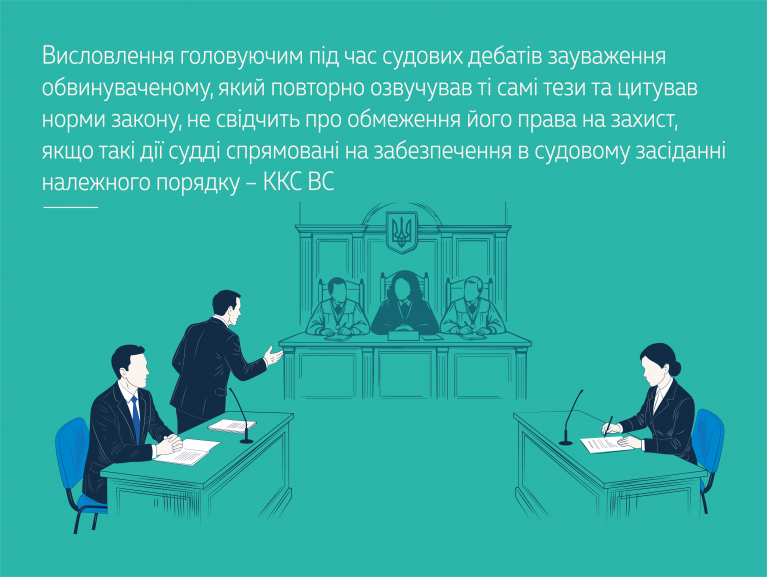
The presiding judge’s comments addressed to the accused during closing arguments, when the accused repeatedly stated the same theses and cited legal norms, do not indicate a restriction of his right to defence if such actions by the judge were directed at maintaining proper order in the court hearing.
In this criminal proceeding, the courts of previous instances found the accused guilty and sentenced him under Part 2 of Article 15, Part 1 of Article 152, and Part 4 of Article 187 of the Criminal Code of Ukraine. In his cassation appeal, the convicted person claimed that his time to speak during closing arguments in the court of appeal had been restricted.
Upholding the decisions of the lower courts without changes, the Supreme Court noted that, pursuant to Part 6 of Article 364 of the Criminal Procedure Code of Ukraine, a court is not entitled to limit the duration of closing arguments to a specific time. At the same time, the essence of closing arguments is not confined solely to the speeches of the participants in the proceedings. Closing arguments also encompass the presiding judge’s role in organizing and conducting them, as well as supervising the order of speeches and, to a certain extent, their content. The presiding judge has the right to interrupt a participant’s speech if, after a warning, that participant again goes beyond the scope of the criminal proceedings or repeats statements of an offensive or improper nature, and to give the floor to another participant.
As follows from the video recording of the court hearing of 2 July 2025, during the accused’s closing argument, the presiding judge of the appellate panel repeatedly asked him not to quote legal provisions or restate arguments and references to legal sources that had already been presented, noting that such conduct indicated an abuse of procedural rights. After that, the accused continued his speech and concluded it with the words, “my statement is finished”. The presiding judge announced that the text of the speech would be added to the case file and granted the floor to the defence counsel and the prosecutor. Thereafter, the accused was given the last word. The court also included his written statement in the case materials.
The panel of judges of the Criminal Cassation Court of the Supreme Court concluded that the remarks made by the presiding judge to the accused during the court proceedings did not constitute any restriction of his rights, as the presiding judge’s actions were aimed solely at complying with the provisions of Part 1 of Article 321 of the Criminal Procedure Code of Ukraine, under which the presiding judge in a court hearing directs the conduct of the hearing, ensures compliance with the sequence and order of procedural actions, the exercise by participants in criminal proceedings of their procedural rights and the fulfilment of their obligations, and directs the court proceedings towards ensuring that all circumstances of the criminal proceedings are established, removing from the proceedings anything that is irrelevant to the criminal proceedings. Ensuring proper conduct of closing arguments in this manner did not in any way affect the accused’s exercise of the right to defence.
Resolution of the Criminal Cassation Court of the Supreme Court of 19 March 2026 in case No. 335/6584/22 (proceeding No. 51-492км23) – https://reyestr.court.gov.ua/Review/135124524.
This and other legal positions of the Supreme Court can be found in the Database of Legal Positions of the Supreme Court - https://lpd.court.gov.ua.
_03_03.png)