Contact center of the Ukrainian Judiciary 044 207-35-46
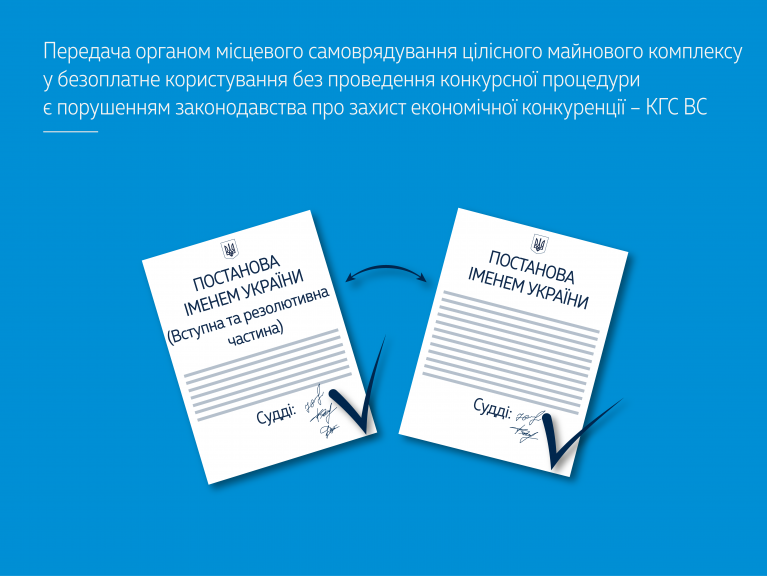
In the presence of a shortened court decision signed by the full composition of the court, the absence of a judge’s signature on the full text of the court decision (signed by the other judges of the panel, who constitute the majority of the court’s composition) is not an unconditional ground for cancelling the court decision under clause 3, part 1 of Article 411 of the Civil Procedure Code of Ukraine (and similar provisions of the Code of Administrative Proceedings of Ukraine and the Commercial Procedure Code of Ukraine), if this is caused by objective, insurmountable reasons that arose after the announcement of the shortened court decision (for example, the death of the judge).
This conclusion was made by the Grand Chamber of the Supreme Court.
In this case, a person (not in whose favour the court order was issued) filed an application to cancel the court order on the recovery of child support (alimony) from the debtor for the maintenance of two children in the amount of 1/3 of his earnings. The application was based on the violation of the rights of the applicant’s and the debtor’s joint children, whose interests were not taken into account when determining the amount of alimony.
The court of first instance returned the application without consideration. The court of appeal upheld this decision. The cassation appeal was motivated by the fact that the full text of the appellate court’s ruling was not signed by one of the three judges of the panel due to his death, which, according to clause 3, part 1 of Article 411 of the Civil Procedure Code of Ukraine, constitutes grounds for cancellation of the ruling.
When considering this case, the Grand Chamber of the Supreme Court noted that the existence of such an imperative ground for cancellation of a court decision as the absence of a judge’s signature on it is linked to the need to eliminate any doubts regarding the composition of the court and the genuine (actual) content of the decision. However, the legitimacy of the court decision and the composition of the court do not raise doubts in a case where the shortened decision was signed and announced by the full composition of the court, and the full text was signed by the two remaining judges due to the death of one member of the panel.
The Grand Chamber of the Supreme Court drew attention to the fact that the Civil Procedure Code of Ukraine (as well as the Code of Administrative Proceedings of Ukraine and the Commercial Procedure Code of Ukraine) contains rules that allow the court, based on the results of the hearing, to immediately adopt a full court decision or to limit itself to drawing up the introductory and operative parts of the decision (shortened decision). Such a shortened decision must be signed by the full composition of the court, attached to the case file, and announced in the court hearing (part 6 of Article 259 of the Civil Procedure Code of Ukraine).
At the same time, according to part 5 of Article 268 of the Civil Procedure Code of Ukraine, the date of adoption of the decision is the date of its announcement (regardless of whether the full or shortened decision was announced).
Taking the above into account, the Grand Chamber of the Supreme Court noted that a shortened court decision is also a judicial act that records the result of the court’s consideration of the case. Although the preparation of the full text is of significant importance for understanding the court’s reasoning and exercising the right to appeal, its preparation is merely a stage in the written formalization of an already adopted decision, and not a repeated act of the court’s expression of will.
Therefore, the Grand Chamber of the Supreme Court concluded that clause 3, part 1 of Article 411 of the Civil Procedure Code of Ukraine does not apply if the full decision lacks the signature of a judge who has died (provided the other judges of the panel have signed it), but the case file contains a shortened court decision signed by the full composition of the court and announced in the court hearing.
At the same time, the Grand Chamber of the Supreme Court emphasized that the opposite conclusion — that clause 3, part 1 of Article 411 of the Civil Procedure Code of Ukraine must be applied in such situations — would lead to the unjustified cancellation of a court decision whose legitimacy is beyond doubt, for purely formal reasons. This would itself contradict the requirement of legal certainty as a component of the rule of law and would create conditions for violating the rights of other participants in the court proceedings.
In this case, the Grand Chamber of the Supreme Court found no grounds for cancelling the ruling of the appellate court on the basis provided for in clause 3, part 1 of Article 411 of the Civil Procedure Code of Ukraine, nor did it establish any other grounds for cancelling the contested decisions of the courts of first and appellate instance.
Resolution of the Grand Chamber of the Supreme Court dated 11 March 2026 in case No. 946/3565/24 – https://reyestr.court.gov.ua/Review/134833422.
This and other legal positions of the Supreme Court can be found in the Database of Legal Positions of the Supreme Court - https://lpd.court.gov.ua.
_03_03.png)