Contact center of the Ukrainian Judiciary 044 207-35-46
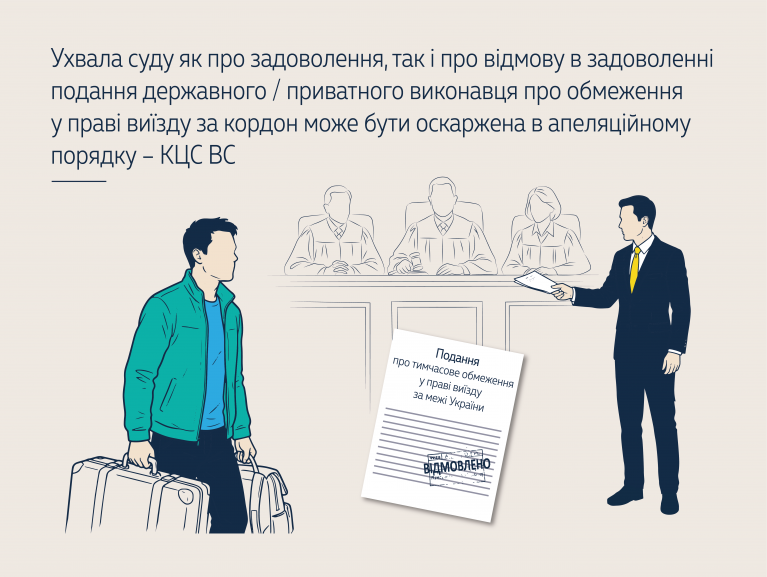
A court order temporarily restricting a debtor’s right to leave Ukraine is issued at the stage of enforcement of court decisions. As it is not possible to appeal against it simultaneously with the main decision, such an order is subject to appeal regardless of the outcome of the consideration of the enforcement officer’s application.
Such conclusions were reached by the Supreme Court as part of the panel of judges of the Second Judicial Chamber of the Civil Cassation Court.
In the case under review, the state enforcement officer applied to the court for a temporary restriction on the debtor’s right to leave Ukraine.
The court of first instance refused to grant the application.
The court of appeal refused to open appeal proceedings, noting that a court order refusing to grant a motion for a temporary restriction on the right to leave Ukraine is not subject to appeal separately from the court’s decision. Article 353 of the Civil Procedure Code of Ukraine provides for the possibility of appealing only against rulings on the application of a temporary restriction, and not against a refusal to apply it. An erroneous statement by the court of first instance regarding the possibility of appeal does not constitute grounds for a review on appeal.
The Civil Cassation Court of the Supreme Court disagreed with the court of appeal and reached the following legal conclusions.
Everyone is entitled to a fair and public hearing of their case within a reasonable time by an independent and impartial tribunal established by law, which will decide on disputes concerning their civil rights and obligations (Article 6 of the Convention for the Protection of Human Rights and Fundamental Freedoms).
Procedural rules are designed to ensure the proper administration of justice and compliance with the principle of legal certainty, and the parties must be entitled to expect that these rules are applied. The principle of legal certainty applies not only to the parties but also to national courts (see: Diya 97 v. Ukraine, No. 19164/04, ECtHR, 21 October 2010).
The panel of judges, taking into account the conclusions of the Constitutional Court of Ukraine regarding the application of procedural law provisions on the right to appeal against decisions of the court of first instance, referred to established case law on the approach whereby such decisions are subject to appeal. This approach is based on the principle that an individual’s constitutional right to judicial protection must be upheld without fail. The essence of this approach lies in the fact that:
1) rulings, in respect of which the possibility of appeal is expressly provided for in Part 1 of Article 353 of the Civil Procedure Code of Ukraine, constitute separate grounds for appeal;
2) objections to rulings that cannot be appealed separately from the court’s decision are included in the appeal against the court’s decision (Part 2 of Article 353 of the Civil Procedure Code of Ukraine);
3) court rulings which, depending on their content and the stage of the proceedings, cannot be appealed by including objections in the court decision, may be appealed separately from the decision if the person lodging the appeal cannot restore their rights by any means other than by appealing the ruling of the court of first instance.
Therefore, the Civil Cassation Court of the Supreme Court noted that the appeal court failed to take into account that the interpretation of para. 31 of Article 353 of the Civil Procedure Code of Ukraine must consider whether the person filing the appeal has the possibility or impossibility of restoring their rights by any means other than appealing the ruling of the first-instance court separately from the court’s final decision.
Consequently, the Civil Cassation Court of the Supreme Court concluded that a distinctive feature of a court ruling on the temporary restriction of a debtor’s right to leave Ukraine, the adoption of which was requested by a state enforcement officer, is that it is adopted at the stage of enforcement of court judgments on the recovery of debt from the debtor, and it is impossible to appeal it simultaneously with the judgment of the court. In this regard, a court ruling, whether granting or refusing a state or private enforcement officer’s application to restrict the right to leave the country, may be appealed.
In view of the above, the Civil Cassation Court of the Supreme Court quashed the appeal court’s ruling and referred the case back to the appeal court to decide on the opening of appeal proceedings.
Resolution of the Supreme Court of 18 March 2026 in case No. 331/6717/25 (proceedings No. 61-2064св26) – https://reyestr.court.gov.ua/Review/135124431.
This and other legal positions of the Supreme Court can be found in the Database of Legal Positions of the Supreme Court - https://lpd.court.gov.ua.
_03_03.png)