Contact center of the Ukrainian Judiciary 044 207-35-46

Judge of the Grand Chamber of the Supreme Court Mykola Mazur and Judge of the Supreme Court at the Criminal Cassation Court Svitlana Yakovlieva participated in an event held on 16–20 March 2026 at the International Nuremberg Principles Academy (Nuremberg, Germany).
The visit was organized for a group of Ukrainian judges and prosecutors and included a series of expert sessions, discussions, and practical workshops dedicated to contemporary approaches to the qualification, investigation, and adjudication of the crime of aggression.
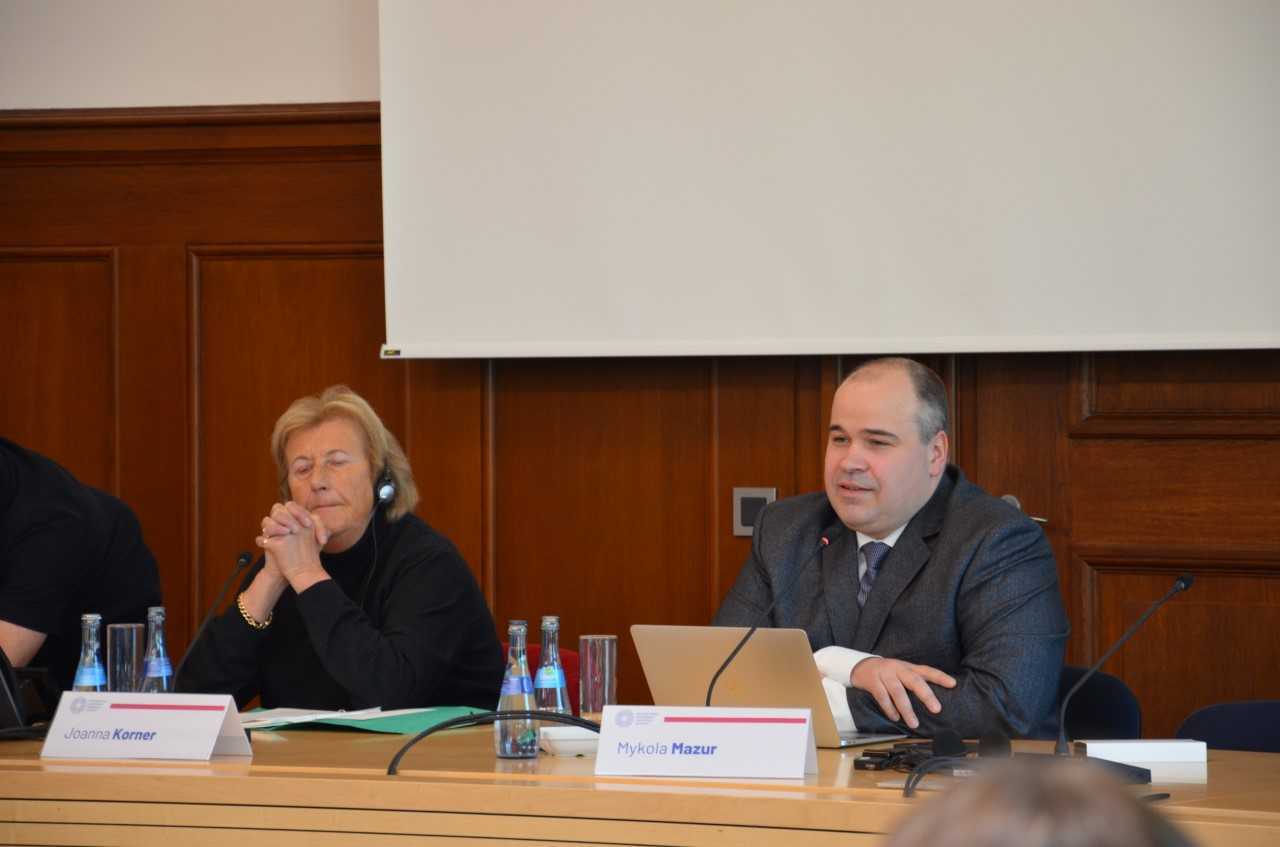
One of the sessions was conducted by Judge of the International Criminal Court Joanna Korner together with Judge of the Grand Chamber of the Supreme Court Mykola Mazur.
During her presentation, Joanna Korner outlined the ICC’s approach to standards of proof in cases involving international crimes. She highlighted the staged application of these standards - from the “reasonable grounds to believe that a person has committed a crime” standard at the stage of issuing an arrest warrant to the “beyond reasonable doubt” standard at the stage of delivering a verdict. She emphasized that the burden of proof remains on the prosecution, stressed the importance of a comprehensive assessment of evidence in its totality, and noted the admissibility of both direct and circumstantial evidence, provided that their combined weight allows for a single reasonable conclusion regarding the person’s guilt.
Mykola Mazur presented the approach of the Grand Chamber of the Supreme Court to the interpretation of the elements of the crime of aggression and explained the reasoning behind the relevant decision. He noted that Article 437 of the Criminal Code of Ukraine does not contain an explicit indication of the perpetrator of this offence. However, the Grand Chamber’s conclusion regarding the “leadership” nature of the crime of aggression is based on an analysis of its objective elements (since the content and nature of the acts provided for in this article indirectly indicate who may commit them) and the object of the offence (as not every individual, by virtue of their capacity, is able to harm peace as a component of the international legal order).
According to the findings of the Grand Chamber of the Supreme Court, the crime of aggression can be committed by individuals who, by virtue of their official authority or actual social position, are capable of exercising effective control over or directing political or military actions and/or significantly influencing political, military, economic, financial, informational, and other processes within their state or beyond its borders, and/or directing specific areas of political or military activity.
The speaker noted that this definition covers a somewhat broader circle of individuals than that provided in Article 8bis of the Rome Statute of the International Criminal Court. However, this difference does not constitute a contradiction: first, states have the sovereign right to shape their own criminal legislation; second, the definition of the crime of aggression in Article 8bis is formulated “for the purpose of this Statute”; and third, the interpretation developed by the Grand Chamber does not contradict the generally accepted understanding in international law of the crime of aggression as a “leadership crime”, nor the approaches established after World War II in Nuremberg.
Thus, the conclusion of the Grand Chamber of the Supreme Court represents a logical development of the Nuremberg Principles.
The meeting will contribute to the development of proper judicial practice on the crime of aggression that is consistent with international law. The event also carried symbolic significance, as it took place in the building where, in 1946, the International Military Tribunal convicted criminals of the Nazi regime, including for committing crimes against peace.
_03_03.png)