Contact center of the Ukrainian Judiciary 044 207-35-46
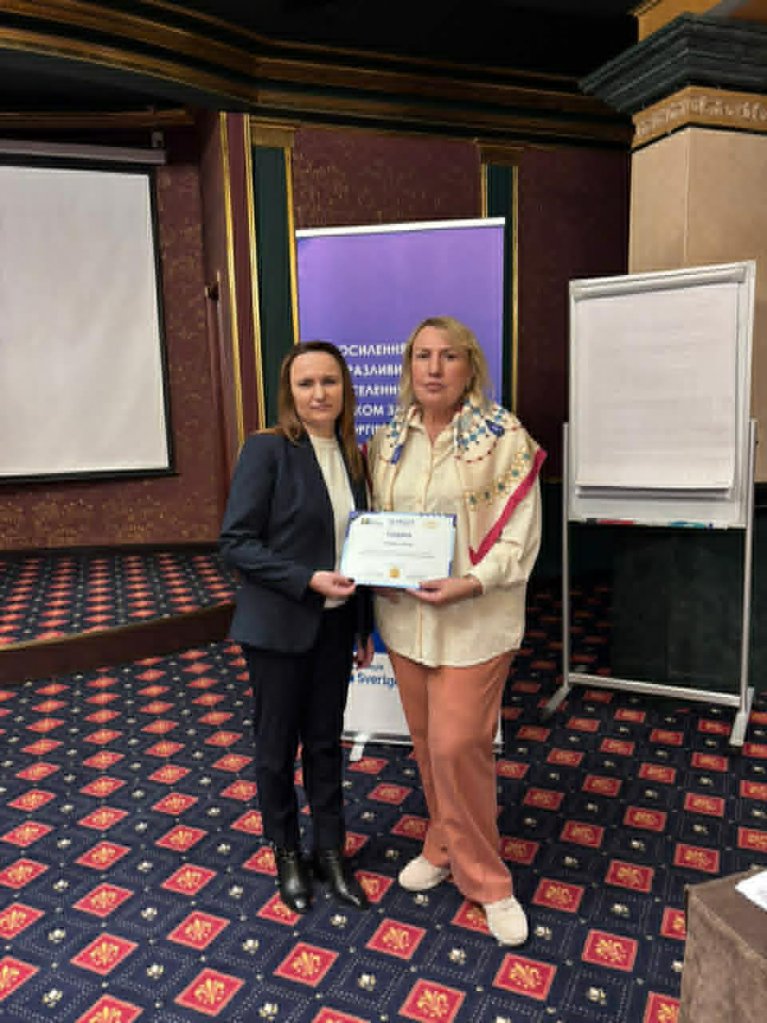
Judge of the Grand Chamber of the Supreme Court Nadiia Stefaniv delivered a speech as part of a training for trainers working with anti-human trafficking programmes. The training was organized by the National School of Judges of Ukraine with the support of the International Organization for Migration.
During her presentation, the judge emphasized the particular relevance of the topic of countering human trafficking in the context of armed aggression against Ukraine. “Under the current conditions, the vulnerability of potential victims of human trafficking is increasing, which places higher demands on the effectiveness of both pre-trial investigations and the judicial examination of such criminal proceedings,” she said.
Nadiia Stefaniv analyzed the dynamics of judicial practice, which shows an increase in the number of convictions and other court decisions in cases of this category across all instances.
She separately examined the types of court decisions, in particular verdicts delivered under the general procedure, in simplified proceedings, and on the basis of plea agreements. As the speaker noted, when approving a plea agreement, the court is limited in its ability to establish factual circumstances other than those set out in the indictment. In particular, the resolution of the Criminal Cassation Court within the Supreme Court dated 2 November 2021 in case No. 750/5031/18 (proceedings No. 51-2761км21) formulated the approach regarding the limits of judicial review when approving plea agreements.
A significant part of the lecture was devoted to defining the vulnerable state of the victim. “A vulnerable state is an evaluative concept and is determined taking into account the specific circumstances of the criminal proceedings, based on both expert opinions and the totality of evidence regarding the person’s life circumstances,” the judge noted.
These approaches are reflected in case law, in particular in the resolution of the Criminal Cassation Court of the Supreme Court dated 30 September 2021 in case No. 344/13523/18.
The lecturer also addressed the approaches to the qualification of crimes and the grounds for closing criminal proceedings, and provided examples from judicial practice regarding different forms of exploitation:
Nadiia Stefaniv familiarized the trainers with the case law of the European Court of Human Rights, which serves as an important guideline for developing uniform approaches to handling cases of this category. In particular, she spoke about the judgments in the cases of Rantsev v. Cyprus and Russia, Chowdury and Others v. Greece, and S.M. v. Croatia.
“The Court emphasizes that human trafficking falls within the scope of Article 4 of the Convention for the Protection of Human Rights and Fundamental Freedoms and constitutes a threat to human dignity,” the judge said.
In addition, Nadiia Stefaniv examined the issue of protecting the rights of victims, emphasizing: “Ensuring adequate protection of victims is a key element of effective justice in human trafficking cases”.
The discussion covered, in particular, the right to free legal aid, the court’s obligation to explain procedural rights, and the application of security measures. In court practice, the following mechanisms are used: questioning with the use of technical means, holding closed court hearings, minimizing contact between victims and the accused, and using specially equipped premises.
_03_03.png)