Contact center of the Ukrainian Judiciary 044 207-35-46
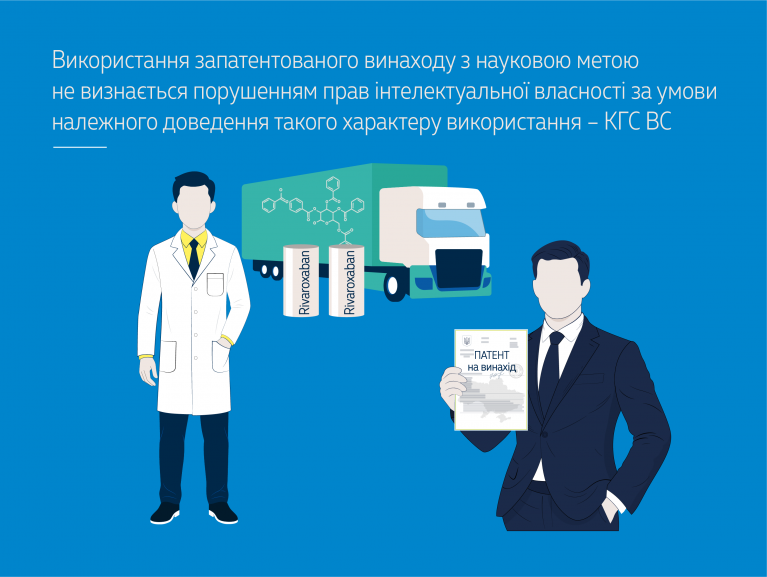
The use of a patented invention for scientific purposes or in the course of an experiment is not considered a violation of intellectual property rights only if the scientific/experimental nature of such use is properly proven. In the absence of relevant evidence, the patent owner is entitled to demand a prohibition on the use of the invention and the application of other remedies.
This conclusion was reached by the Commercial Cassation Court within the Supreme Court.
In the case, the plaintiff – the owner of a patent for the invention “Substituted oxazolidinones and their use for the prevention of blood clotting” – sought to prohibit the defendant from using the invention without permission and to seize and destroy 9 kg of the imported pharmaceutical substance “Rivaroxaban”.
During the initial hearing, the claim was dismissed. However, the Supreme Court overturned those decisions and remanded the case for a new hearing to verify the defendant’s references to the use of the invention for scientific purposes or in the course of an experiment. This included checking whether the defendant had a scientific unit, qualified personnel, necessary research conditions, and whether the quantity of the substance corresponded to the declared scientific purpose.
Following the new hearing, the local commercial court (upheld by the appellate court) partially satisfied the claim: it granted the request to seize and destroy the pharmaceutical substance but refused to prohibit the use of the invention, deeming such a prohibition an improper remedy. The courts reasoned that the defendant had not proven the scientific purpose of using the substance, but at the same time considered a perpetual and absolute prohibition impermissible.
The Commercial Cassation Court of the Supreme Court agreed with the conclusion that the scientific purpose had not been proven. The Court noted that the defendant had not provided evidence of carrying out full-fledged scientific activities, had not confirmed the presence of relevant specialists or research, and had imported a significantly larger volume of the substance than justified by the declared purpose. Additionally, the filing of applications for the registration of medicinal products containing this active substance was taken into account, indicating the commercial nature of the use.
At the same time, the Commercial Cassation Court disagreed with the refusal to prohibit the use of the invention, stating that such a claim is a proper remedy, as it directly follows from the content of the patent owner’s exclusive rights. The prohibition on the use of the invention is aimed at protecting property rights of intellectual property for the term of the patent and is not inherently “perpetual” in the sense understood by the lower courts.
Following the cassation review, the Commercial Cassation Court partially granted the plaintiff’s cassation appeal, overturned the decisions of the lower courts regarding the refusal to prohibit the use of the invention, and adopted a new decision in that part satisfying the claim. The Supreme Court also dismissed the defendant’s cassation appeal against the court decisions in the part where the claim was granted.
Resolution of the Commercial Cassation Court of the Supreme Court dated March 5, 2026, in case No. 911/165/18 – https://reyestr.court.gov.ua/Review/134651255.
This and other legal positions of the Supreme Court can be found in the Database of Legal Positions of the Supreme Court - https://lpd.court.gov.ua.
_03_03.png)