Contact center of the Ukrainian Judiciary 044 207-35-46
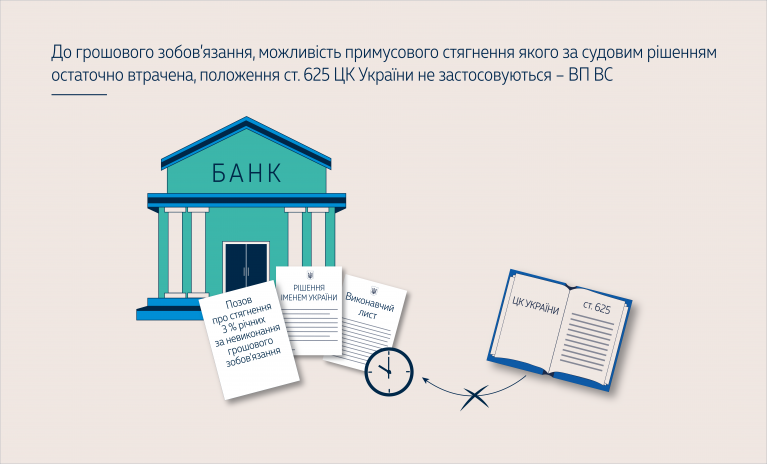
An obligation to pay a debt, which has been confirmed by a court judgment ordering its compulsory recovery, where the time limit for presenting the writ for enforcement has expired and the court has refused to renew that time limit, and where the possibility of its enforcement has been lost, cannot be considered terminated in the substantive legal sense. In other words, such an obligation continues to exist as one in respect of which the claims, although deprived of compulsory protection, may still be voluntarily performed in a proper manner.
In such a case, the provisions of Part 2 of Article 625 of the Civil Code of Ukraine cannot be applied to the relevant monetary claims (those for which the possibility of compulsory recovery under the court judgment has been exhausted).
These conclusions were made by the Grand Chamber of the Supreme Court.
In this case, the dispute arose in connection with the bank’s claim for the recovery of 3 per cent per annum (under Article 625 of the Civil Code of Ukraine) accrued on the credit debt that had been recovered from the borrower (debtor) by a court judgment, the right to compulsory enforcement of which had been lost due to the expiry of the time limit for presenting the enforcement document for execution and the court’s refusal to renew that time limit.
The courts of first and appeal instances dismissed the claim.
Having examined the cassation appeal, the Grand Chamber of the Supreme Court noted that a court judgment restoring rights to monetary sums does not create new obligations, but merely confirms or transforms an existing obligation. However, the possibility of compulsory recovery of the debt is exhausted upon the expiry of the time limit for presenting the enforcement document for execution, unless the court has renewed that time limit.
Although in such a case the limitation period is formally inapplicable, in practice the obligation loses its legal enforceability, and the claim under this obligation becomes one that cannot be protected by compulsory means. Nevertheless, its voluntary performance does not constitute unjust enrichment (a natural obligation).
Taking into account that the accrual of inflationary losses on the amount of the debt and 3 per cent per annum provided for by Part 2 of Article 625 of the Civil Code of Ukraine forms part of the monetary obligation and constitutes a special form of liability of the debtor for delay in the performance of a monetary obligation, after the exhaustion of the possibility of compulsory enforcement of the principal obligation, the rules of Part 2 of Article 625 of the Civil Code of Ukraine do not apply to the principal claim.
The Grand Chamber of the Supreme Court observed that allowing the creditor to repeatedly bring claims for the recovery of additional amounts in respect of a principal claim that is no longer subject to compulsory protection due to the creditor’s own negligence would contradict the principle of legal certainty.
Since in this case the bank brought the claim for the recovery of 3 per cent per annum after the final loss of the possibility of compulsory enforcement of the court judgment on the recovery of the principal debt, the Grand Chamber of the Supreme Court agreed with the conclusion of the courts of first instance and appeal that there were no legal grounds for recovering the ancillary obligation provided for by Article 625 of the Civil Code of Ukraine.
Resolution of the Grand Chamber of the Supreme Court dated 11 February 2026 in case No. 754/511/23 — https://reyestr.court.gov.ua/Review/134456472.
This and other legal positions of the Supreme Court can be found in the Database of Legal Positions of the Supreme Court - https://lpd.court.gov.ua.
_03_03.png)