Contact center of the Ukrainian Judiciary 044 207-35-46
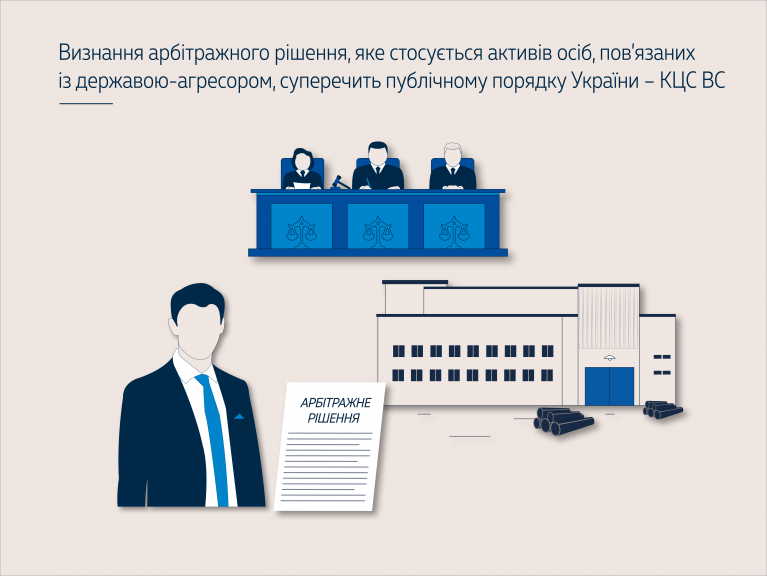
The use of international commercial arbitration to circumvent sanctions restrictions violates the public order of Ukraine. The court is obliged ex officio to examine the possibility of such a violation, irrespective of any challenge to the arbitral award and the arguments of the parties to the proceedings.
These conclusions were reached by the Supreme Court, sitting as a panel of judges of the Third Judicial Chamber of the Civil Cassation Court, when reviewing on appeal a decision of the appellate court that had been adopted by it as a court of first instance.
In the case under review, a foreign legal entity applied to the court for recognition and enforcement of an ad hoc international commercial arbitral award rendered following the resolution of a dispute arising out of a guarantee agreement. The application was based on the fact that the decision of the international commercial arbitration provided for the recovery of monetary funds in foreign currency under the guarantee agreement from a company registered in Ukraine in favour of the applicant, which the debtor was not performing voluntarily.
The court of first instance granted the application, referring to the fact that the arbitral award had entered into legal force and was subject to enforcement, and that the debtor was not performing it voluntarily. No grounds for refusal to recognise and grant leave to enforce it had been established by the court. The court also noted that the debtor’s lack of monetary funds to discharge the indebtedness under the guarantee agreement, which had been concluded after the introduction of martial law in Ukraine, could not constitute a ground for refusing the application.
The Supreme Court set aside the ruling of the court of first instance and refused the application for recognition and leave to enforce the arbitral award, since the granting of such an application would be contrary to the public order of Ukraine, and made the following legal findings.
Since 24 February 2022 martial law has been in force in Ukraine, within the framework of which the state has introduced personal and other restrictive measures for the protection of national security and the economy. In particular, by Resolution of the Cabinet of Ministers of Ukraine No. 187 of 3 March 2022 “On Ensuring the Protection of the National Interests in Connection with Future Claims of the State of Ukraine Arising from the Military Aggression of the Russian Federation”, a moratorium was introduced on the performance of certain acts involving persons connected with the relevant aggressor state that may result in the alienation of property in Ukraine.
During the period of martial law, sanctions constitute instruments for the protection of Ukraine’s national interests. Actions aimed at the artificial avoidance or circumvention of the application of sanctions and their real consequences amount to a violation of public order.
In light of the circumstances established in this case, the Supreme Court saw no grounds to disagree with its own conclusion and the conclusion of the High Anti-Corruption Court, drawn during the consideration of other cases involving the guarantor company, to the effect that this company, which is the debtor in the arbitral dispute, is a person connected with the aggressor state, since control over it, despite organisational attempts to conceal this from the Ukrainian state, is exercised by citizens of the russian federation who fall under the sanctions imposed pursuant to the decision of the National Security and Defence Council “On the Application of Personal Special Economic Sanctions and Other Restrictive Measures”.
The Supreme Court noted that the assumption by the company of the corresponding guarantee obligations, which became the basis for the claims of the foreign legal entity and the foundation for the relevant arbitral dispute, is contrary to Cabinet of Ministers Resolution No. 187 and creates opportunities for the withdrawal of assets from under the sanctions provided for by the above-mentioned decision of the National Security and Defence Council and/or for their circumvention through the recognition and grant of leave to enforce the arbitral award, which violates the public order of Ukraine.
Furthermore, the Supreme Court emphasised that the court is obliged to examine independently any such possible violation of public order ex officio, irrespective of any challenge to the arbitral award and the arguments of the parties to the proceedings.
In view of the foregoing, the Supreme Court, acting as a court of appellate instance, allowed the prosecutor’s appeal, set aside the contested ruling and refused the foreign legal entity recognition and leave to enforce the arbitral award.
Resolution of the Civil Cassation Court of the Supreme Court of 15 January 2026 in case No. 824/157/23 (proceedings No. 61-1265ав25) – https://reyestr.court.gov.ua/Review/133708536.
This and other legal positions of the Supreme Court can be found in the Database of Legal Positions of the Supreme Court - https://lpd.court.gov.ua.
_03_03.png)