Contact center of the Ukrainian Judiciary 044 207-35-46
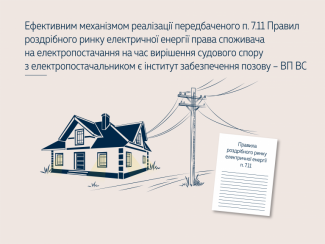
The implementation of the consumer’s right to electricity supply during the resolution of a court dispute with the electricity supplier, as provided for in clause 7.11 of the Retail Electricity Market Rules (REMR), is carried out by securing the claim in the form of a prohibition on disconnecting the electricity supply to the consumer for the duration of the consideration of the relevant court case, provided that the consumer’s application is substantiated precisely by this legal norm.
Otherwise, the failure by electricity suppliers to comply with the requirements of clause 7.11 of the said Rules within the framework of the initiated dispute will result in the consumer having to apply to the court in the context of another court proceeding, which does not comply with the principles of reasonable time limits for the consideration of the case by the court and procedural economy.
These conclusions were made by the Grand Chamber of the Supreme Court.
In this case, the dispute arose in connection with the termination of electricity supply to the plaintiff’s house and the electricity supplier’s failure to fulfill its obligation, in accordance with the requirements of clause 7.11 of the REMR, to restore the supply after the court opened proceedings in the case upon the plaintiff’s claim challenging the actions of the electricity supplier.
The courts of first and appeal instances dismissed the claim.
The Grand Chamber of the Supreme Court was faced with the question of an effective procedural mechanism for the practical application of clause 7.11 of the REMR.
The Grand Chamber of the Supreme Court primarily noted that, in accordance with paragraph 4 of clause 7.11 of the Retail Electricity Market Rules, during the court’s consideration of disputed issues regarding the consumer’s violation of these Rules and/or the terms of contracts, the existence of which is provided for by the said Rules, the disconnection of electricity supply to such a consumer related to the contested violation shall not be carried out, provided that the consumer timely submits to the electricity supplier, before disconnection, the relevant court ruling on the acceptance of the claim for consideration. The opening of proceedings in the case after the fact of disconnection of the consumer serves as grounds for the restoration of electricity supply.
The Grand Chamber of the Supreme Court emphasized that this provision of clause 7.11 of the REMR is imperative for the electricity supplier, who has the right to disconnect the consumer from electricity supply and to restore it. However, electricity suppliers do not always comply with the requirements of this norm.
Taking into account the above, as well as the criteria for applying paragraph 4 of clause 7.11 of the REMR, the Grand Chamber of the Supreme Court concluded that, in the event a consumer applies to the court for the protection of their rights, the alternative-free and most effective mechanism for the practical application of clause 7.11 of the RMR - given the content of this legal norm - is the institution of securing the claim, namely the issuance of a ruling prohibiting the disconnection of electricity supply to such a consumer for the duration of the proceedings on challenging the fact of the consumer’s violation of these Rules and/or the terms of the contracts.
In this case, the Grand Chamber of the Supreme Court found the conclusions of the lower-instance courts to be well-founded. Those courts, in refusing to satisfy the claim, proceeded from the fact that the plaintiff’s facility had been lawfully disconnected from electricity supply (a fact also established by a court decision in another case that had entered into legal force).
Resolution of the Grand Chamber of the Supreme Court dated February 11, 2026, in case No. 344/13201/23 – https://reyestr.court.gov.ua/Review/134456475.
This and other legal positions of the Supreme Court can be found in the Database of Legal Positions of the Supreme Court - https://lpd.court.gov.ua.
_03_03.png)