Contact center of the Ukrainian Judiciary 044 207-35-46
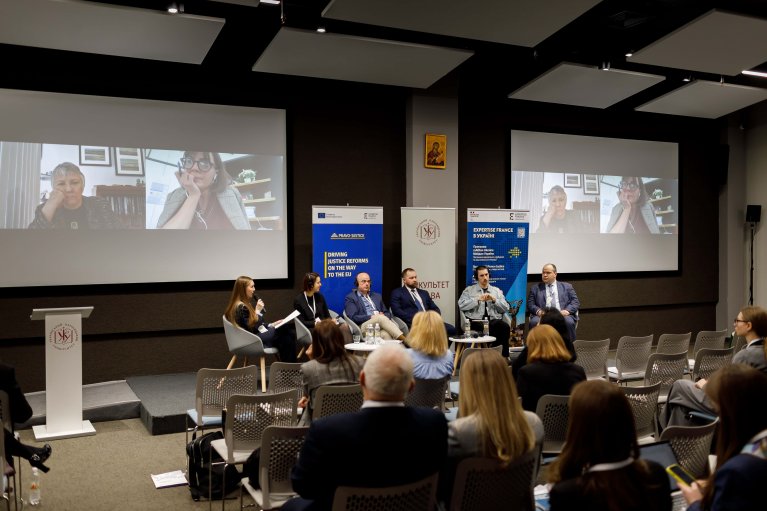
Ukraine’s judicial system has demonstrated its institutional capacity to administer justice even in the midst of a full-scale war. This was stated by Supreme Court judge Mykola Mazur at the inaugural international conference "International Law, Accountability and Justice for Ukraine", organised by the Ukrainian Catholic University.
“The unique aspect of the situation is that justice regarding international war crimes is being administered during the war itself,” the speaker emphasised during a professional discussion on the classification of international crimes.
He noted that the judicial system is part of Ukrainian society and has likewise suffered losses and hardships. “Some judges have gone to the front line. One of the Supreme Court judges – Leonid Loboiko – was killed in a Russian drone attack whilst delivering humanitarian aid in the Kharkiv region. Dmytro Konstantynov, a judge at the Krasnohrad District Court in the Kharkiv region, was killed during humanitarian demining operations. Another defender of Ukraine, Anatolii Nahornyi, the Head of the Veselivka District Court in the Zaporizhzhia region, was killed in the Kupiansk area. Yuliia Matvieieva, a judge from Mariupol, spent several months in Russian captivity. Liubov Kharechko, Vice President of the Chernihiv Court of Appeal, was shot dead in her car along with her family whilst attempting to evacuate. Court buildings have been destroyed. Courts from areas of active hostilities have relocated to other regions, yet the administration of justice has not ceased,” the judge recalled.
Mykola Mazur also spoke about trends in the administration of justice during the war. Following the start of Russia’s full-scale invasion of Ukraine, the judge explained, the number of proceedings concerning war crimes has risen significantly. The number of convictions under Article 438 of the Criminal Code of Ukraine has long since exceeded one hundred and is approaching two hundred.
At the same time, Mykola Mazur noted, judicial practice has undergone changes. A significant number of proceedings in war-related cases are being heard under the in absentia procedure (in the absence of the defendant).
“The in absentia procedure makes it possible to gather and record evidence that can subsequently be used in both national and international courts, and to hear cases gradually without allowing a backlog of pending proceedings to accumulate,” the speaker noted.
At the same time, he highlighted the serious challenges facing the justice system. Under European standards, any convicted person who has not been duly notified of the proceedings is entitled to a review of their sentence without any time limit.
As an example, the judge cited the case law of the European Court of Human Rights in the case of SANADER v. Croatia. The ECHR ordered Croatia to pay compensation to a person convicted in absentia who had not served their sentence and was living outside the country. The national courts refused to review the case, but the ECHR found a violation of the right to a fair trial and awarded compensation.
“I think this is not the kind of justice we strive for,” remarked the speaker, as proceedings in absentia require special attention to ensure compliance with fair trial standards and to prevent future risks to the state.
The speaker also drew attention to the emergence in Ukraine of at least two acquittals in cases involving war crimes. “Is this good or bad?” he asked the audience. And then, summarising the audience’s reaction, he added: “It is good, because it demonstrates that justice is not one-sided, that courts examine the details, assess the evidence, offer their own interpretation and apply the law,” he noted.
Mykola Mazur emphasised that despite the extraordinary circumstances, the Ukrainian judicial system is functioning and developing case law that may be significant for international justice.
_03_03.png)