flag Ukrainian Judiciary
| Українська | English |

Contact center of the Ukrainian Judiciary 044 207-35-46
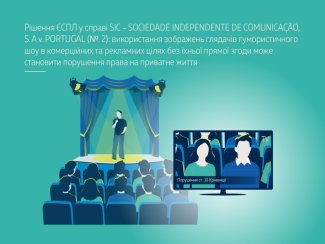
ECHR judgment in SIC – SOCIEDADE INDEPENDENTE DE COMUNICAÇÃO, S.A. v. PORTUGAL (No. 2): Using images of comedy show audience members for commercial and advertising purposes without their explicit consent may violate their right to privacy

04 march 2026, 17:19

The case concerns the Portuguese television company SIC, the owner of the SIC Radical channel. In 2012, two individuals, M.G. and M.K., attended a stand-up show by comedian J.S. in Lisbon. During the performance, the comedian made a number of controversial jokes, including references to paedophilia (the case of Josef Fritzl) and remarks with racist undertones. Offended by this, M.G. and M.K. entered into a verbal dispute with the comedian and left the venue.

Despite the presence of a notice indicating that the show was being recorded, the television company later used footage of this heated argument (clearly showing the audience members’ faces and voices) in a promotional advertisement and in episodes of the documentary series The Comedian. The promotional video was broadcast several times a day for at least 45 days, and the series episodes were available on the SIC Radical website and on YouTube.

  1. G. and M.K. brought proceedings before the courts, claiming that their images had been used without their consent, causing them humiliation and distress. Ultimately, the Supreme Court of Portugal ordered the television company to pay the victims €40,000 in compensation and to remove the video. The television company then lodged an application with the European Court of Human Rights, alleging a violation of its right to freedom of expression (Article 10 of the Convention for the Protection of Human Rights and Fundamental Freedoms).

The European Court of Human Rights unanimously held that there had been no violation of Article 10 of the Convention.

The Court concluded that the interference with the applicant’s freedom of expression had been “necessary in a democratic society” for the protection of the rights of others – namely, the right of M.G. and M.K. to respect for their private life – and that, overall, the State had ensured a fair balance between the television company’s right to freedom of expression and the right of private individuals to respect for their private life.

The ECtHR also noted, in particular:

  • Lack of public interest: the Court observed that the broadcast of the video was purely for entertainment purposes (aimed at attracting an audience) and did not contribute to a debate on matters of general public interest;
  • Status of the individuals concerned: M G. and M.K. were private individuals who were not public figures and had not sought publicity by merely attending the show;
  • Clear and unequivocal consent: despite notices indicating that filming was taking place during the show, M.G. and M.K. did not, through their conduct, clearly and unequivocally demonstrate implied consent to the recording of the argument or to the use of their images and voices in the series and advertisements;
  • Negative consequences: broadcasting the footage of the argument was humiliating and could harm the individuals’ reputation in both their professional and personal lives. The applicant company took no measures to minimise the harm, for example by blurring the faces of M.G. and M.K. or altering their voices;
  • Proportionality of the sanction: in the circumstances of the case, the amount of €40,000 awarded in compensation for the unlawful broadcast of the images and voices of M.G. and M.K. was not excessive.

The official text of the judgment in SIC – SOCIEDADE INDEPENDENTE DE COMUNICAÇÃO, S.A v. PORTUGAL is available on the website of the European Court of Human Rights at: https://hudoc.echr.coe.int/ukr?i=001-247832.

We also remind readers about the ECHR Knowledge Sharing Platform (ECHR-KS), which contains materials on the case law of the European Court of Human Rights in Ukrainian, available at: https://ks.echr.coe.int/uk/web/echr-ks/.