Contact center of the Ukrainian Judiciary 044 207-35-46
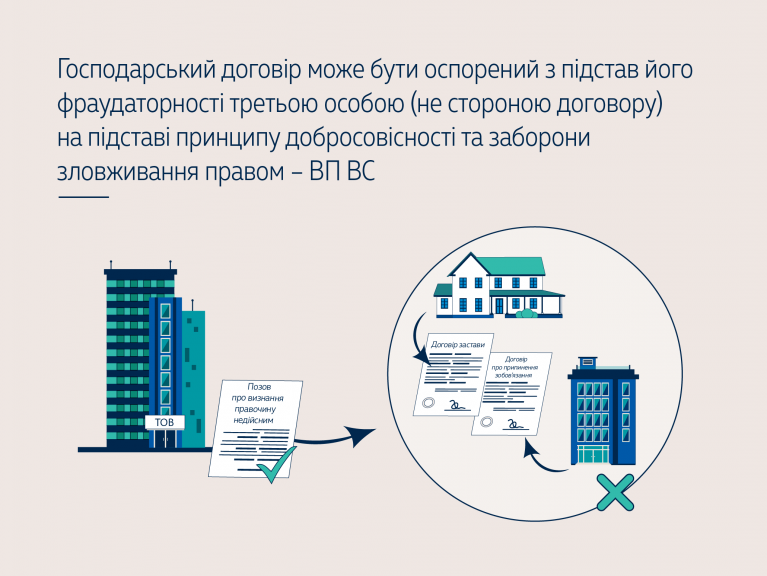
An economic agreement may be challenged as one aimed at avoiding the enforcement of claims against the debtor’s property, based on the general principles of civil legislation (Clause 6 of Article 3 of the Civil Code of Ukraine) and the inadmissibility of abuse of rights (Part 3 of Article 13 of the Civil Code of Ukraine).
At the same time, a claim for recognition of such a transaction as invalid on grounds of its fraudulent nature (fraudulent conveyance) may be filed by a third party who was not a party to the transaction, but is a creditor of the respondent under another obligation and has presented a property claim (in particular, has acquired or may acquire the status of a claimant in enforcement proceedings).
These conclusions were made by the Grand Chamber of the Supreme Court.
According to the circumstances of the case, LLC challenged in court the loan agreements, the vehicle pledge agreement, and the agreement on termination of obligations by way of conveyance of consideration in lieu of performance, concluded between the respondents. As a result of these transactions, one of the respondents (the debtor) disposed of liquid assets that could have been used to satisfy the claimant’s claims.
The courts of first and appellate instances granted the claim.
The cassation appellant argued, among other things, that the courts declared the transactions invalid not on the basis of specific statutory provisions on the invalidity of transactions, but on the basis of “general principles of good faith and the inadmissibility of abuse of rights”, which cannot be applied to business entities outside the procedure for declaring the debtor insolvent.
Upon reviewing the decision in the case, the Grand Chamber of the Supreme Court took into account that the Civil Code of Ukraine does not contain a separate definition of fraudulent transactions. Their identification is achieved through the application of the principles (general foundations) of civil legislation and the limits of exercising civil rights. The common feature of such transactions is the parties’ actions aimed at removing the debtor’s property in favour of third parties in order to prevent the debtor from fulfilling its obligations to creditors, in violation of the principle of good faith in civil legal relations.
The Grand Chamber of the Supreme Court concluded that a fraudulent transaction may be declared invalid on the basis of the general principles of civil legislation (Clause 6 of Article 3 of the Civil Code of Ukraine) and the inadmissibility of abuse of rights (Part 3 of Article 13 of the Civil Code of Ukraine).
In its resolution of 18 December 2024 in case No. 916/379/23, the Grand Chamber of the Supreme Court, when qualifying the transaction as fraudulent and determining the legal grounds for declaring it invalid, applied the provisions of Clause 6 of Part 1 of Article 3, Parts 1–4 of Article 13, Part 1 of Article 203, and Part 1 of Article 215 of the Civil Code of Ukraine.
The Grand Chamber of the Supreme Court concluded that the normative basis for qualifying a transaction as fraudulent and declaring it invalid under Articles 3 and 13 of the Civil Code of Ukraine (contrary to the principle of good faith and the prohibition of abuse of rights) is sufficient.
The Grand Chamber of the Supreme Court also noted that a distinction must be drawn between insolvency (within bankruptcy proceedings) and non-insolvency challenges to fraudulent transactions. The invalidity of a fraudulent transaction in non-insolvency proceedings is intended to protect the interests of the creditor (or creditors) “through the possibility of access to the debtor’s property”, including assets held by third parties.
In light of the above, the Grand Chamber of the Supreme Court stated that a fraudulent transaction may be challenged by an interested person who was not a party to it. Where a third party (a non-contracting party) brings such a claim in order to protect its rights and interests as a creditor under another obligation, the claim for recognition of the fraudulent transaction as invalid is a lawful and effective means of protection. This is because the creditor is usually interested in the return of monetary funds rather than in the property itself, which would subsequently need to be sold to recover those funds.
In this case, while agreeing with the conclusion of the courts of first and appellate instances regarding the invalidity of the pledge agreement and the agreement on termination of the obligation on the grounds of their fraudulent nature, the Grand Chamber of the Supreme Court nevertheless found erroneous their conclusion as to the invalidity of the loan agreements. This conclusion was reached without establishing the presence of signs of a fraudulent transaction in those agreements or their necessity for the subsequent transactions involving the transfer of property into pledge and later into ownership. Accordingly, the judicial decisions were quashed in the part concerning the invalidity of the loan agreements, and a new decision was adopted refusing to satisfy those claims.
Resolution of the Grand Chamber of the Supreme Court dated 4 February 2026 in case No. 910/6654/24 – https://reyestr.court.gov.ua/Review/134266626.
This and other legal positions of the Supreme Court can be found in the Database of Legal Positions of the Supreme Court - https://lpd.court.gov.ua.
_03_03.png)